





From the rooms to the algorithm: the new era of audiovisuals
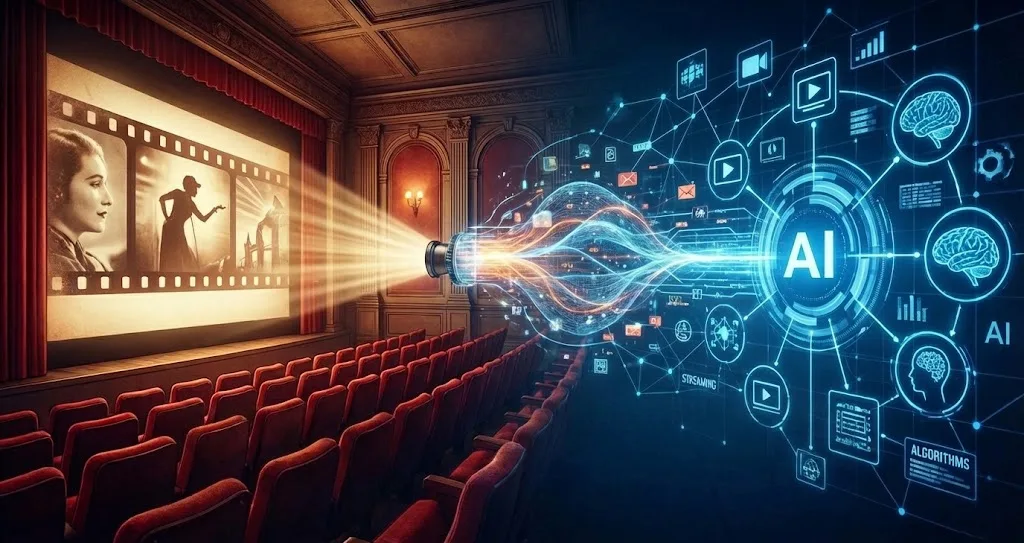

In this forum, Javier García, data consultant at GAD3, analyzes a new turning point in cinema in which the power of the algorithm to define the preferences of viewers could take over from the democratic results of exhibition in theaters.
Sometimes, to understand a present change, it is convenient to revisit the past. When in 1980 the premiere of Heaven’s Gate bankrupted United Artists (the production company founded by Chaplin and Griffith, among others) Not only was failure noted in ticket office of the film, but also the symbolic end of a way of making films. The western, an emblematic genre of Hollywood for decades, fell out of favor in the midst of the process of consolidating a new generation of directors that brought new blood to the industry.
This episode is another example of the cinema's transformative capacity. In some cases, changes are forced; In others, they respond to more natural dynamics. With the possible purchase of Warner Bros. on the part of Netflix We are not facing a financial disaster, but we are facing a deep reconfiguration of the industry that threatens to alter the balances on which it has been built for decades.
At first glance, the operation would mean the concentration of one of the most valuable audiovisual catalogs under the same brand: Game of Thrones, Harry Potter, Dune…It is not strange, therefore, that other actors like Paramount have entered the scene, joining the bid for Warner's legacy.
Changes in consumption: what the data says
Beyond the outcome of the operation, what seems indisputable is that the way in which consumers relate to the market has changed. audiovisual. We live in the era of series and premieres on streaming platforms, but also in the era of mass consumption of entertainment through TikTok and other social networks. This change is clearly reflected in the data.
If at the beginning of the 2000s people attended more than three times a year per inhabitant, in 2024 the average is around 1.5 attendances, which makes the experience more occasional and selective.
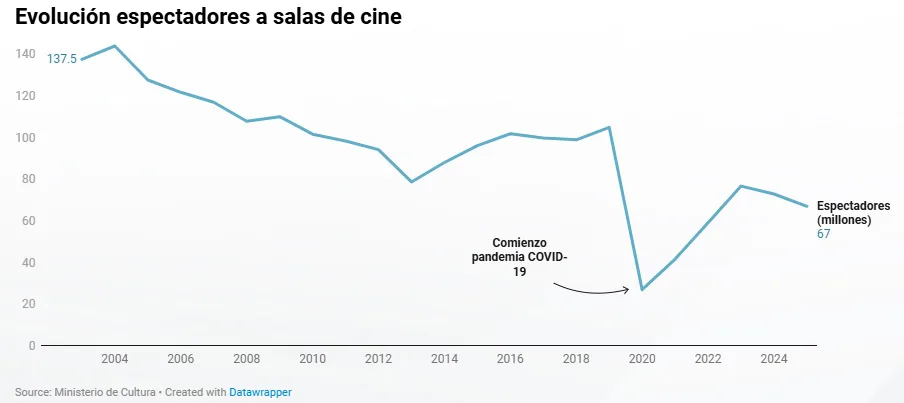
In Spain, the evolution of cinema attendance confirms this transformation. Since the beginning of the century, the number of spectators decreases progressively, with the pandemic as the definitive breaking point. The subsequent recovery exists, but remains incomplete: 2019 levels have not yet been reached. In fact, according to Comscore data, in 2025 theater attendance registered a 8% fewer viewers than in 2024, in a context marked by the concentration of the box office on so-called event films, such as Lilo y Stitch, Jurassic World o Avatar.
Added to this decline is a gradual drop in attendance frequency, as stated by the SGAE: if at the beginning of the 2000s people attended more than three times a year per inhabitant, in 2024 the average is around 1.5 attendances, which makes the experience something more occasional and selective, focused on big premieres.
From the viewer to the algorithm
This does not mean that the public has abandoned the theaters, but rather that they have lost their central role in audiovisual consumption. A space that they now share, increasingly, with the streaming platforms: If in 2018 only 39% of the population had a subscription, in 2024 that figure will already reach 64.5%, according to the Survey of Cultural Habits and Practices of the Ministry of Culture.
The data is no longer limited to describing consumption, but they start to shape it.
This sustained growth has also transformed the way stories are accessed. Already There are no fixed schedules or a clear hierarchy of premieres: he content adapts to the user. Added to this is the algorithmic spin: platforms not only distribute, but They interpret the data left by each viewer (pauses, abandonments, repetitions) and learn from them. The data is no longer limited to describing consumption, but they start to shape it.
Is there room for risk in the algorithm era?
This context allows us to recover some ideas from the cultural critic. Mark Fisher, who described contemporary culture as a constant reiteration of the past, clinging to recognizable formulas in the face of the difficulty of imagining something truly new. From this perspective, the rise of metrics-driven models and retention patterns raises obvious limits.
It is worth asking whether in the digital ecosystem of the future there will be room for such bets. radicals like the third season of Twin Peaks the gestures of creative break as Megalopolis.
When the creative decisions are increasingly oriented towards what has already worked or towards what the majority public demands, the most risky or difficult to classify proposals risk being left out. It is worth asking, then, if in the digital ecosystem of the future there will be room for such bets. radicals like the third season of Twin Peaks the gestures of creative break as Megalopolis, the most personal and controversial project of Francis Ford Coppola.
Not an ending, but a redefinition
In that sense, the possible purchase of Warner Bros. on the part of Netflix does not offer clear answers, but new questions, especially about the future of theatrical distribution. The Netflix's usual strategy (limited releases in a few theaters and for short periods) introduces doubts about the role that the collective cinema experience will occupy in an increasingly personalized ecosystem.
As in other turning points in the history of the medium, it is not so much an end as a redefinition: the question is no longer just where the movies are released, but how, when and from what place we see them.
This article was originally published on the GAD3 blog.
Javier Garcia
Data consultant at GAD3

Did you like this article?
Subscribe to our NEWSLETTER and you won't miss anything.
Related articles
 Christie's new RGBH generation marks a leap in efficiency for small to medium-sized digital cinema theaters
 Audiovisual Talent Week returns with the algorithm and content consumption at the center of its proposal
 Netflix, beyond the algorithm: the new patent that redefines the personalized experience
 Netflix's VMAF algorithm will evaluate video quality in Vega (Interra)
 Mediaset will have its own 'Paquita Salas': 'The Agency', a new series about a representation agency
 TDS MultiMedia: audiovisual production in iconic Toronto concert halls, with Blackmagic
 The Christie CP4435-RGB projector arrives at Ōma Cinema, a new way of understanding movie theaters
 The UPC, seeking to improve the algorithm to detect false images
 ATG Danmon designs and integrates the new newsroom and editing rooms at Alaraby Tv
 “Evergreen content” = (File + AI) x SEO. A simple but effective algorithm
 Challenges of a new reality in the audiovisual sector
 Samsung Cinema LED aims to open a new era in screens for movie theaters
 Blackmagic Design further optimizes the algorithm of its Ultimatte digital composer
 Basque Audiovisual Services + Tech, new brand for Basque audiovisual technology