





No interference with Clear-Com's Tempest digital wireless intercom
The innovative concept of the Tempest digital intercom, which completes Clear-Com's FreeSpeak range, makes it possible to work in television environments in free bands without interference from foreign networks. The system allows it to coexist with a multitude of Wi-Fi networks at full capacity.
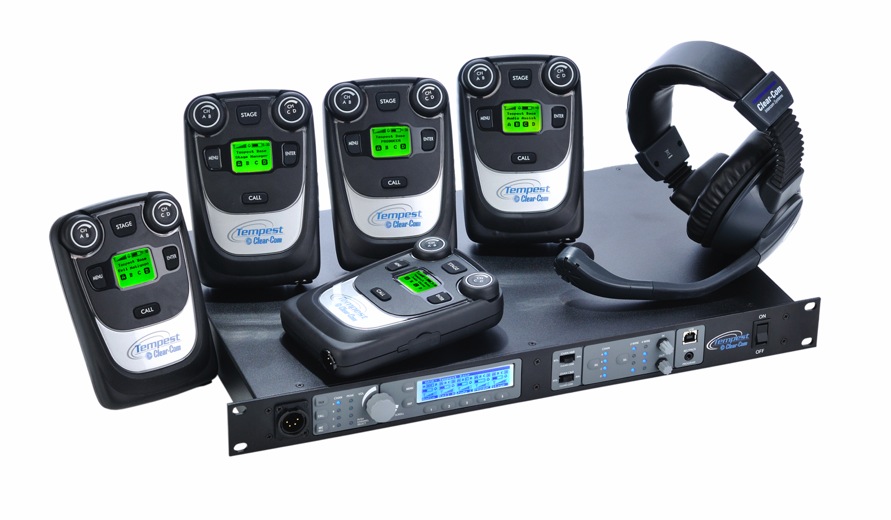 Integrated into the FreeSpeak range, Clear-Com has a digital wireless intercom solution for television environments whose main advantage is that it allows working in bands freed from foreign networks.
The growing number of users of the UHF band and the recent rearrangement of this band for DTT channels make it increasingly difficult to allocate frequencies for analog wireless intercom systems. The pressure from the authorities to enforce current legislation also increasingly effectively deters users without legally allocated frequencies.
Seven years ago Clear-Com presented the FreeSpeak solution as the first broadcast-quality digital intercom system that worked in a released band, in this case the DECT band (1.9Ghz). It was a cellular, modular system integrated into the Clear-Com intercom matrices. Now, with Tempest it aims to cover another segment of the market by offering a real alternative to the autonomous analog wireless intercom systems widely implemented in our country.
ICM band
Tempest works in the band called ICM (or ISM) from 2.4Ghz to 2.48Ghz. It is a released band practically common in all countries in the world. This band is used extensively by WiFi and WiMax networks, so a priori it may be unsafe for high availability intercom applications such as those of a broadcast system.
That is why the fundamental design parameter of Tempest was the absolute need to coexist with a multitude of Wi-Fi networks at full capacity. Finally, this has become the main differentiating factor compared to other market solutions that work in the same band.
The key to the “friendly cohabitation” between Tempest and WiFi networks lies in its modulation scheme. While the 802.11b/g or WiFi standard uses DSSS (Direct Sequence Spread Spectrum) modulation, TEMPEST uses Frequency Hopping Spread Spectrum (FHSS).
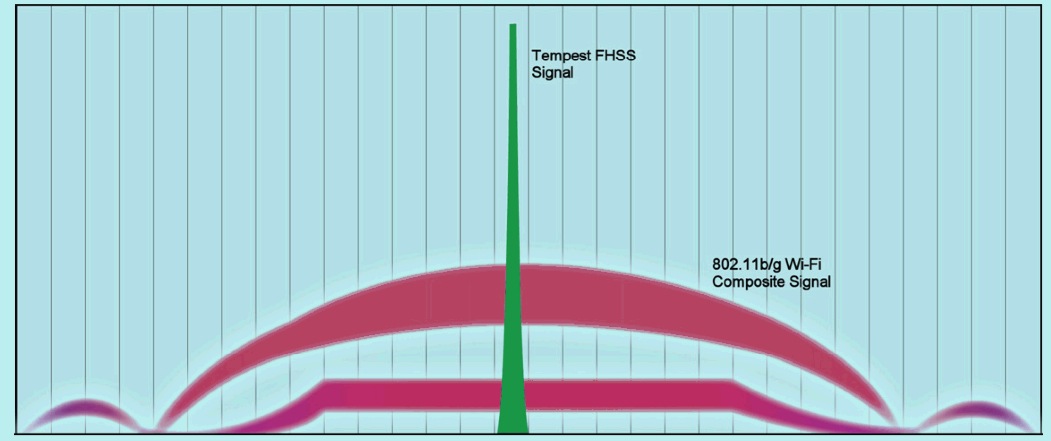
As we see in this figure from the spectrum analyzer, it can be deduced that the DSSS modulation distributes the energy uniformly throughout the 22Mhz channel, while the FHSS carrier of TEMPEST concentrates the power in a 1.5Mhz band. This means that, on the one hand, the FHSS carrier clearly stands out from the energy of the WiFi channel and is clearly demodulated and, on the other hand, WiFi traffic is not interfered with.
To complement this technique and further improve the isolation between both networks, Tempest uses the frequency hopping technique, changing its location in the spectrum every 5 milliseconds (200 times per second).
Tempest additionally uses other technologies to improve its immunity against interference from WiFi networks without interfering with them in turn, such as frequency multiplexing (TDMA) by which all Belt packs use the same carrier; 2xTX (all packets are transmitted twice in consecutive frequency hops. It drastically reduces the possibility of a packet not reaching its destination due to outside interference), Lost Packet Concealment (packet redundancy. Up to 4 consecutive packets must be lost to affect transmission) and spatial and polarization diversity.
Thanks to the combination of all these advanced technologies, one Tempest intercom station can work with five beltpacks simultaneously in Full Duplex and up to 10 stations can be co-located simultaneously in the same space. It is available in 4-channel and 2-channel stations. Finally, it should be noted that all the beltpacks are intelligent with the local possibility of choosing the channel with two level controls and an integrated display.
Did you like this article?
Subscribe to our NEWSLETTER and you won't miss anything.
Related articles
 RAI installs a Clear-Com intercom in partnership with Video Progetti
 The German Welt migrates to an IP intercom system with Clear-Com
 MG Stage adopts Clear-Com intercom systems in its productions
 Clear-Com unveils its next generation of wireless digital intercom
 BBC installs Clear-Com FreeSpeak II intercoms in fourteen studios
 Intercom from an Apple Watch with Clear-Com
 Clear-Com updates its HelixNet intercom system
 QinMedia installs a FreeSpeak wireless intercom from Clear-Com on TVE
 TVN adopts Riedel's Artist system for wireless digital intercom
 Mediaset Spain remodels its wireless intercom systems with Clear-Com
 Slovenian RTV installs a Riedel digital wireless matrix and intercom
 Clear-Com Tempest: two-channel intercom
 Riedel begins marketing its Acrobat wireless digital intercom
 FreeSpeak 2.0 and Tempest 2400, two intercom systems from Clear-Com at IBC'09