





EVS presents the advantages of working with MXF-based flows
EVS begins in Madrid the promotional tour of the hardware and software solutions presented by the Belgian company, in which OpenCube is already fully integrated, for working with MXF (Material Exchange Format) files. The intention is to manage the increasingly common global tapeless production environments. Broadcasters such as LaSexta, Sogecable, ARTE or MTV, as well as numerous production companies, already trust EVS-OpenCube technology in their MXF-based workflow management.
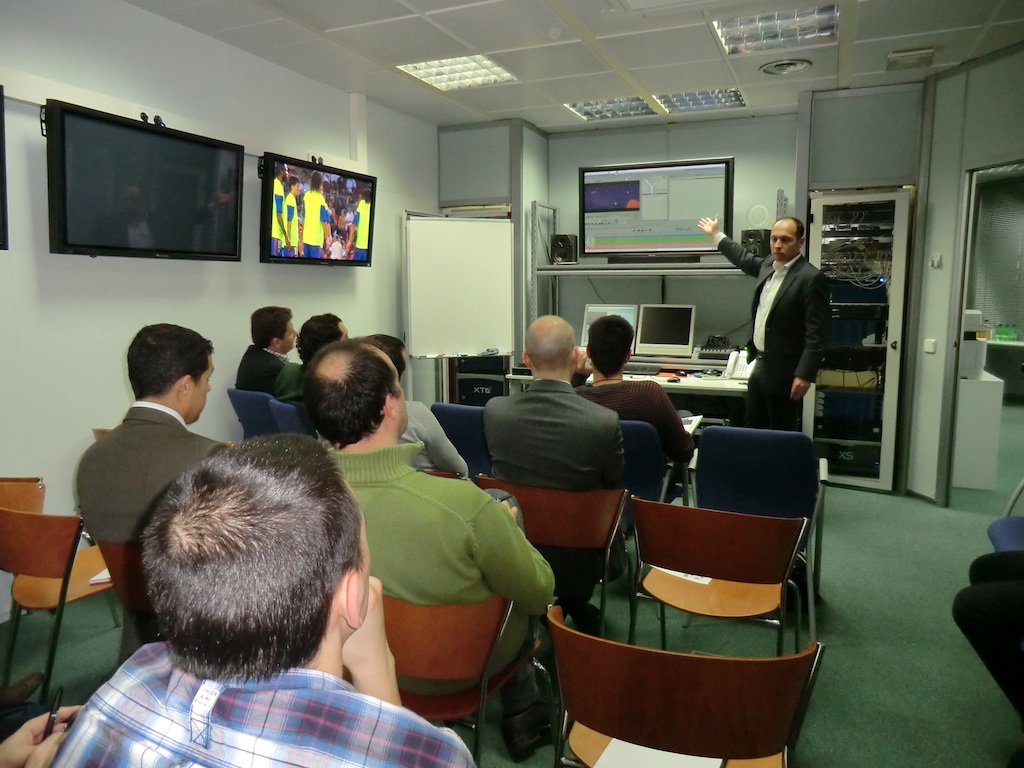
The Europe, Middle East and Africa branch of EVS has planned a tour that will take them to a total of 13 cities until early April, presenting their proposals for tapeless workflows.
On the tour, which began in their offices in Madrid on February 22, EVS and OpenCube (a company already fully integrated into EVS) presented the advantages of MXF as a standard to avoid file transport problems that arise in broadcast production environments, accustomed to working with different formats and codecs, especially HD.
The Belgian company EVS, with almost twenty years of experience, currently has around 400 workers and five R&D centers in Toulouse, Paris, Brussels, Liège and Chegdu (China). Its market is focused on the production of sports, news and entertainment for television and its sights are currently directed towards the digitization of files and content management; intake and work without tape; and file conversion and especially MXF tools. That is why the purchase of the very young OpenCube (founded in 2002) by EVS, according to Marc Caeymaex, General Manager of EVS Ibérica, has meant taking advantage of the commercial strength of both, since they worked together with MXF and this was a way to integrate the product in a more effective way.
MXF, un formato contenedor
Este tipo de archivos MXF se generan en la ingesta o directamente en cámaras como XDCAM de Sony o DVCPRO P2 de Panasonic, utilizándose como intercambio de formato broadcast y en D-Cinema.
MXF es un formato contenedor de audio, vídeo y de sus metadatos asociados; código de tiempo, teletexto y subtitulados, que pueden ser guardados e intercambiados en el traspaso entre sistemas; siendo esta una de sus principales ventajas, ya que esta información a menudo tiende a perderse.
MXF fue aprobado como estándar por SMPTE (Society of Motion Picture and Television Engineers) en 2001. Este formato de encapsulado es independiente del tipo compresión que se emplee, ya que transporta desde vídeo con compresión hasta sin compresión. La Sexta, Telemadrid y Sogecable son algunos de los entornos de producción que han optado por el trabajo con estos archivos MXF.
Software
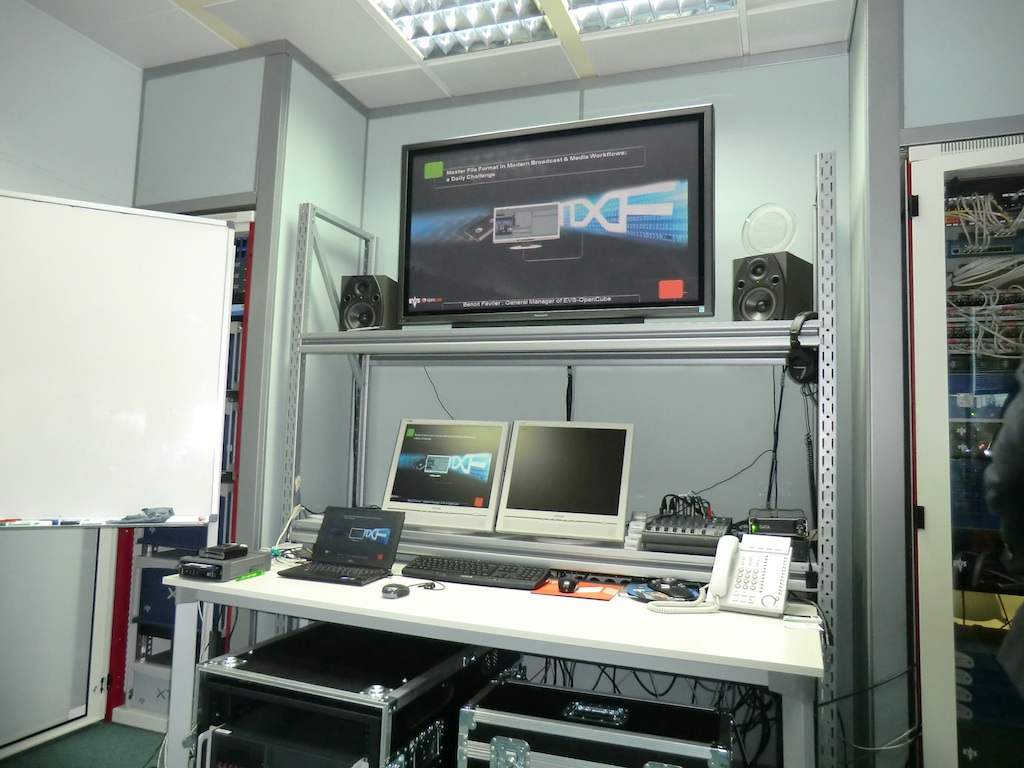
En la presentación, a cargo de Benoit Fèvrier, Mananging Director de EVS-OpenCube, se habló de las soluciones de Software planteadas especialmente para entornos de producción con PC.
El OpenCube XFReader permite visualizar todo tipo de vídeos MXF en Windows. Tiene las funciones habituales de un player, pero también permite marcar puntos de entrada y salida para crear subclips y seleccionar los tracks de audio.
OpenCube XFConverter está pensado para la conversión de formatos contenedores como MXF, Quicktime o AVI, sin modificar la esencia del contenido, y la posterior operabilidad con AVID y Final Cut.
Hardware
El servidor OpenCube HD/SD con estándar abierto, trabaja sobre Linux y es capaz de soportar diferentes formatos en calidad SD y HD. Puede trabajar directamente conectado a un VTR para la digitalización del archivo y su conservación, o trabajar en directo para la producción o post producción.
Por último, OpenCube DCP para soluciones de flujos de trabajo con HD y D-Cinema. DCP también trabaja sobre Linux y facilita la producción en 2D y 3D con distintos tipos de material sin compresión en HD, 2K y 4K, convirtiéndolos en archivos MXF. Permite la reproducción en tiempo real de HD 4.2.2, HD 4.4.4 y 2K y está especialmente pensado para cines con D-Cinema.
Teresa Barceló
Did you like this article?
Subscribe to our NEWSLETTER and you won't miss anything.
Related articles
 Brut turns to Moments Lab and LucidLink to integrate AI-based workflows into Cannes Film Festival coverage
 Dalet to Demonstrate AI-Based, Collaborative Workflows for Production, Automation, and Monetization in Las Vegas
 Brainstorm presents InfinitySet 5.2 at NAB 2023, which adopts the advantages of Unreal Engine 5
 Learning to work in HDR
 ESP xMedia and Matrox Deliver Breakthrough in Cloud-Based Multi-Camera Workflows
 MOG Technologies destacará los avances en los flujos de trabajo basados en archivos en NAB 2019
 Tedial presents at IBC the advantages of artificial intelligence applied to the production of live sports
 Imagine Introduces Xenio Workflow Manager, Aimed at Enabling Software-Defined Workflows
 Pablo Blanco: “working with Álex de la Iglesia is very easy”
 TSL presents new services for advanced workflows at CABSAT 2013
 Sony Optical Disc Archive: a complete archiving solution for file-based workflows
 Harris presents QuiC, a solution for quality control in file-based environments
 Discover with EVS-OpenCube how to work in an MXF-based flow
 Storage Strategies for Simplified File-Based Workflows