





DVB-T2 Lite: a new window of opportunity for mobility services
Vicente Pla, Broadcast Project Manager specializing in digital television, analyzes in this Tribune where the DTT standard can go after the emergence of the new Lite profile of the DVB-T2 standard (ETSI EN 302 755).
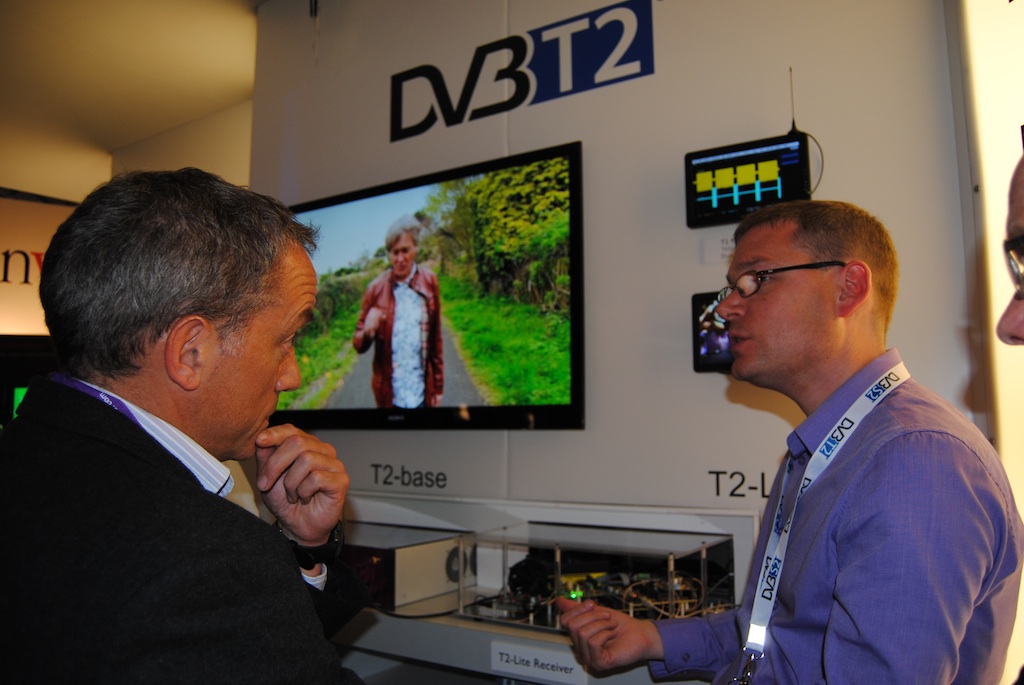
With the appearance on the scene this summer of the Lite profile of the DVB-T2 standard (ETSI EN 302 755) the panorama of mobile television may change. Especially for those countries that have adopted the DVB-T2 standard.
In the Spanish National Technical Plan for DTT (RD 944/2005) there was already talk of mobile television through DVB-H (ETSI EN 302 304). However, in Spain these emissions never reached beyond some isolated pilot projects. Other countries with stable emissions abandoned them over the past year.
The cause of failure may have to be sought in the commercial part. Was it in the interest of a telephone company to subsidize a DVB-H terminal to stop the data consumption caused by watching television through the incipient 3G networks? Was it profitable for broadcasters to assume the deployment of a DVB-H multiplex shared among all of them when the receivers were not available on the market? In short, many unknowns for a business model that was replaced by streaming through 3G networks.
With the appearance on the scene this summer of the Lite profile of the DVB-T2 standard (ETSI EN 302 755) things may change. Especially for those countries that have adopted the DVB-T2 standard.
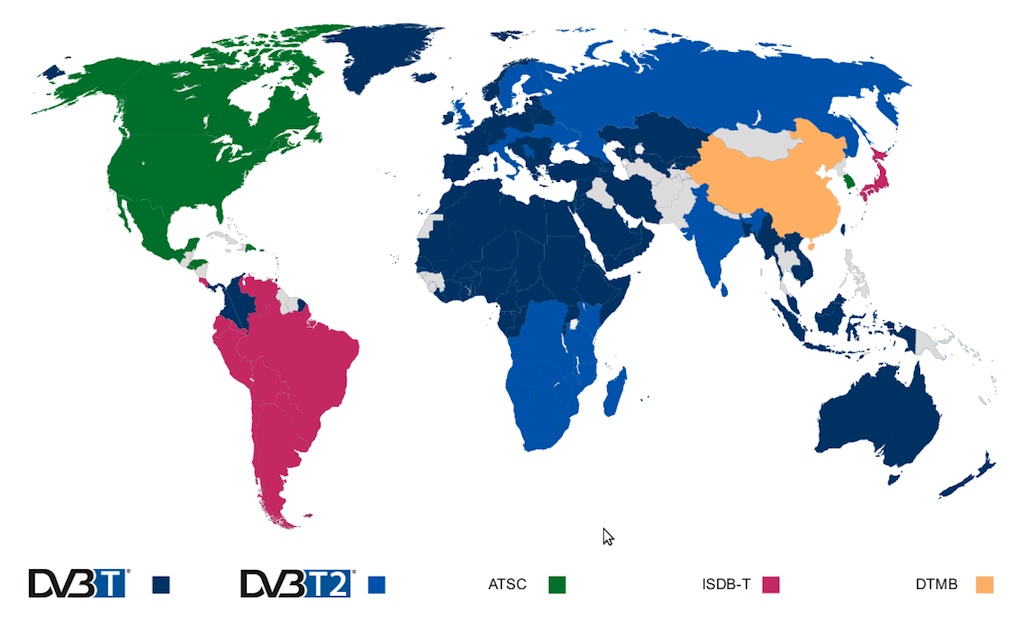
The DVB-T2 specification incorporates a series of tools that in the case of single frequency networks (SFN) allow an increase of up to 67% in their capacity compared to DVB-T.
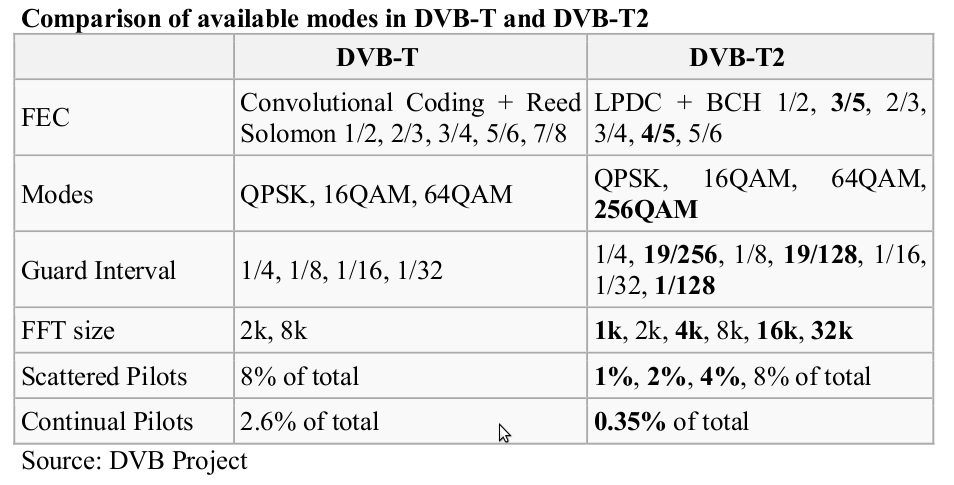
In addition, DVB-T2 since its inception has had the latest developments in DVB-S2 modulation and error protection, which provide a substantial improvement in its robustness and capacity compared to DVB-T:
- Error correction with LDCP and BCH codes instead of the traditional Reed-Solomon and convolutional DVB-T codes.
- Improvements in scattered and continuous pilots.
- Incorporation of 256 QAM modulation
- New guard intervals (19/256, 19/128, 1/128)
- New work modes (1k, 4k, 16k and 32k)
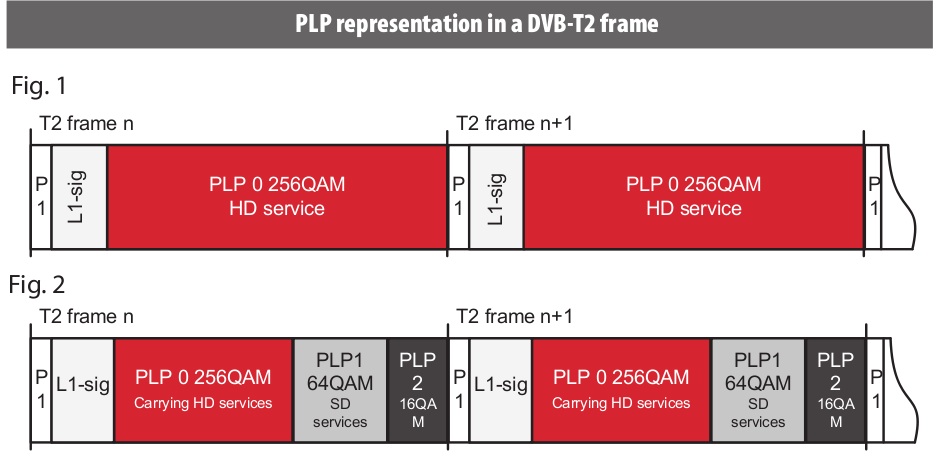
- Introduction of Physical Layer Pipes (PLP) so that each service within a multiple can enjoy different robustness and protection.
- Openness to possible improvements through Future Extension Frames (FEF) that allow the introduction of new frame models not defined in the conception of the DVB-T2 specification.
More specifically, in version 1.3.1 of DVB-T2 that was released this summer, a new type of frame was introduced through the use of FEF extensions: DVB-T2 Lite.
With the use of FEF and PLP, the opportunity opens up to transmit DVB-T2-Lite signals simultaneously through the same RF channel where DVB-T2 content is broadcast. Thus, different levels of robustness are used for each type of signal, the benefit of the system being that both frames can be transmitted at the same time on the same RF channel.
The new “Lite” profile is a reduced version of DVB-T2. It allows efficient implementations of receivers for services such as digital radio or mobile television broadcasting, prohibiting those DVB-T2 modes that consume more memory and battery.
Using these techniques, a new DVB-T2 multiplex could be launched with SDTV or HDTV services that would incorporate a specific DVB-T2 Lite PLP for mobile reception. It would not be necessary to invest in the deployment of a new specific network for mobile devices without having an established business model.
DVB-T2 Lite arrives at a time when:
- The emergence of the Smart Phone market is increasing data traffic through mobile networks exponentially.
- The implementation in many countries of digital radio and mobile television has not yet occurred.
- The world economy is severely damaged and there are threats of recession.
- The deployment of 4G telephony has begun.
In countries where the launch of High Definition television has been done through DVB-T2 networks, it is easy to introduce additional services for mobility by giving up some bandwidth and thus achieving a very robust PLP destined for mobile reception. The BBC is carrying out tests on the Freeview HD multiplex, in Finland they have decided to replace DVB-H with DVB-T2 Lite, and Open Channel in Copenhagen wants to broadcast its radio with DVB-T2 Lite.
In Spain at the moment the situation is different. The deployment of HDTV channels has been done through DVB-T networks, mixing standard definition content with high definition content. We are immersed in the process of liberalization of the frequency band between 790 and 862 Mhz (RD 365/2010 “Digital Dividend”) through which all the SFNs of the national private channels were broadcast, and some multiple regional and provincial channels of the national and regional public televisions respectively. The new services granted in accordance with the provisions of RD 944/2005 and RD 365/2010 have just started after the analogue blackout. The second phase of RD 365/2010 is pending, which indicates that before January 1, 2015, the frequency band from 790 to 862 Mhz must be used for other uses. The deployment of 4G telephone services based on the LTE (Long Term Evolution) standard has begun. We are immersed in a deep economic crisis and unemployment plagues our society. The fragmentation of audiences produced by the arrival of DTT has meant that some television stations have had to close or reduce their production to a minimum.
What's more, administrations have seen their income substantially reduced and in Europe there is talk of a second “Digital Dividend” with the liberalization of the band between 700 and 790 Mhz.
Will any body in this context decide to legislate to migrate DTT to DVB-T2 and force users to change their digital television receivers again? Will television operators opt for deploying a multiplex for mobile television using DVB-T2 Lite or DVB-H technology? Will they prefer that whoever wants to use the data connections of their mobile devices to watch TV or listen to the radio? These are questions that remain in the air and that will be resolved over time.
Vicente Pla
Broadcast Project Manager DVB specialist and trainer
vpla@coitt.es

Did you like this article?
Subscribe to our NEWSLETTER and you won't miss anything.
Related articles
 The 6GHz band is the “only opportunity” for the development of the new 6G in Europe
 The new CyberSecurity Summit at ISE 2026 will turn cybersecurity into an opportunity for the audiovisual sector
 B3 is born, a new services company for the broadcast industry
 Fujifilm debuts its new compact data archiving solution, Kangaroo Lite, at IBC 2024
 SimplTrack Lite, the new HuddleCamHD streaming camera with automatic tracking
 Direkt Link 500/600: Intinor's next-generation mobility coding backpack
 TVU Networks will offer turnkey services to contribute to mobility during the World Cup in Russia
 Blockchain: a great opportunity for creators, media and companies
 HP establishes a new category of workstations designed for mobile work on performance, innovation and reliability
 Broadcast Pix presents Vox Lite, a new proposal for voice control in small productions
 Abertis will present its latest solutions for mobility and connected TV at MWC
 RYMSA: solutions for DTT in mobility
 Adobe announces more tools for mobility
 Adobe's new Flash Lite player for mobile