





Training, key to the development of audiovisual
The training of the audiovisual sector has been the topic that has brought to an end the cycle of Technical Conferences organized by IFEMA within the framework of Broadcast IT 2011.
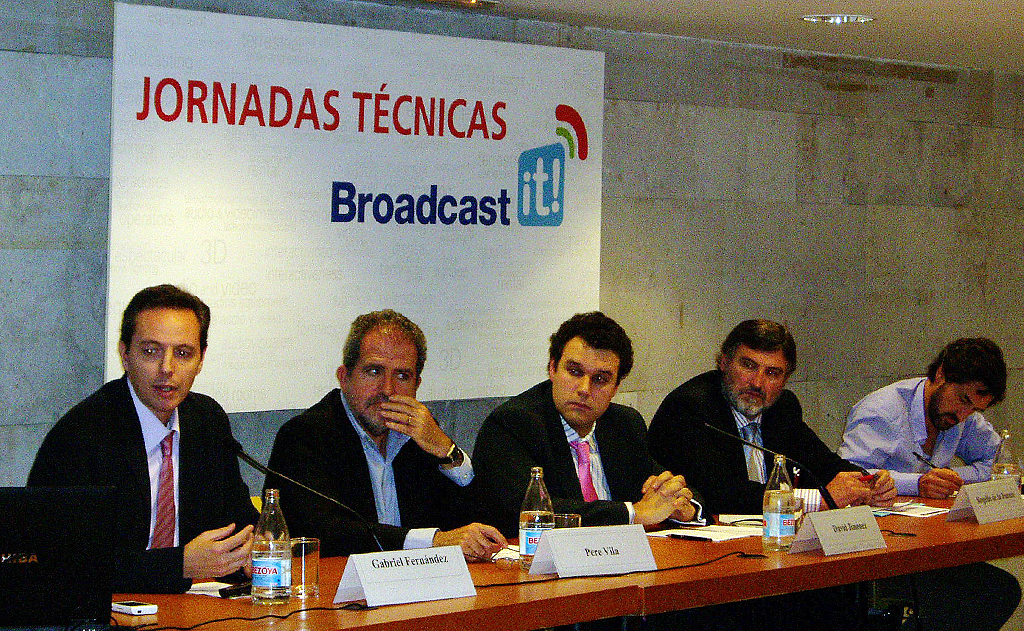
The 2011 Broadcast IT Technical Conference has been concluded for two years with the analysis of the current state of training in the audiovisual sector. The last session, presented by David Jiménez, from the Department of Signals, Systems and Radiocommunications of the E.T.S. of Telecommunications Engineers of the Polytechnic University of Madrid (UPM) was titled 'Training: training needs for new professionals'. In it, aspects have been debated such as the definition of the Bologna framework, what can be done in the environment linked to broadcast; training needs; the core aspects and specialties; the new training models, and the training of the trainer.
To do this, we had the presence of Pere Vila, director of Planning and Technological Innovation of RTVE, who offered the vision of a television operator; Ignacio Fernández-Vega, director of Audiovisual Services Design at Telefonica, who provided the point of view of a telecommunications operator; Rogelio de la Fuente, president of AEQ, a company in the sector, and Gabriel Fernández, from La Salle University.
The representative of this private university center has explained the main features of the European Higher Education Area (EHEA), embodied in 1999 in the Bologna Declaration, signed at the Italian university of the same name, and the influence of this plan on the different degrees related to the audiovisual sector. From now on, the name of bachelor's degree will replace those of diploma, graduate and technical and higher engineering, and will allow direct access to the world of work.
All the speakers have agreed that training is a fundamental element in today's society, and in this sector it is a key element for its development, professional qualification and competitiveness. For this reason, they consider it necessary that universities provide future professionals with the appropriate instruments so that they can be in the best conditions to face the continuous technological advances and adaptation to new products and markets that occur in this sector, but that, at the same time, students are also up to date with this new technology that is emerging every day, as is the case of the current process of digitization of both video and audio and the convergence with the Networks.
In this regard, Rogelio de la Fuente has pointed out that currently what companies are looking for is a professional with very specific training, multitasking, very agile in the face of technological changes. “It is not taught at the university, it is the company that is paying for this training,” he alleged. For his part, Pere Vila demanded that the new professionals be more specialized, as well as have more practices and certifications.
In this sense, master's degrees and postgraduate courses are emerging as the solution for those who want to seek their 'added value' in specialization, a point in their favor in the difficult task of entering the audiovisual labor market. The head of Technology of the Public Entity considers that these courses should provide students with technical specialization, specialization in equipment and specialization in the management of the company's personnel, while the director of Audiovisual Services Design at Telefonica, Ignacio Fernández-Vega, highlighted the importance of English, interactive classes and the need to continue studying every day.
“From now on it is the student who has to learn to solve problems, today knowing how to do is very important,” added Rogelio de la Fuente, who also believed that “universities and companies must reach an understanding about practices.”
As a culmination of the round table, José Manuel Menéndez, University Professor of the Department of Signals, Systems and Radiocommunications of the E.T.S.I.T. from the UPM, present in the room because he was initially going to be in charge of moderating the debate, proposed that companies be forced to get involved in training programs for future workers in certain aspects, to which the representative of Telefónica responded that, in the specific case of the telephone operator, they have their own university and organize ad-hoc courses and support programs for their employees around the world.
Did you like this article?
Subscribe to our NEWSLETTER and you won't miss anything.
Related articles
 RTVE Instituto and ALÍA sign an agreement to promote audiovisual training
 TVU Search AI, key to the audiovisual production of Red Bull's Wings for Life World Run
 RTVE joins forces with the National Digital Content Pole of Malaga to promote audiovisual training
 Nine university students receive the UniTalent-EITB 2022 awards for the development of audiovisual talent
 Collaboration between the broadcast and automotive industries, key to the development of digital radio
 The reorganization of the 3.5 GHz frequencies, key to the development of 5G, is completed
 FIACINE and CAACI join forces to promote the development of Ibero-American audiovisual activity
 The International University of Valencia and The Core sign an agreement to promote audiovisual training
 RAMPA organizes five professional meetings to contribute to the training of women in audiovisual
 Innovation, a key factor in the development of pay television
 JVC JY-HM360, a new ProHD model designed for social reporting and audiovisual training
 The digital economy, key to the development of all economic sectors
 The Television Academy and the UNED sign an agreement for the training of audiovisual professionals
 Digitalization is key to the development of pay-TV in Central America