





Fovea HD Caliber, an HD and SD converter with advanced features
Este conversor está especialmente indicado cuando se trabaja con imágenes con un gran área de movimiento, como un paneo a lo largo de una cancha, junto con otros objetos de menor tamaño también en movimiento
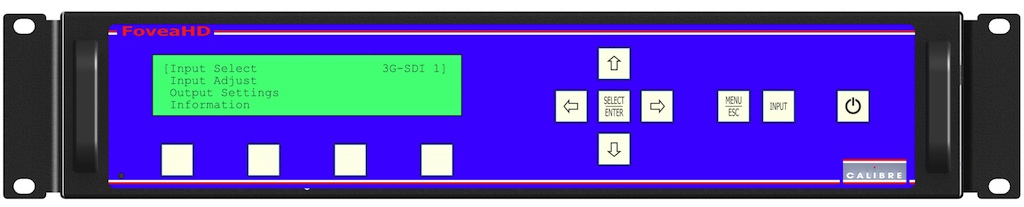
Calibre, compañía británica con casi un cuarto de siglo de especialización en soluciones de procesamiento y visualización de imagen, cuenta ahora con un interesante conversor de estándares HD y SD de alto rendimiento con compensación de movimiento.
Este conversor está especialmente indicado cuando se trabaja con imágenes con un gran área de movimiento, como un paneo a lo largo de una cancha, junto con otros objetos de menor tamaño también en movimiento, como podrían ser los jugadores o el balón. Su función de movimiento global basado en el algoritmo MEMC es capaz de tratar paneos rápidos con muy buen resultado. Por otro lado, Fovea HD permite crear zonas de exclusión para aquellos contenidos que pudiesen estar degradados por estimación de movimiento, como subtítulos o faldones con resultados o rótulos, excluyéndolos del procesamiento.
Esta solución sobresale también por un mayor control con manejo de cadencia para el procesamiento de contenido original en película o 24p, así como la habilidad de preservar la cadencia en conversiones entre formatos 50i y 59.94i, manteniendo el look de cine a la vez que realiza una conversión MEMC real.
Otra interesante función es la detección de cortes de escena y la posibilidad de seguir cadencia y preservar los requerimientos de cada una de las escenas.
Su rendimiento destaca principalmente cuando se trata de material que ha sido fuertemente comprimido o que contenga mucho movimiento de carácter esconder-mostrar.
Para visualizar los resultados es posible partir la pantalla de seguimiento en dos áreas, con y sin procesamiento.
Calibre ha mejorado en este nuevo equipo el rendimiento mejorado en fps bajos para formatos 23.98, 24, 25, 29.97 y 30p con la habilidad de crear entradas y salidas en pocos fotogramas por segundo para aplicaciones como entrega de catch-up tv, por ejemplo.

Did you like this article?
Subscribe to our NEWSLETTER and you won't miss anything.
Related articles
 AJA gives the keys to Bridge NDI 3G, its latest NDI/SDI converter
 Caliber expands its range of solutions with Live Virtual Solution (LVS)
 InSync develops the MCC-4K-A frame rate converter, which For-A will distribute
 Lynx Technik will debut its HDR Evie converter at NAB 2019
 Coretronic acquires British image processing company, Calibre
 Taiwanese Coretronic acquires British image processing company Caliber
 Panasonic makes the transition to IP easy with a coaxial converter
 VSNExplorer will show its advanced features in collaborative work environments at CABSAT 2015
 GFD uses Caliber scalers for its installations with Sony 4K projectors
 New mini video-optical converter from Opticomm
 ZDF begins using Teranex's 2D-3D converter
 Golf Channel Simplifies PAL Output with For-A's FRC-7000 Converter
 AmberFin begins marketing the iCR standards converter
 Focus MC-HD1, new universal HD converter