





Caminando hacia la estandarización de la Ultra HD
Damián Ruiz y Conchi García Pardo, R&D Engineers en el Instituto de Telecomunicaciones y Aplicaciones Multimedia (iTEAM-UPV) han centrado su ponencia en Broadcast IT Experience en los avances en codificación para Ultra Alta Definición y la convergencia del DVB con LTE y LTE-eMBMS.
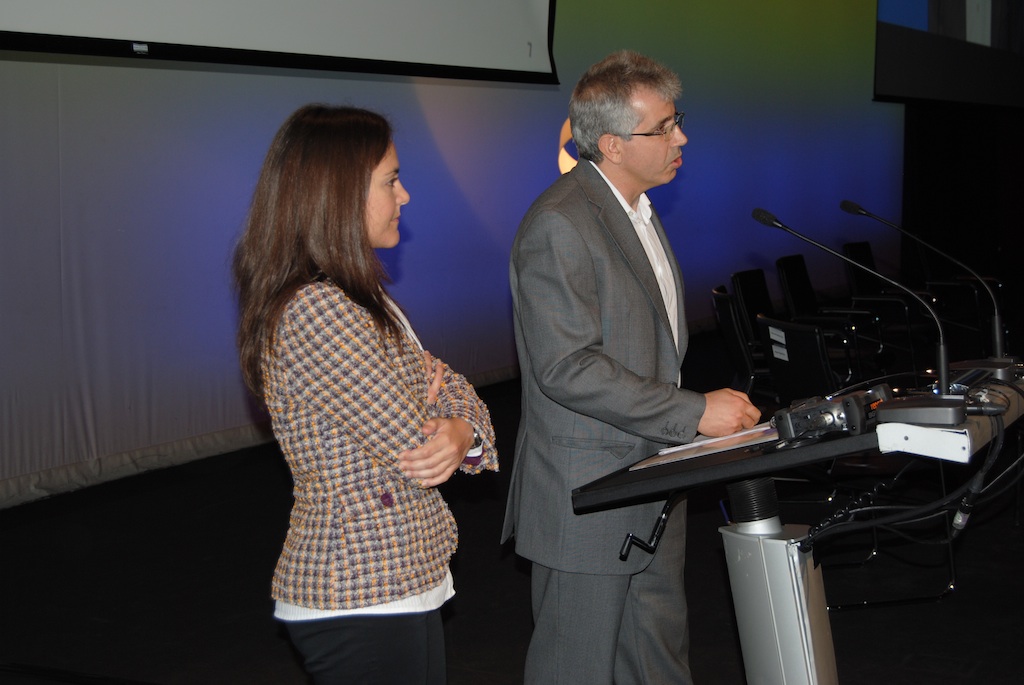
¿Qué grado de eficiencia se consigue en la difusión de contenidos audiovisuales en LTE-4G y DVB-T2? ¿Qué perspectivas de optimización aportarán los nuevos estándares de codificación como HEVC? ¿Cómo convergirán las redes broadcast y de datos y cómo afectará a la emisión? A todas estas preguntas han dado respuesta Damián Ruiz y Conchi García Pardo, R&D Engineers en el Instituto de Telecomunicaciones y Aplicaciones Multimedia (iTEAM-UPV) en su conferencia en Broadcast IT Experience.
Damián Ruiz ha destacado las numerosas pruebas que se están llevando a cabo en toda Europa con contenidos 4K a H.264 a 25 fps a 8 b y 50 fps a 10b. Ruiz ha reseñado la alta eficiencia de los estándares de compresión de vídeo, especialmente el HEVC, que han permitido mejoras en la eficiencia de hasta un 50%. “La alta eficiencia en muy bajas tasas binarias (OTT) y la alta eficiencia con formatos de muy alta resolución (UHDTV) serán clave en los próximos años”, ha comentado.
La ventaja del HEVC es que su tecnología innovadora permite mantener una arquitectura híbrida con ME-MC y 2D-DCT. En este momento ya se están llevando a demostraciones de decorders sobre iPad y Nexu, posteriormente llegará la implantación de servicios de streaming, finalizando con la aprobación de los perfiles finales en 2014, ha aventurado Damián Ruiz.
En cuanto al DVB-T2, Damián Ruiz ha destacado la eficiencia de la segunda generación del estándar europeo. “Bajo similares condiciones de topología de red se obtiene una mejor eficiencia objetiva”, admite Ruiz.
En este sentido, el grupo de trabajo iTEAM de la Universidad Politénica de Valencia está llevando a cabo un piloto experimental en Sevilla con estándar DVB-T2 junto a codificación HEVC. En este proyector colabora Axión, Sapec y Egatel.
LTE y LTE-eMBMS
Conchi García Pardo ha centrado su ponencia en el segundo dividendo digital y en la convergencia del DVB con LTE y LTE-eMBMS.
García Pardo ha compartido con los profesionales que han acudido a Broadcast IT Experience algunos resultados de una investigación de campo que iTEAM ha llevado a cabo sobre el uso del espectro de UHF en Colombia (el despliegue del DVB-T2 se ha llevado a cabo con dos operadores y dos redes) y España.
Para esta investigadora, la aparición del LTE-eMBMS ha venido motivada por la pérdida de espectro para radiodifusión y la necesidad de la industria de tener espacio para distribución de contenidos. García Pardo ha destacado que emplea transmisión OFDM al igual que DVB-T/2 y cuenta con la posibilidad de implementar redes de frecuencia única, así como transmitir aa una única celda con el consiguiente uso floexible de portadoras unicast/broadcast. Sin embargo, ha admitido que no sería un canal viable para HDTV/UHDTV.
Did you like this article?
Subscribe to our NEWSLETTER and you won't miss anything.
Related articles
 35 short films in the race towards a Goya
 La estandarización del DAB+ en España: dificultades, desafíos y retos
 Walking with a firm step towards Ultra High Definition
 Lawo paves the way towards broadcast 3.0
 Hans Hoffman (UER/EBU) defiende en Sevilla la necesidad de una estandarización para UHDTV
 Google Chromecast Ultra: streaming hasta en 4K Ultra HD con HDR
 Towards a new revolutionary concept of Digital Terrestrial Television
 IBM and Ericsson take another step towards 5G
 Caminando hacia el DVB-Sx
 Hacia una nuevo concepto en contribución SNG
 Know Media refuerza sus servicios hacia Latinoamérica
 Errequerre: hacía falta una plataforma así
México avanza hacia la licitación de la banda de 700 MHz
Errequerre: hacía falta una plataforma así
México avanza hacia la licitación de la banda de 700 MHz
 Sony avanza hacia el 3D en entornos domésticos