





La tecnología de compresión de Sapec, presente en los workshops de BIT Broadcast
El camino hacia el 4K está siendo mucho más rápido de lo que se preveía hace unos pocos años y, como ha quedado patente en BIT Broadcast, Sapec está preparada para los nuevos retos de codificación de alta eficiencia.
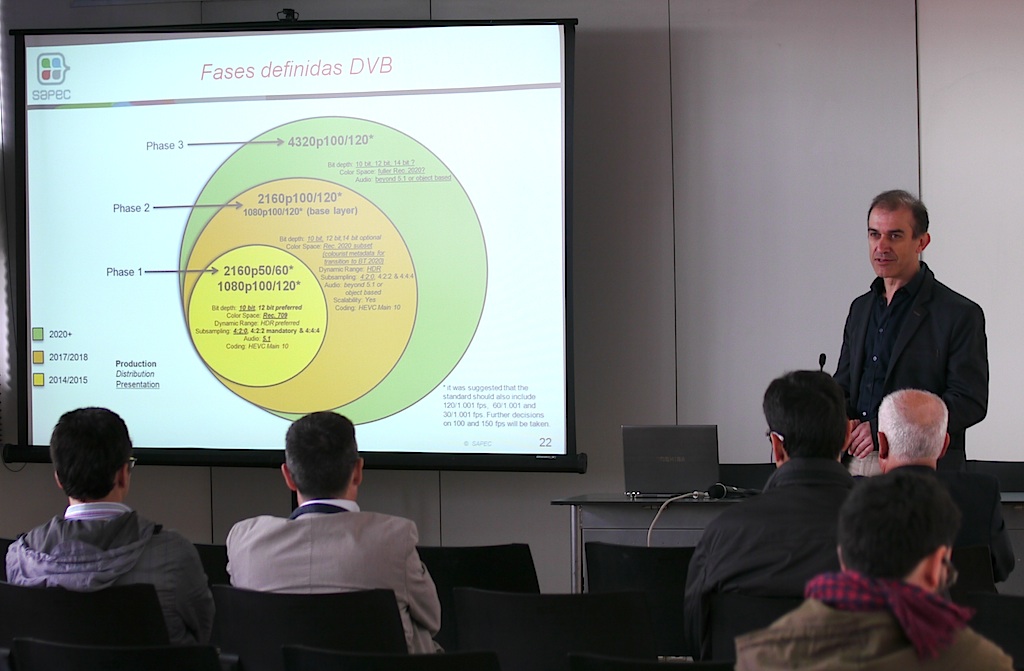
Sapec ha estado presente en esta edición de BIT Broadcast, y lo ha hecho con dos ponencias dedicadas al 4K y a los nuevos estándares de codificación HEVC. Mientras que el martes Miguel Ángel Cristóbal, director general de Sapec, participó en la ponencia dedicada al documental The passion of the Prado junto a los responsables de RTVE, Abertis, Hispasat, Sony y Apuntolapospo para hablar del procesado llevado a cabo; ayer fue Juan José Anaya, director técnico de Sapec, dentro de las charlas organizadas por el Cluster ICT-Audiovisual de Madrid, quien ofreció una magnífica interpretación del estado actual de la Ultra Alta Definición, detallando los nuevos estándares de codificación que soportan esta resolución, los sistemas de contribución y distribución necesarios para esta tecnología, así como la evolución que están experimentando los nuevos formatos de codificación.
La ponencia UHD-HEVC: Contribución y distribución, impartida por Anaya se convirtió en una excelente exposición a nivel de ingeniaría del estado actual de la UHD y de los nuevos estándares de codificación (HEVC), y hacia dónde está yendo Sapec en este sentido.
El camino hacia el 4K está siendo mucho más rápido de lo que se preveía hace unos pocos años, más teniendo en cuenta el largo camino de la HD, que tuvo en los Juegos Olímpicos de Barcelona de 1992 su primera gran superproducción.
La Ultra Alta Definición es un formato diferenciador para el usuario y hoy, gracias a los nuevos estándares de codificación HEVC (ITU-H.265) se consiguen importantes eficiencias de compresión que permiten que la UHDTV sea ideal para capturar el contenido y una fácil adaptación a HDTV para el broadcaster.
Para Anaya el estándar de codificación H.264 fue en su día una auténtica revolución, y a día de hoy se ha vuelto a mejorar en torno a un 50 por ciento esta compresión, consiguiendo importantísimas eficiencias. Anaya destacó que con HEVC entre 15 y 20 Mbps se puede transmitir una señal de ultra alta definición (es posible ver esta demostración en el stand de Abertis Telecom).
El HEVC se desarrollará por tanto mucho más rápido que el MPEG2/H.264, y se convertirá en el “facilitador” de la tecnología UHDTV, y a nivel profesional las contribuciones utilizarán los nuevos perfiles definidos para HEVC (4.2.2). Hasta la fecha, las pruebas llevadas a cabo se han venido haciéndose en HEVC 4.2.0, pero en un futuro inmediato se apostará plenamente por una compresión HEVC 4.2.2 para los enlaces de contribución, aunque la entrega final pueda ser llevada a cabo en HEVC 4.2.0 debido al exigente bit rate. De esta forma, los perfiles extendidos del HEVC (4:2:2) ofrecen mayor robustez en la multigeneración que los estándares actuales. En todo el proceso del camino de la señal de televisión, se realizan varios saltos y es necesario codificar y decodificar la señal, pero manteniendo la calidad de la señal desde los primeros pasos de la cadena.
4K al mismo bitrate que la HD
A modo de resumen, Anaya destacó que las contribuciones de señal UHD con el nuevo formato H.265, perfil 4:2:2, podrían realizarse a bit rates equivalentes a los actuales para HD con H.264.
Si las contribuciones en H264 se suelen realizar entre 20 y 40 Mbps (1080i25) ó 50 Mbps para 1080p50, una contribución UHD 4Kp50 en H264 4:2:2 necesita una tasa superior a los 100 Mbps. Por tanto, estos perfiles extendidos del HEVC son una solución eficiente para las contribuciones en UHD-4K. HEVC consigue una reducción del 50% respecto a H264 4:2:2, y por tanto, las contribuciones en HEVC-4K podrían realizarse al mismo bit rate que los actuales servicios H264-HD (al mismo frame rate)”.
Anaya destacó por último que SAPEC dispone de librerías de Codificación y Decodificación HEVC, con las que se han realizado las codificaciones 4Kp25 y 4Kp50 de los diferentes demostradores, y que se están analizando alternativas para soportar UHD1 en este tipo de equipamiento.
Actividades de Sapec en UHDTV y HEVC
Sapec ha participado en todas las demostraciones UHDTV que se han hecho hasta el momento en España: Mobile World Congress 2013 y 2014, DVB World Meeting 2013, día 4K de Canal+ y en esta edición de BIT Broadcast ha participado en el workshop sobre el documental El Museo del Prado y su tecnología está presente en el stand de Abertis Telecom.
En todas, el contenido mostrado en las pantallas ha pasado por una codificación hecha en Sapec. Las primeras se hicieron en H.264, pero ya en San Sebastián se contó con el nuevo codificador / decodificador HEVC, que se presentó a nivel mundial recientemente en el NAB de Las Vegas. SAPEC cuenta con un gran Know How en toda la parte de codificación, y por ello es capaz de ofrecer al cliente no solo el valor añadido del producto sino este know-how cimentado en una dilatada experiencia.
Según Miguel Ángel Cristóbal, director general de Sapec, “no vendemos cajas, sino que vendemos soluciones. Nos gusta enterarnos donde se va a utilizar el equipo, qué entorno va a tener. Muchos clientes de hecho cuando tienen que resolver algo, cuentan con nosotros para que les aportemos alternativas y soluciones. Desde el punto de vista de la preventa, tenemos un caché de ingenieros antes que puros vendedores de cajas”. Sapec ofrece también servicios de integración, de ingeniería, de puesta en marcha y de soporte, ”una cosa que nos caracteriza es que hasta ahora no hemos dicho que no a una posible adaptación o necesidad. Y es que al ser una empresa pequeña nos permite ser más dinámicos, y eso es lo que nos ha permitido seguir contando con clientes como Telefónica, TVE, la EBU y un largo etcétera”, comenta Miguel Ángel Cristóbal.
En la actualidad Sapec está participando en el proyecto de la UER: BeyondHD y en la el proyecto Europeo Eureka sobre UHDTV: UHD4U. En el NAB de Las Vegas presentó sus primeros equipos Cod-Dec en tiempo real y en este Broadcast se puede ver su eficiencia en el stand de Abertis Telecom
Did you like this article?
Subscribe to our NEWSLETTER and you won't miss anything.
Related articles
 Sapec estará presente por primera vez en ANGACOM junto a Euromedia Service
 La compresión de vídeo con tecnología EyeQ centrará la presencia de Harmonic en IBC
 Telestream integrates Comprimato JPEG2000 compression technology in Vantage
 Sapec and the UPV demonstrate at the SMPTE annual conference the efficiency of HEVC for UHD compression in HFR
 Callao City Lights: a profitable DooH example at the BIT Broadcast 2014 workshops
 BIT Broadcast takes the pulse of the present and future of the industry in an extensive workshop program
 Crosspoint acude a BIT Broadcast con un extenso programa de workshops
 The BIT Broadcast 2014 workshops will take the pulse of an industry in the face of a future in continuous evolution
 BIT Broadcast 2014 reunirá en más de 75 workshops a los profesionales más destacados del sector
 Broadcast IT Experience Workshops, a meeting point for professionals in the sector
 Ateme 10-bit compression technology on Sky Italia
 Sensio adquiere la tecnología de compresión de Algolith
 Repeticiones en HD sin compresión con la tecnología de AJA
Compresión de las señales en la RTP portuguesa, con Sapec
Repeticiones en HD sin compresión con la tecnología de AJA
Compresión de las señales en la RTP portuguesa, con Sapec