





140 Sennheiser wireless microphones made the Eurovision Song Contest possible
El evento musical en directo más grande del mundo se componía de 140 micrófonos inalámbricos Digital 6000 y 9000 de Sennheiser, además de 42 canales de la serie 2000 IEM con un total de 196 receptores de petaca.

Como ya viene siendo tradición, el Festival de Eurovisión supuso un espectacular despliegue técnico. En esta edición celebrada en el centro de convenciones Expo Tel Aviv y retransmitida a cerca de 180 millones de espectadores la organización contó como partner de la empresa de alquiler Agorà y los expertos en sistemas RF de Sennheiser que se desplazaron hasta allí para ayudar en el despliegue del sistema de monitores y micrófonos inalámbricos, así como en la gestión de frecuencias y la monitorización de RF.
El sistema instalado por Agorà y Sennheiser se componía de 140 micrófonos inalámbricos Digital 6000 y 9000 de Sennheiser, además de 42 canales de la serie 2000 IEM con un total de 196 receptores de petaca.
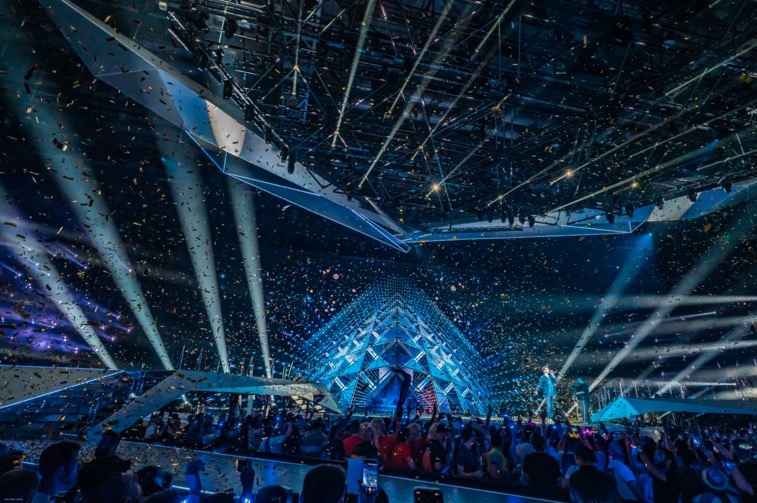
Volker Schmitt, director de Customer Development and Application Engineering, destaca que “el principal reto técnico en el Festival de Eurovisión 2019 es que se desarrollaba en dos pabellones, con un tercer pabellón del Expo Tel Aviv para el Centro de prensa. El pabellón principal, con el escenario y su impresionante pared de pantallas LED, tenía capacidad para 7500 espectadores. Desde aquí, las actuaciones en el escenario se transmitían a un segundo pabellón que albergaba la Green Room, donde otros 2000 espectadores podían ver el certamen en directo en un enorme mural de vídeo”.
La fase más delicada de la planificación de frecuencias para Schmitt y su equipo empezó a principios de marzo con otra ronda de mediciones de frecuencias in situ.
“Comprobamos las frecuencias ocupadas dentro y fuera del Expo Tel Aviv y comparamos estos datos con las mediciones realizadas anteriormente para así disponer de una amplia base para nuestro plan de frecuencias. Había bastante actividad por la transmisión DVB-T, pero gracias a la eficiencia frecuencial de Digital 6000 logramos encontrar espacio para todos los micrófonos y auriculares in-ear. El plan de frecuencias también abarcaba el Centro de prensa, ya que queríamos evitar cualquier interferencia si un periodista con equipo inalámbrico se desplazaba al pabellón del escenario o a la Green Room”, explica Schmitt.
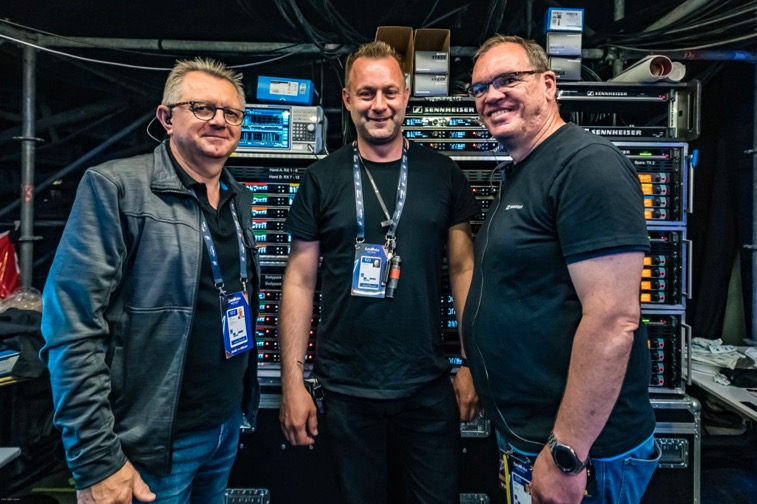
Configuración del sistema
Al instalar la infraestructura de RF en el recinto, como siempre, se prestó una especial atención a la posición del receptor y las antenas transmisoras. Cuando se le preguntó sobre cuál ha sido el mayor reto en esta área, Schmitt mencionó el mural de vídeo de la Green Room: “A diferencia de la espectacular pared de paneles LED del escenario, este pequeño mural de vídeo emitía mucho ruido de RF, por lo que hubo que tener un cuidado especial a la hora de colocar las antenas para evitar las interferencias. Para las entrevistas en la Green Room con los artistas y presentadores, hemos utilizado dos antenas receptoras A 2003 junto con dos A 5000-CP para transmitir las señales de monitorización”.
“Otro reto que surgió justo antes de una de las galas en directo fue con el vestido que llevaba una de las presentadoras”, comenta Schmitt. “El vestido estaba confeccionado con hilos metálicos, por lo que el transmisor alojado bajo esta prenda ¡quedó prácticamente apantallado! Tras una breve charla con el equipo de producción y de vestuario les convencimos de que el transmisor debía llevarse encima del vestido. Entre todos se nos ocurrió rápidamente la idea de añadirle una especie de cinturón al vestido, en el que podríamos fijar los dos transmisores de la presentadora”.
“Cuando algo así pasa justo antes de una gala, la cosa se pone interesante. Por lo general, una producción suele ser algo aburrido para el equipo encargado del recinto, porque se ha realizado un gran esfuerzo en la preparación del evento y todo ha sido comprobado para funcionar como la seda antes de instalar la infraestructura técnica”.
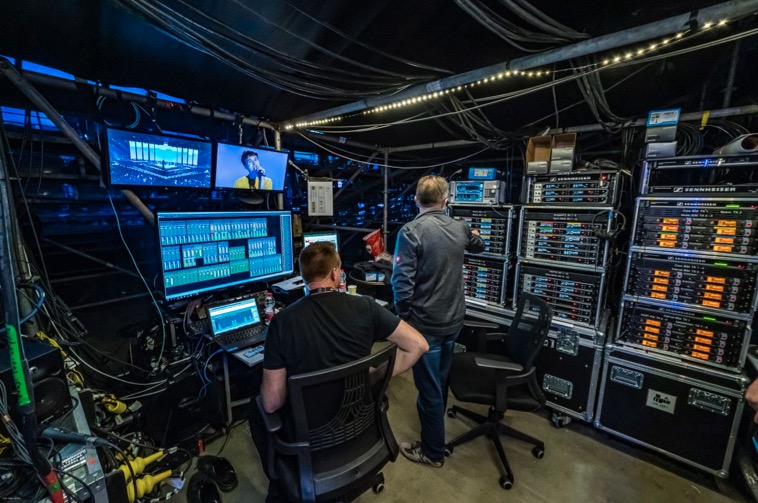
Monitorización del espectro
Todo plan de frecuencias debe ser estrechamente monitorizado y protegido in situ. A pesar de los innumerables carteles de advertencia que indicaban claramente que no debían utilizarse equipos inalámbricos no autorizados en ninguno de los pabellones del Festival de Eurovisión, se “interceptó” a 39 usuarios antes de que sus equipos inalámbricos no autorizados pudieran perturbar los ensayos generales, las semifinales, la gala del jurado o la gran final.
Además de que Agorà suministrase el sistema inalámbrico de Sennheiser para el escenario y la Green Room y que Kilim se encargase del sistema para el Centro de prensa, el equipo eurovisivo de Sennheiser se trajo unos extras de última hora para poder atender peticiones especiales.
“Nos trajimos unos auriculares específicamente para las presentadoras, a las que también les facilitamos unos auriculares in-ear IE 500 PRO en lugar de los IE 40 PRO estándar. Otra opción extra fueron un par de SKM 9000 para los participantes rusos que necesitaban micrófonos plateados. Por el mismo motivo, cambiamos los micros a las presentadoras por unos SKM 9000”.
Como los ensayos comenzaron casi cuatro semanas antes de la final, Sennheiser se trajo un equipo de ocho expertos en radiofrecuencia. “Así pudimos hacer rotaciones con los miembros del equipo”, comenta Schmitt. “En realidad, nuestro equipo era casi tan internacional como el mismo certamen, ya que estaba compuesto por un holandés, que se puso muy contento con la victoria de su compatriota, dos daneses, un brasileño, un coreano y tres alemanes. Estamos muy satisfechos con la excelente colaboración de todo el equipo de producción y, particularmente, con el equipo de Agorà”.
Sennheiser en Eurovisión 2019
- 44 receptores de micrófono de doble canal EM 6000
- 48 transmisores de petaca SK 6000
- 115 micrófonos de diadema Sennheiser a medida para los transmisores de petaca de los artistas y presentadores
- 68 transmisores de mano SKM 6000 con cápsulas MD 9235 para los artistas
- 16 transmisores de mano SKM 9000 COM con cápsulas MD 9235 para intercom entre realización y presentadores
- 2 SKM 9000 para los participantes rusos
- 6 adaptadores Command KA 9000 COM para las petacas
- 21 estaciones de carga L 6000 de montaje en rack con módulos de carga para los transmisores SK 6000 y SKM 6000/9000
Sistemas inalámbricos de monitorización in-ear- 21 transmisores de doble canal SR 2050 IEM
- 4 combinadores de antenas
- 196 receptores de petaca EK 2000 IEM (incluidos los 36 para Madonna)
De estos equipos, la Green Room y el Centro de prensa utilizaron 12 canales de Digital 6000 cada uno, con 6 micros de mano y 6 petacas cada uno. Se utilizaron 8 canales del sistema 2000 IEM en la Green Room y 2 canales del sistema 2000 IEM en el Centro de prensa.
Antenas en total- 15 A 5000-CP
- 14 A 2003
- 12 A 1031
- 1100 metros de cable RF de baja pérdida
Did you like this article?
Subscribe to our NEWSLETTER and you won't miss anything.
Related articles
 Sennheiser MKH RF microphones help capture the soundscapes of the world's tallest trees
 The sound of 'Ferrari' (Michael Mann) comes to life with Sennheiser microphones
 Sennheiser's EW-DX microphone line is completed with a new four-channel Dante receiver
 Sennheiser strengthens the MKH 8000 condenser microphone series with a filter module
 5 pillars that made the production of Eurovision 2021 possible
 Sennheiser and Neumann launch new wireless and studio products at NAMM 2019
 Sennheiser's 6000 series digital wireless microphones take center stage at the Eurovision Song Contest
 Sennheiser expands the range of studio microphones with the MK 8
 Monitoring and controlling Shure wireless systems is now possible from iOS
 DPA microphones accompanied the Eurovision participants in their press conferences
 Sony debuts the new range of UWP-D wireless digital microphones at Prolight + Sound
 The Eurovision Song Contest once again displays a technological showcase
 Greater adjustable bandwidth in Sennheiser wireless devices
 Sennheiser renews its Evolution wireless line