





América Latina contará en 2020 con menos del 20% del espectro móvil sugerido por la UIT
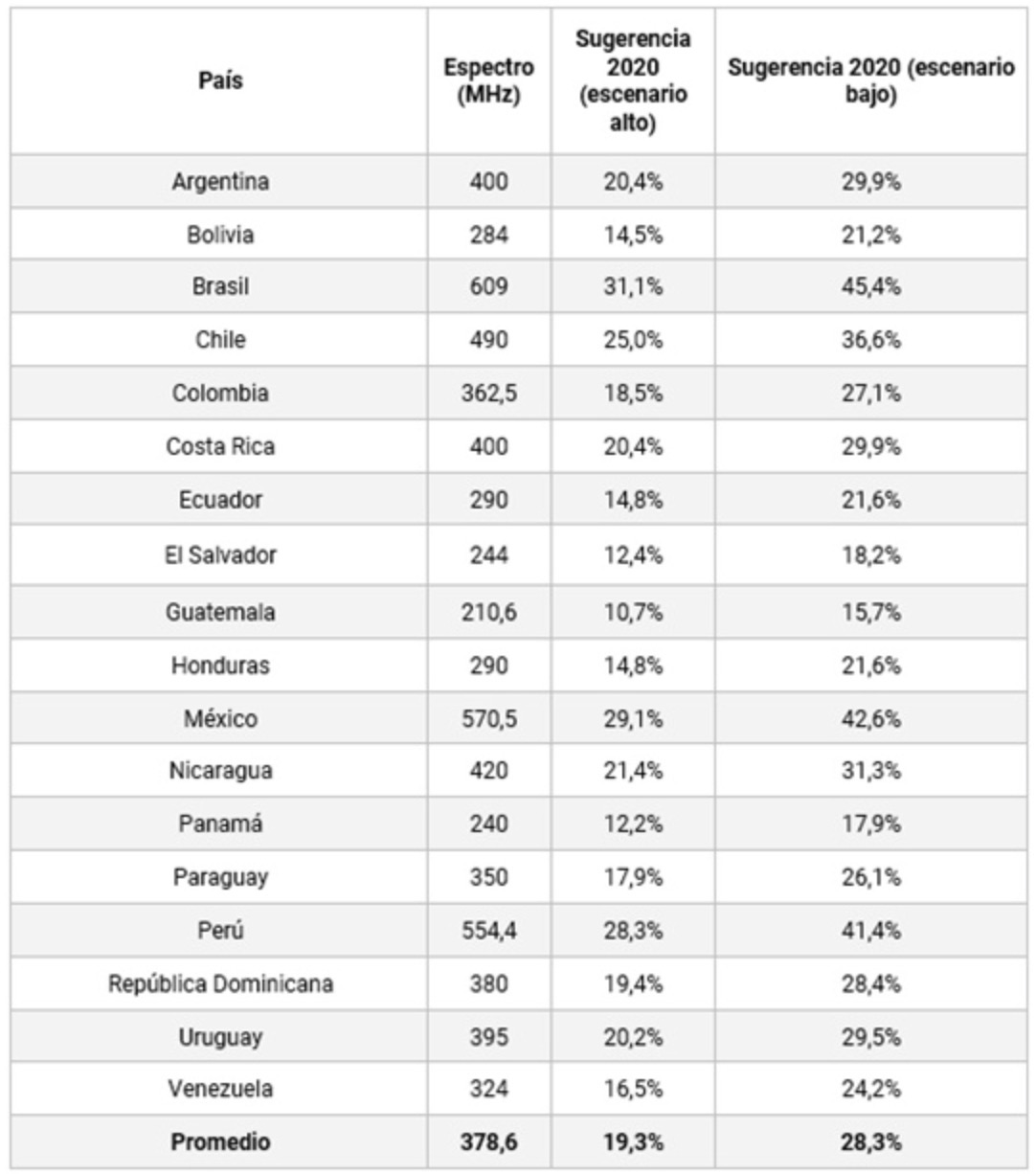
Un informe de 5G Americas remarca que solo 7 de 18 mercados asignaron 400 MHz o más, equivalente a estar por encima del 20% de lo sugerido por la UIT para 2020: Argentina, Brasil, Chile, Costa Rica, México, Nicaragua y Perú.

La cantidad de espectro para servicios móviles que asignaron los países latinoamericanos arrojó en 2019 un promedio regional de 378,6 MHz, de acuerdo con la última edición del estudio Análisis de las Recomendaciones de Espectro de la UIT en América Latina elaborado por 5G Americas. La cantidad es inferior al 20 por ciento de la capacidad sugerida por la Unión Internacional de Telecomunicaciones (UIT) para 2020, por lo que es importante que los gobiernos pongan a disposición de la industria más espectro radioeléctrico para los próximos años.
Con datos relevados al 15 de agosto de 2019, el reporte de 5G Americas encontró que el promedio regional de espectro para servicios móviles actual de 378,6 MHz representa apenas un 19,3 por ciento de la sugerencia de la UIT para 2020, que es de 1.960 MHz para su escenario alto. Es de remarcar que el reporte solo contempla espectro asignado para servicios móviles por debajo de 3 GHz.
Además, el promedio regional de espectro asignado para redes móviles de 2019 es apenas 4 por ciento más alto que el medido por el mismo ejercicio en 2018, por lo que es importante que los gobiernos planifiquen la entrega de más espectro para acompañar la digitalización de la sociedad, indica el estudio.
El reporte concluye que se proyecta una mayor adopción de los servicios móviles por usuarios masivos, pero también por gobiernos y empresas a través de la adopción de nuevas tecnologías, como el Internet de las Cosas (IoT) aplicado a ciudades inteligentes e Industria 4.0. Este aumento en la demanda agregará presión sobre las redes móviles, que requerirán más espectro para poder dar respuesta a dichas necesidades de conexión.
Asimismo, el estudio sugiere que estas nuevas asignaciones de espectro radioeléctrico que se produzcan por medio de subastas y licitaciones deben realizarse en el marco de planes de espectro de largo y mediano plazo, que además sean visibles por las entidades de la industria para permitir una planeación adecuada de las inversiones.
Estas hojas de ruta del espectro deben contemplar la asignación del recurso en tiempos adecuados y con condiciones que permitan la ampliación de la conectividad en los países. Los reguladores deben tener en cuenta el estado de la industria, la disponibilidad de entornos de tecnologías y considerar en la planeación de nuevas licitaciones las inversiones que requiere la industria no solo para adquirir las licencias del espectro, sino también para despliegue de infraestructura que permita el aprovechamiento del recurso.
De acuerdo con el reporte, hay 7.092 MHz de capacidad potencial de espectro que puede ser asignada en la región en licitaciones y subastas pautadas para 2019-2020 (fechas sujetas a cambio por cada administración). En estos concursos ya se contemplan bandas que pueden poner los “cimientos” de 5G en América Latina, como 600 MHz, 2,5 GHz, 3,5 GHz, 26 GHz y 28 GHz.
El reto de estos nuevos procesos es el de asignar capacidad para mantener el desarrollo de 4G y 5G, pero también de encontrar nuevos mecanismos que permitan reducir la brecha digital. Entre las propuestas del reporte se encuentran la de considerar disposiciones especiales para estas nuevas licencias, como condiciones diferenciadas para zonas rurales, entre las que se pueden analizar menores costos del espectro para estas zonas o intercambiar pagos de espectro por inversiones en conectividad.
Did you like this article?
Subscribe to our NEWSLETTER and you won't miss anything.
Related articles
 NHK contará cómo trabajó en 8K durante Tokio 2020 en 4K HDR Summit
 Los Juegos Olímpicos Tokio 2020, los menos vistos de la historia de la televisión en España
 La banda de 3,5 GHz será determinante para el desarrollo del 5G en América Latina
 Así se encuentra el espectro radioeléctrico para móviles en América Latina
 El Vaticano contará en 2020 con un servicio de streaming
 La televisión de pago volverá a crecer en América Latina en 2020
 Q12 Trivia emitirá desde México una versión de su quiz show diario vía móvil para los usuarios en América Latina
 El 46% de los hogares en América Latina contará con banda ancha fija en 2023
 La situación del 5G en Norteamérica y América Latina en el 5GForum
 Televisión Abierta solicita al Gobierno que se garantice la reserva del espectro sub 700 para TDT al menos hasta el año 2030
 Canal F1 Latin America, único canal que ofrecerá todo el Mundial de Fórmula 1 en HD para América Latina
 “Trabajamos para proteger y defender la TDT ante la asignación de espectro al servicio móvil”, Elena Puigrefaut
 España contará con 4,4 millones de suscriptores a IPTV en 2020
 El gobierno uruguayo reasigna parte del espectro de Cablevisión para banda ancha móvil