





Technological journalism or technology for journalism?…. in times of pandemic
David Corral (Innovation at RTVE) reviews in this Tribune the use that the Corporation makes of the latest technological applications while raising key issues for our future, such as sustainability, ethics... and the footprint of the SARS-CoV-2 coronavirus.
The confinement caused by the pandemic coronavirus SARS-CoV-2 and the disease it causes, Covid-19, has boosted conventional and digital media audiences, with consumption at historic levels. At essential functions of the media: inform, educate and entertain, the pandemic has added one more task: the fight against fake news.
The havoc that the outbreak of the coronavirus has caused globally is well known - thousands of victims, more than half of humanity confined, economic damage that is difficult to estimate - but its passage has also left positive traces, such as the heroic work of multiple professionals, the solidarity of societies, the environmental respite or the boost it has given to teleworking and the Fourth Industrial Revolution and its technologies, to which the press is no stranger in any of its formats.
The media are doubly immersed in an unprecedented transformation. We are looking for a new business model in the face of the exhaustion of the current one while we overcome the paradox that the coronavirus has caused us. The confinement has increased the consumption of information and entertainment on television, radio and the Web, with Netflix reigning in OTT services, YouTube in streaming and social networks or WhatsApp testing the resistance of the networks with the mobile phone as another of the beneficiaries of this crisis. But the more it is demanding, in quantity and quality of content, the worse the sector is with the closure of many newspapers, the loss of jobs and the advertising that supported them.
It has also forced, to maintain activity and comply with social distancing and confinement, an urgent technological adaptation to telework and communicate from outside the different facilities. The "digital transformation", which was previously a project for the future in most companies, is now a strategic necessity for survival. And after the transition from analog to digital, now is the leap to the cloud, in which we work remotely in our companies and hold video conferences or go live, without being surprised by the image, journalists, interviewees or guests from anywhere and with all types of headphones, backgrounds, noises and children and pets around. 5G will also arrive, which will connect millions of devices enabling the IoT (Internet of Things), the advanced analytics (Big Data), he Deep Learning, the 3D printing o to Artificial Intelligence (AI), among many other technologies and, with them, new and varied professional profiles.
And faced with the threat, risk or uncertainty of change and what will come after the scourge of the coronavirus passes, at some point, we have the empathy, the talent and the ability to overcome; technology used ethically and equally; the need to respond to challenges such as the environment; the fight against the control of geopolitical narratives, disinformation and cyber threats or the duty, as media, to continue informing, entertaining and educating our audiences, wherever they are.
Where are we
We have just started the decade of the 20s of this 21st century. Year 2020, that of the coronavirus, that of the parenthesis in our lives, a year whatever it is called will mean a before and after in the world as we knew it. What will come is unpredictable. Surely something similar but, in essence, very different from the world we knew and in which many "hows" will change: what normality will be like, how we will live, how we will relate, how we will protect the health of the planet, how we will learn, how we will work, how we will move, how we will consume, what society will be like, how we will be global, how capitalist...
The damage caused by this new coronavirus, SARS-CoV-2, is well known. Millions of people affected, half of humanity confined, fear and uncertainty, almost unquantifiable economic damage, unemployment growing at a tremendous pace, debt at unknown levels, bankrupt companies...
Geopolitics transformed with the United States that no longer acts as a lighthouse of the (“free”) world due to abandonment, passivity or blindness. China has become an economic superpower following its own rules of the game, with masterful control of technology and social networks and, although it will continue to be an advanced student in the art of reverse engineering and copying everything that has been given to it to manufacture, it is already a master in the art of creating. Last year, China became the world leader in international patents with a record 265,800 applications, overtaking the United States, which had held first place for more than four decades.
The European Union seems absent from itself and with debatable leadership at a key moment for its future. The UN is not in a better situation and multiple international and national institutions and organizations are also in question due to its cost and poor operability and response capacity...
But misfortune and difficult times are also when the most unpredictable side of the human being shines at its best. Throughout the world, in the face of adversity, there have been examples of dedication, professionalism and empathy of doctors and health personnel, scientists, cleaners, military and security forces, transporters, taxi drivers, salespeople, farmers, ranchers and fishermen, teachers, journalists, pilots and many other “essential” and “non-essential” employees and self-employed workers.
Since the beginning of the pandemic we have seen daily applause and messages as a sign of gratitude to those anonymous heroes behind their masks; multiple acts of solidarity, support and respect; of involvement and help to those most in need; of open and shared knowledge; of companies transforming to respond to medical needs such as respirators or masks; of workers, innovators or entrepreneurs adapting to continue generating resources; of teleworking without borders or of a great achiever, together with the human being and his humanity, the technology used for its best purposes.
After confinement and the ravages of the coronavirus, 7.8 billion people populate our planet Earth immersed in the Fourth Industrial Revolution and the Second Information Revolution, but we have barely left behind - if we have - the Third Industrial Revolution with the Internet turning 50 as one of its clear protagonists.
In 2020, and spurred by the emergence of COVID-19, Artificial Intelligence (AI), Cloud, 5G, IoT (Internet of Things), Blockchain, neural networks, Deep Learning, 3D printing, system virtualization, advanced analytics (Big Data), nanotechnology, quantum computing or task robotization (RPA), among others, are already transforming elements from sectors as diverse as health, agriculture, transport, mobility, energy, construction, banking, education, insurance, press...
And what borders will they allow us to cross? Defeat known diseases, such as cancer; to the unknown ones that we still do not know will arrive, as has happened to us with Covid-19; end hunger; get to Mars...
The horizon does not seem gloomy, quite the opposite. If some of the most favorable forecasts come true we will find ourselves with abundant and cheap renewable energy along with a greater focus on sustainability and the environment; gene therapies will minimize diseases; life expectancy could increase by more than 10 years; there will be more wealth and better distributed; Mobility will be redefined with autonomous vehicles and everything, literally “everything”, could be connected at a very low cost with one particularity, that “everything” will be “Smart”.
According to the report Cisco Annual Internet Report In 2023 there will be 29.3 billion interconnected devices globally, half M2M (Machine to Machine), and about three per person and almost ten per home. In Spain, with 350 million connected devices, we will find 20% of homes “connected” and with seven devices per person. Important detail, almost half of all of them will be able to capture images.
And today, how are we connected? Spain is the third country in Europe by number of fiber optic connections and, together with the 60,000 mobile network antennas spread throughout the national territory, 99% of the population has access to the Internet and telephone. Around the world, in 2020, just over 4.5 billion people have an Internet connection, 59% of the world's population, with China, India and the United States leading the way.
According to real-time intelligence data from the GSMA, a global organization that brings together some 800 mobile operators and 200 related companies, in mid-April of this year (and counting) there were more than 9.8 billion mobile lines and 5.2 billion customers. That is, most of the world's population has at least one device in their hands. Of all of them, 3.5 billion have a smartphone (a smartphone). Initially they were used for what they had been invented, “talking on the phone.” Today too, but they are also our assistants, our confidants, our coaches, our movie theaters or televisions, our bankers, our maps, our main entertainment in confinement... Whatever comes to mind.
There are nearly five million APPs (mobile applications) ready to download on Google Play (for Android devices) and in the Apple App Store (for IoS devices of the same brand). Of them, we are going to focus on some that are of particular interest to the media due to their impact, content or capacity for dissemination, the “social” ones.
The most popular ones are available in the main languages, if not directly in almost all of them. They allow users to connect, interact or find out what is happening with friends, other people, institutions or events without encountering geographical, political or economic limitations (except those directly imposed by some governments).
Los mobile devices, any of them and whether connected to a telephone line or WiFi, continually put 3.5 billion users in contact on social networks. The most popular, with almost 2.45 billion users, is Facebook, as well as the first to exceed 1 billion registered accounts. Other examples are YouTube (2 billion users), Whatsapp (1.6 billion), Instagram (1 billion), TikTok (500 million) or Twitter (330 million). Politicians, footballers, artists, the networks themselves or technology manufacturers are the most popular, gathering millions of followers on their profiles.
So, if the coronavirus has increased the consumption of news and content noticeably; if it is through multiple channels and devices; if the media have amply demonstrated their ability to inform, educate and entertain; Yes, almost all productive, industrial, service sectors, etc. they are or are going to transform; if governments encourage digitalization and modernization; if society is not and will not be immune to these changes (quite the opposite); If we are increasingly connected to all types of devices such as phones, bracelets, watches, vehicles, televisions, home assistants, vacuum cleaners... aren't the media affected as receivers, generators and transmitters of content? How or where our audience consumes or how they perceive the veracity of our news, the entertainment of our content or the usefulness of our work does not affect us either? He who is free from doubt...
Where are the media?
At this time, the media are doubly immersed in a unprecedented transformation. We were, are and will be rebuilding or looking for a new business model in the face of the exhaustion of the current one. And, looking for a way out of that crisis, the unexpected push came from China.
The coronavirus has caused the closure of many newspapers, the loss of jobs and the advertising that supported them. It has also forced, to maintain activity, a mandatory technological adaptation and the urgent reflection that the future we want to be is already, is today.
The “menu of the day” is over for everyone, prepared with general content. Today the demand (and the survival of many media) involves achieving the almost individualization of news and content: viewers, readers, listeners or consumers want personalized, continuous, immediate access to what they want, where they want it and how they want it, which is even an experience.
The speed and dynamics with which content is created and discarded today mean that innovative elements are required, whether from the narrative, the technique or the medium, that is, from what we tell, the way we do it and where or how we distribute it. Focusing on the user consists of not only finding what they want us to say, but how they want us to do it and also how they prefer to feel heard.
Audiences are so fragmented and the market so saturated with platforms, devices or media, that it is not easy to discern where we are going without forgetting what and who we are as media.
The written press abandons paper, increases its audiovisual content and competes on the Internet looking for survival models based on paywalls or freemium accounts, a digital transformation to which native media are not immune at all. Radios become digital, broadcasts on Medium Wave or AM are fondly remembered, while current programs are broadcast on television or Social Networks. DAB (Digital Audio Broadcasting) seems to be the choice of the future and podcasts are the reference. Twitter, FaceBook, YouTube, Twitch or TikTok have billions of followers who generate content, shared for free, that is transformed into billions of advertising revenue, figures that disappear from conventional platforms.
According to WARC, in 2020 it was estimated that advertising in the digital environment could grow by 7.1% to $660 billion, more than half of global advertising investment, figures that were known before the pandemic. To give some examples, it was estimated that 107,900 would reach Google, 82,900 would reach Facebook, YouTube would obtain 18,500 and Twitter 3,300.
In Spain Television is no longer the hegemonic medium and passes the baton to the digital world, which achieved 38.6% of advertising investment ahead of television's 33.7%, according to data from the consulting firm InfoAdex. Atresmedia and Mediaset, the Spanish communication companies that make the most profits, have lost more than 50% of their stock market value since Netflix arrived in Spain in 2015.
Television, as we knew it (as a business and as a device), is inevitably changing. The future of many audiovisual companies and technologies is, to say the least, uncertain. New technologies and consumer behavior are forcing the sector to adapt to a new complex and constantly evolving market. In it, it is essential to innovate and define a strategy that allows us to compete and face, even survive, many great challenges.
These range from retuning by Second Digital Dividend, which could leave out many viewers by losing (literally) the DTT channels; the consolidation of the growing list of AVOD, SVOD, TVOD and OTT (OverTheTop) platforms, such as Netflix, HBO, Movistar+, Apple TV, Amazon Prime Video, Disney+, Sky, Starzplay, FlixOlé, Rakuten TV, Hulu, Filmin... which will move 86.8 billion dollars in 2026, to streaming broadcasts on YouTube, Facebook or similar, which add new viewers every day who are abandoning the old television.
According to a recent Statista study, carried out among people who like streaming services, 62% of them stated that traditional TV is irrelevant and 84% of them have already replaced it. This trend will continue to increase and by 2023 streaming users will have grown by approximately 20% more.
In addition, traditional, linear television is losing its oldest viewers and, en masse, young people and adolescents, who dedicate most of their time to options such as Netflix or YouTube. In 2020, the use of video on mobile phones was expected to increase by 50% and on Social Networks by 39%, figures that the coronavirus has skyrocketed due to confinement and limitation of movement, in many cases more than 200%, according to data from Justwatch.
Mobile devices are transforming global media consumption in recent years, playing a very relevant role in telling current events, positioning, in “one to one” communication, and above all being a personal and customizable television that is always with you.
The BBC, a world reference for independence, rigor and quality, was the pioneer of television in 1927. Also, and for the worst, in the summer of 2017, when the unthinkable happened for the first time: one of its television programs had no viewers. Since then it has not been the only time or the only television medium that has broadcast for anyone at any time.
Are there reasons to think that television will not be centenary? It might seem so, but this time of transformation is also a time of opportunity. In this new ecosystem, competition with platforms can become coexistence and, even better, collaboration.
The new screens will grow until they are no longer physical objects and the image quality of 4K a 8K, for now. The technological changes to adapt to new consumption should not surprise us, haven't the media been disruptive throughout its history? Aren't we the first to give the news and references in the face of the deception of "fake news"? Don't we have great professionals, enormous experience, a legacy preserved in our archives, all the channels we can imagine to communicate, means to listen and learn or to know what the tastes and interests of each user are?
Are we not used to working with institutions, companies, universities or entrepreneurs on the needs of today and what could be tomorrow? Shouldn't we take advantage of the opportunities that will be given to us by the fact that everything will be connected and equipped, for the most part, with devices that allow images or audio to be captured (with consent and respect for privacy and the General Data Protection Regulation)? Are we not aware of the potential we have for ubiquity, for immediacy...? That never in the history of humanity has there been so much audiovisual content available through so many platforms?
Aren't there already smart and interactive televisions (present in more than 25% of Spanish homes), voice assistants or much more conventional channels so that we can interact and communicate with our viewers, with the society to which we owe in the case of RTVE as a public service? After all, don't we as human beings live in an eternal process of transformation? Let us then take advantage of technologies and innovation to be where we should be and not lose focus on “knowing who we are.”
Artificial intelligence. The insightful nexus
Around seventy years old, Artificial Intelligence (a term coined by the American scientist John McCarthy in 1956, two years after the death of Alan Turing, British mathematician, cryptographer and pioneer of computing and AI), is demonstrating that it is fully capable of being the link and the brain of the technologies and innovations that are shaping the world. Fourth Industrial Revolution.
After spending a long winter of lethargy and oblivion, it is, now, a strategic sector for the industry and economy, with an estimated global economic impact of 390.9 billion dollars in 2025 according to Artificial IntelligenceMarketSize, Share & Trends Analysis Report By Solution, By Technology (Deep Learning, Machine Learning), By End Use (Advertising & Media, Law, Healthcare), And Segment Forecasts, 2019 – 2025, and according to Gartner, by 2021, 70% of companies will incorporate some Artificial Intelligence system to support the productivity of their workers. In Spain, the adoption of AI could lead to an increase in our GDP by 0.8 points in the coming years, according to data from PwC.
With the aim of achieving this growth, aligning the policies and actions of the different government actors, institutions, industry, universities, entrepreneurs and other actors in the public and private sectors, last 2019 the then Ministry of Science, Innovation and Universities presented the National Strategy on Artificial Intelligence, a text that will be updated in 2020 and which, as reported by the new Secretary of State for Digitalization and Artificial Intelligence, Carme Artigas, will be a “work tool” that aims to place the country in a “leading” position in this area within the European Union.
The Spanish strategy, which will be added to those already published by autonomous communities such as Catalonia and Valencia, has four fundamental axes: the digitalization of Spain; the digitalization of public administrations; the development of AI as a driver of innovation, entrepreneurship and business transformation and the creation of “safe and reliable” environments for sharing data in which civil digital rights are guaranteed so that technological development “is compatible with social advancement.”
The national strategy will incorporate the recommendations of the European Digital Strategy and the EU Artificial Intelligence White Paper published last February. Over the next five years, in order not to be left out of the race led by the United States and China with a great advantage, the Commission will invest tens of billions of “public and private” euros in “High Impact Projects” through programs such as “Horizon Europe”, Digital Europe or Connect Europe II.
The community objective is to be competitive and leading while recovering what many know as “digital sovereignty” (control of our data), and that, beyond technological issues, we define what we want “European” AI to be like. The EU defends that it must be human-centered and supervised by him; respect fundamental rights; It has to be ethical and deontological; combat illegal content/fakes; robust to resist cyber attacks; technologically transparent; ensure the traceability of your actions and decisions; protect data privacy and governance; respect diversity and guarantee social, democratic, economic and environmental well-being.
Additionally, of course, AI has been and is a key tool in the fight against coronavirus. An algorithm developed by the Canadian company BlueDot to analyze news, reports and databases in different languages, made it possible to raise the alarm that cases of an unknown pneumonia were occurring in Wuhan, China. This StartUp, created by doctor Kamran Khan and with a good number of epidemiologists among its employees, was also able to predict how this new epidemic would begin to expand and jump borders throughout Asia, it was the beginning of Covid-19.
Since then, Artificial Intelligence has been supporting the detection, alert, diagnosis, fight, control or study of coronavirus by the scientific community, industry or different governments. Throughout the world, dozens of people, entrepreneurs, companies, universities, institutions, etc., have had vital support for the detection of cases, the management of enormous databases, the projection of scenarios, the creation of possible vaccines, preventive alert, knowledge of the situation and state of people, resources or infrastructure.
Initiatives like the C3.ai Digital Transformation Institute They will finance with hundreds of millions of dollars the work of the best scientists, researchers and programmers from institutions such as Princeton, Carnegie Mellon, the Massachusetts Institute of Technology (MIT), C3.ai or Microsoft, among others, to use AI to mitigate the pandemic and in the detection of future epidemics.
Artificial Intelligence in the media
The use of different tools based on AI to generate and assist journalists within the media has been common for years, although it was the last decade when the most promising experiences began.
In 2010, the first work began in different US media and in 2013, the American news agency Associated Press began to use the tool. Automated Insights to create stories from data. First it was sports news and then they addressed economic reports. Two years later, in 2015, they were already automatically generating more than 3,000 quarterly stories on financial results from major American companies, which meant increasing productivity tenfold.
The American newspaper The Washington Post, at the forefront of technology, has used since 2016 Heliograph to write news about politics and sports. In its first year it produced some 850 articles and won an award for “its excellence in the use of bots”, particularly for its coverage of the 2016 US presidential elections. Bloomberg has “Cyborg” to convert financial reports into news, Forbes has “Bertie” to help journalists by collecting data and generating drafts and the New York Times, to name a few, has “Editor” for automatic text review.
And if we talk about specific coverage, such as electoral events, the French newspaper Le Monde stands out in Europe, which produced 150,000 web pages in four hours during the last French legislative elections using “Syllabs” or those of the British BBC and the Finnish YLE, both public and partners of the EBU like RTVE. Both have departments specifically dedicated to AI research, in the case of the BBC with Datalab and News Labs and in the case of YLE with its News Lab, in which its Voitto robot stands out, with which they have covered multiple topics.
In the last general election in the United Kingdom, the BBC, for the first time, used “Arria NLG” AI to publish localized news about the results of each of the 690 electoral districts in the United Kingdom moments after the official results were known.
In our country, the EFE agency is developing a project with Narrativa, a Spanish company that works with dozens of global media outlets and that generates more than 250,000 news items weekly with Gabriele, a tool based on AI and deep learning. The content they work with is economics, weather, lottery or sports, topics of frequent coverage in other media, such as the sports newspaper SPORT, which uses AI to report on lower soccer leagues.
The characteristics and possibilities of using these new technologies in the journalistic field are multiple and go beyond the automatic generation of texts, a field in which it is estimated that by 2025 around 70% of written news could already be generated by Artificial Intelligence. Current capabilities allow content to be adapted and modified almost infinitely to personalize according to our style and the preferences of the recipient.
Such is the progress that China has copyrighted an economic article written by the AI tool “Dreamwriter” of the technology giant Tencent. Internationally, the debate is intense about whether or not texts generated by AI should be protected by copyright, with precedents such as a document from the International Intellectual Property Organization in 2017 that indicates that only human creations should be protected by law.
Other use cases may include subtitling; transcription; translation into different languages; automatic text assistance and review; recommend audiovisual content to complete a news story; recommendation, segmentation and personalization of content; fake news detection; news alerts; quickly analyze large databases; application in assistants or virtual robots; improve the use and access to files or even cases such as that of the Chinese news agency Xinhua, which since November 2018 already has the first television presenter generated by Artificial Intelligence on staff.
In content recommendation we are used to the personalization of algorithms such as those of Netflix or Spotify, but there are other very interesting cases. In the field of rights, the lawyer, musician and programmer Damien Riehl, with AI, together with Noah Rubin, has created 68 million melodies that they have registered and made available to the public (allthemusic.info) to avoid copyright lawsuits.
And in the cinema, in its mecca, Hollywood is receiving its new “managers.” Cinelytic has signed an agreement with Warner so that its AI helps in making decisions about the scripts or the actors who will participate in a film. In Europe, an AI developed in Switzerland called LargoAI and with sufficient skills to predict or modify a film to make it a success, estimate its income, decide the best actors and soundtracks or cancel scenes, among other skills of this Oscar award, was recently presented at the latest edition of the Berlinale.
Artificial Intelligence at RTVE
RTVE, as a reference for public service and innovation, is investigating and delving into the possibilities that AI offers us. It is not an investment in infrastructure or equipment, it is an investment in training and knowledge and in being prepared for the future that is already present.
With the UC3M and specialized companies work on automatic subtitling of news from our territorial centers, both in Spanish and other official languages. Another example is Dataminr, an alert system present in our newsrooms since 2017 that uses Artificial Intelligence to detect “issues of news interest” on social networks, that is, events that will end up being news, such as attacks, accidents, statements by public figures, etc.
Con EFE has been signed pilot project of tests for news generation based on structured data sources (tables, databases, statistics, binary files, numerical data, etc.), such as sports records, stock market or financial results, lotteries or meteorology. The experience, in the case of RTVE, will be with topics that we currently do not deal with with editors, in this case the 2nd B football League. The generated content, adapted to our style book, is supervised by a journalist before its dissemination, although, once trained, the algorithm can publish it directly and in real time with text and infographics if deemed appropriate.
In a step further, the chair signed with the UC3M will focus in the next two years on the enrichment of these automatic texts using social network content from known sources, such as accounts of football clubs or players, to further personalize this news.
We consider that AI can be a useful tool in our public service mandate by allowing us to cover information that, today, is impossible for us to cover directly, such as the lower football leagues (which are of great importance as they are local information) or sports that are not mainstream and that have their audience and followers and, therefore, the same right to be covered and reported on as the First Division of Football.
In covering the coronavirus, in addition to tools already available such as Dataminr, RTVE has participated together with EFE and Narrativa in two AI projects, both non-profit, that aim to help fight this pandemic:
1)- Covid-19 Tracking Project, which has made available to institutions, media, NGOs and other entities a data repository, automatic narratives generated with AI (an article written automatically every hour) and graphs of the evolution of the coronavirus in Spain and the world. The information, in Spanish and English, is based on data from multiple official sources, such as the Ministry of Health, the Dipartimento della Protezione Civile of Italy, the Robert Koch Institute of Germany or John Hopkins University, among many others. Every day about 100,000 “calls” access the API to view or collect data, graphs, etc., which represents a download of more than 4.5 Gigs of data per day. It has more than 3,600 unique users and by country the majority of accesses are from Spain, Russia, France, USA, Germany, Portugal, Poland, Estonia, Holland, Colombia, Italy, Ireland, Mexico, Luxembourg, Brazil, Canada, Argentina, Switzerland and Panama.
2)- Data For Hope, which had the support of the Secretary of State for Digitalization and Artificial Intelligence, was an event and is a challenge that brought together 120 experts from April 15 to 17, including doctors, entrepreneurs, data scientists, researchers and representatives of organizations and institutions, in order to respond and generate solutions based on data and technology in the face of the crisis caused by Covid-19. The three challenges that have been worked on have been "Prediction models and evolution of the pandemic", "Models for prevention in Africa and South America. Modeling of the pandemic to anticipate the impact in the southern hemisphere" and "Models based on Mobility data. Definition of mobility policies. Models for progressive lifting of limitations."
Artificial Intelligence, like any other technology, is neutral. It is neither good nor bad. It is the use we make of it that will define its nature and impact. Its analysis capacity is undeniable (especially remembering that in 2019 Google achieved quantum supremacy by performing in three minutes and twenty seconds, a calculation that the largest supercomputers would do in about 10,000 years), its cost efficiency and the development and customization of increasingly complex and precise algorithms.
In the journalistic field, they allow, on the one hand, to reach where we cannot reach (more local or minority news or sports), offer more, more specific content, reach more audiences in more places and devices, better SEO positioning or free editors from tedious and repetitive tasks so that they can dedicate themselves to research, analysis, relevant, higher quality and more personal information that AI is not capable of processing and which are what allow us to differentiate ourselves from the rest of the media due to their originality and depth.
On the other hand, and as happens with books without text, it can also be nothing because it does not have enough data or it can be misused due to the unethical or illicit use of data, because it is biased, because it threatens many individual freedoms, because it generates fake news... It is in this "dark reverse" where AI especially needs human involvement to educate, so that with all the development potential it has, we turn into positive things that it is not yet capable of doing.
Cloud, the new world
Could anyone have thought years ago that a company dedicated to selling books online, another that fascinated the world by creating an operating system or a web search engine would end up being examples of transformation, adaptation and vision... without losing its essence?
According to a study by Gartner and Goldman Sachs, 76% of the global Cloud market, a business that represents some 150,000 million dollars in revenue, It is in the hands of Amazon with AWS, Microsoft with Azure and Google with its Google Cloud. In fourth place, very far away, is the Chinese Alibaba.
Furthermore, could anyone have thought, starting in 2020, that a few weeks later millions of people around the planet would be working outside their companies, triggering the consumption of teleworking technologies and the use of videoconferencing tools? For reference, before the pandemic and the emergency measures taken in different countries, only 4% of American workers, still the world's leading economic power, worked remotely. During confinement, according to a Randstad survey, 42.8% of Spanish companies have implemented teleworking measures. The coronavirus has moved the world to the “cloud.”
The first storage systems, based on hard drives, are as modern as Artificial Intelligence. We talk about them as a paradigm of modernity and they are closer to being octogenarian technologies than adolescents. We have gone from those models with just 5 MB (megabytes) of capacity and a ton of weight to the tens of thousands of servers that fill buildings to provide storage that we could consider unlimited and that is constantly growing.
During this time, capacity and traffic evolved from megabytes (MB) and gigabytes (GB), to the terabytes (TB) and petabytes (PB) common today and we have already begun to calculate in exabytes (EB), zetabytes (ZB) and yotabytes (YB). To give us an idea, in 2018 global data on the Internet reached 33zetabytes, currently it has exceeded 50 and according to International Data Corporation (IDC) estimates it could reach 175 in 2025, that is, 175,000 million terabytes.
Own, foreign, mixed, hybrid, shared... whatever it is and whatever it is called, the “cloud” is the possibility of relocating by being able to access the files, services, processes, software or applications that we want from any point, as long as you have an Internet connection. The most common thing is that for free (such as Google Cloud, iCloud, Dropbox, OpenDrive, telephone operators, etc.), for a fixed price or by “setting up” servers on demand, we can forget about investing in equipment, infrastructure, licenses or a large number of our own servers that are dedicated to data processing, storage, etc. All this enormous amount of information, all this virtualization of jobs or equipment, is hosted on servers that are constantly active, 24 hours a day, seven days a week, located within the Internet, literally forming a cloud.
In Spain, 22% of companies currently work with some cloud service, such as email, data processing or the usual “file/storage room”, among others. These are figures that are far from those of Nordic countries, such as Finland, with around 65% of its companies, and Sweden, Norway or Denmark, which exceed 50%.
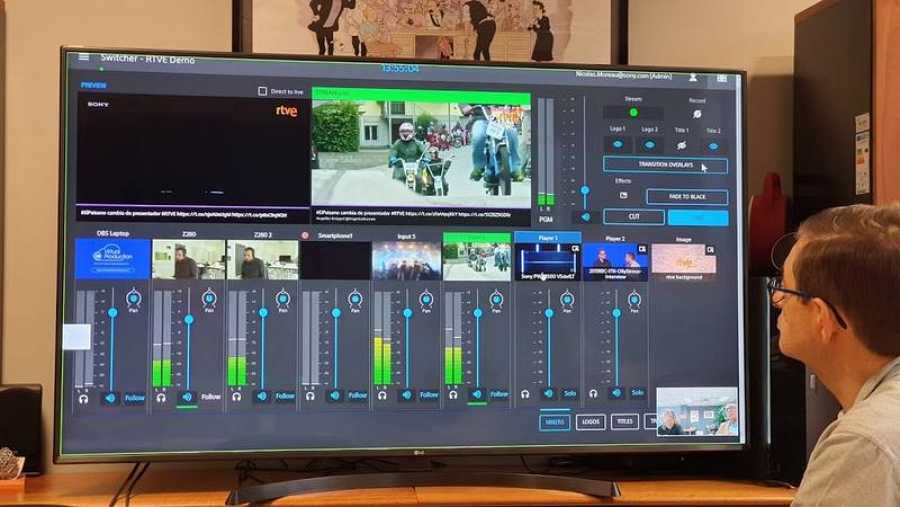
For the media it is a fundamental tool for filing, exchanging documents or to virtualize tasks such as the creation of programs or news, among many other possibilities. At RTVE, for our broadcasts, we have experimented with different systems and we have achieved a pioneering experience using the cloud to test another revolutionary technology, the “edgecomputing", or edge computing. It is the immediate processing of information from connected devices very close to the place where it is generated, instead of moving it through the cloud between users and recipients, generating delays or data loss.
This innovation will allow IoT and 5G applications such as the autonomous car, virtual/augmented/immersive reality or, in the case of RTVE, having made it a reality, together with Telefónica and the UPM, the world's first remote realization without mobile unit in edge computing. It was in December 2019, from the Cineteca de Matadero Madrid, and the radio drama was broadcast Radio is a Dream from Radio 3.
The experience acquired in recent years by RTVE in these “virtualized” production systems, with different tools and in different units, allowed it to continue broadcasting, among others, historical programs such as “Studio Estadio” and some other formats, both for television and other platforms, during confinement and working remotely.
Nowadays, no one is surprised when they see on their screen, in any television or digital format, someone speaking from their home, with headphones, vertical and horizontal videos... Reality has surpassed any fiction. Probably no contingency plan from any media in the world contemplated that in a crisis situation of this magnitude, in which the logical thing is to concentrate efforts, personnel and equipment in the headquarters, the opposite would happen and the work machinery would continue to operate in a “domestic” manner.
From the British BBC, the powerful American networks, the rest of the large European or global networks to the smallest local media, we have all had to solve broadcasts with a lot of ingenuity and available resources. Images that seem taken from YouTube or WhatsApp, direct from famous journalists from storage rooms or garages converted into improvised studios or the viral video of the child entering the room during an interview on the BBC are, currently, the daily routine.
Another application, widely used by companies and media to continue their activity, has been to use services such as Skype, Zoom or similar, which have allowed both meetings and teletraining, as well as live connections with journalists, specialists or politicians. Also that some sports events were adapted to the domestic environment and were held virtually, such as the Tour of Flanders won from his home by Van Avermaet, a preview of what eSports can mean soon.
5G, a solid connection
The fifth generation of mobile phone technologies, 5G, is not only the continuation of previous and new advances (1G were the first mobile phones; SMS arrived with 2G; smartphones and Web connectivity are the great leap of 3G and broadband, with which we connect to watch series or telework, something of 4G), it is the connection that will solidly unite billions of devices, making Industry 4.0 possible.
With it comes the increase in connection speed up to 10-20 GBps (gigabytes per second), or the latency (delay) is barely zero and we can talk about real-time connectivity. But the big leap is that connected devices will multiply to the unimaginable in an “Internet of Things” in which we will live together sharing information with everyday objects such as our phones, refrigerators, televisions, vacuum cleaners, cars or industrial robots, to give a few examples from an endless list.
Nowadays, applications of this technological revolution do not sound strange to us nor do they seem distant. Have we not heard about remote surgical interventions? Of the autonomous cars that circulate in tests on some roads? Of drones that could deliver packages or food? Of work in the field to control crops? Smart cities?
In the midst of the trade war between the United States and China, fought through their technology companies and commercial obstacles, the implementation of 5G was advancing unstoppably until the arrival of the coronavirus, which will slow it down but will not stop it. According to the report Cisco Annual Internet Report, 5G connections will account for 10.6% in 2023 of total mobile connections globally, compared to 0% in 2018.
In Spain, 5G connections will account for 15.5% of total connections (0% in 2018), 4G connections, 48.3% (51.7% in 2018), and 3G/2G connections, 7.4% (38.6% in 2018). In our country, at the moment and commercially, it is only available in some cities with the Vodafone network. Other operators had planned to announce launches at MWC 2020, but after its cancellation they have been waiting for better dates.
Hocelot, a Spanish deeptech company, has carried out an x-ray of the new mobile connectivity paradigm in Spain, one of the countries in the European Union with the highest rate of mobile phones per citizen with a penetration of 117% in the population. According to the study, the categories with the most daily consumption in all age groups are Social Networks and Internet Services, followed by Sales and News.
5G in the media
5G opens a new phase of opportunities for the media. Technically, it will guarantee the almost unlimited mobility of journalists or teams that cover news or any type of event, it will allow the relocation of these teams, it will ensure that they always have a solvent and continuous connection thanks to the Network Slicing (segment the network), and will keep them permanently connected to the Cloud and what is in it (files, software, etc.). All this with a high quality of service and a higher quality of experience for users, such as virtual/augmented/mixed reality applications, immersive or ultra high definition (UHD) video.
A latency never before achieved (the delay time in the travel of data from one point to another on the network, estimated between 1 and 10 milliseconds), together with an immense capacity and speed of data transmission (bandwidth), will revolutionize the consumption of high-quality audiovisual content on mobile devices and will be the beginning of a new era of connectivity and integration of smart devices.
Currently, more than 120 million Chinese are users of 5G networks, a figure that will skyrocket from 2020 around the world when low and mid-range mobile phones with 5G chips and affordable prices begin to hit the market. In Europe it is present in most countries, with the possibility of contracting services from the main operators. In Spain, since 2019, there is coverage in the main cities and our country, through European programs and the actions of entities such as RED.es, has become one of the largest 5G innovation ecosystems that exists.
By the way, for those who have doubts about its impact on health, it is not a transmitter of the coronavirus (it is a hoax), and the WHO has classified 5G as a level 2B carcinogen (at the same level as coffee) and in our country the Scientific Advisory Committee on Radiofrequencies and Health (Ccars) has confirmed that it is harmless. So it seems, for the moment and with the medical studies and economic perspectives in hand, that 5G will bring more benefits than risks.

5G on RTVE
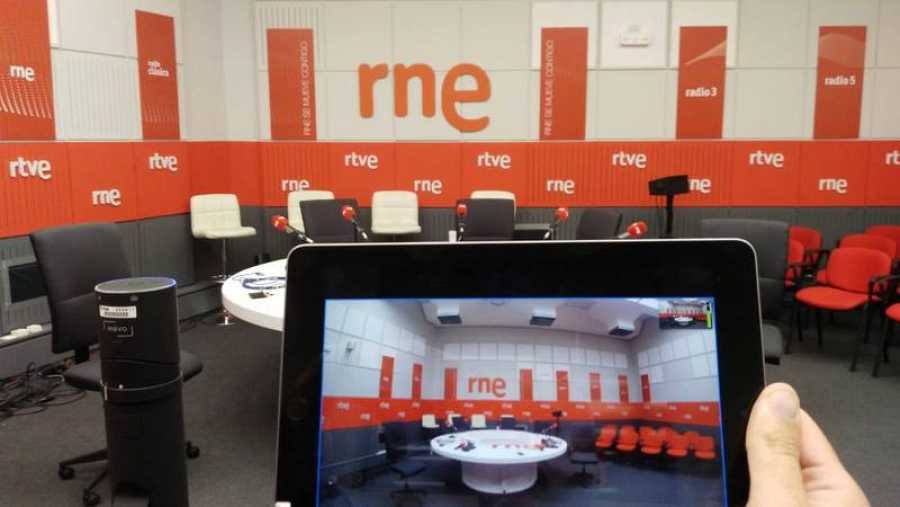
5G will define the media business for years to come. At RTVE we have gone from theory to reality and we have seen what can be done and how we can use it to improve our activity. As a public corporation we are proud to have achieved these pioneering steps and to have taken them together with large telecommunications companies such as Vodafone or Telefónica and public entities such as the Polytechnic Universities of Madrid and Valencia.
Los first to make a live television show worldwide, with a technology based on the first version of the 5G standard known as NSA (non-stand alone, requires a 4G network for control and signaling information), were the South Koreans from SK at the beginning of 2019. In Europe, the pioneer with 5G NSA was the BBC on May 30, 2019, taking advantage of the launch of EE, a 5G telephone operator. Hours later, it made a second broadcast from the same point, but in this case the signal failed and it could not be broadcast because it had consumed all the phone's data. Just two weeks later RTVE became the first television in the world to do a live broadcast with 5G technology “native/pure” (in English, stand-alone SA). It was within the framework of the Global 5G Event, a conference focused on this connectivity that brought together 800 world experts in Valencia for five days.
The next step was to demonstrate some of the virtues that the arrival of 5G can have for us. We go out into the streets in search of the live, the opportunity, the immediacy, the autonomy and independence that gives us access at any time and place to our broadcasts or platforms with a variety of devices, possibilities and tools. It is guaranteed connectivity on the back of mobility.
In July of last year, from the center of Madrid, staff from the Territorial Centers, Innovation and Information Services of RTVE were testing the public 5G network of RTVE at different points. Vodafone to go live on television in news or programs, either by sending raw signals or with input from journalists, or how it could benefit content broadcasts in digital environments and Social Networks.
Two subsequent success stories were the live broadcast in 5G, multi-camera and with cloud realization of the day Advantages and risk of 5G in the audiovisual sector, a meeting organized by the European Parliament and the Television Academy, or the 5G coverage with different devices of the last edition of FITUR, the most important tourism fair in the world.
This operation, based on 4G and 5G, was one of the first carried out in our country and it successfully tested the possible use, if necessary, of mobile phones and specific mobile applications linked to the decoders installed in the Territorial Centers, to obtain live or duplex signals from journalists. This test is another example of RTVE's commitment to innovation and collaboration with the main institutions and technology companies, such as in this case IFEMA, Vodafone and Aviwest, which have provided means and assistance to make a test possible that became a reality.
The experience of these tests obtained in both 4G and 5G in IFEMA and in our facilities in Madrid and Territorial Centers, together with the work of our colleagues from Sant Cugat, who covered the latest editions of the Morocco Rally for Teledeporte with a similar system from the TVU company, have allowed RTVE to add this technology to other media already available to continue reporting in a situation as complicated as the confinement of our staff.
In addition to the media already active in some territorial centers, the technical support provided by TVU has been taken advantage of so that programs such as España Directo could have the participation of their editors going live from their homes using a mobile application. Also so that chef Sergio Fernández, from his own kitchen, can continue clarifying doubts for our viewers, teaching tricks, or giving advice to improve everyday recipes or for cooking in quarantine.
Mobile devices, the gateway
If we add 5G, cloud, connectivity, relocation, an immense number of smart phones, more and more devices with connected cameras and microphones, can't we be where we want and when we want telling what is happening? It is not a question of replacing professionals, but it is evident that, with the available media, we cannot reach all corners of the world to cover what is happening and provide content to more and more platforms and formats of television, radio, web and social networks.
Being able to count on witnesses, observers or public cameras (such as traffic cameras) is an invaluable resource that allows us to be at the scene until our professionals and media arrive, without forgetting that there will always be someone willing to do what others do not want to do.
These same mobile phones belong to users who are abandoning traditional media and channels to consume content on them. The cheaper, more powerful and better screens they have, it is not surprising that their data traffic has increased by 30.6% since 2017, according to a recent study by SimilarWeb, and there is a clear winner: video, live or recorded.
Conventional media are being displaced by platforms born and oriented to be consumed on mobile devices, such as YouTube (with more than 6 billion monthly visits), TikTok (3.7 billion), Facebook (2.5 billion) or Instagram (1 billion), to name a few examples. The decrease in media traffic seems to be related to the democratization of media consumption, since the public turns to general news portals, social media or different video platforms for information or entertainment.
In this last case, the emergence of OTTs stands out. According to Fortune Business Insights, the global market will continue to grow to reach a volume of $86.8 billion in 2026 (a far cry from $30,230 in 2018). The study highlights that growth is led, significantly, by a growing number of smartphone users around the world (at the end of 2018, OTT video consumption on mobile phones was 47.5% of the total, a percentage that increased significantly with confinement).
Advanced and pioneer in this field we have the American Steven Soderbergh, one of the most recognized film directors, author of films such as Sex, Lies, and Videotape, Erin Brockovich, Ocean's Eleven or Traffic, for which he won the Oscar for best director in 2000. His last two films have been shot with a smartphone, in 2018 Unsane with an iPhone 7 Plus and in 2019 High Flying Bird, in collaboration with Apple and distributed by Netflix.
Mobile devices on RTVE
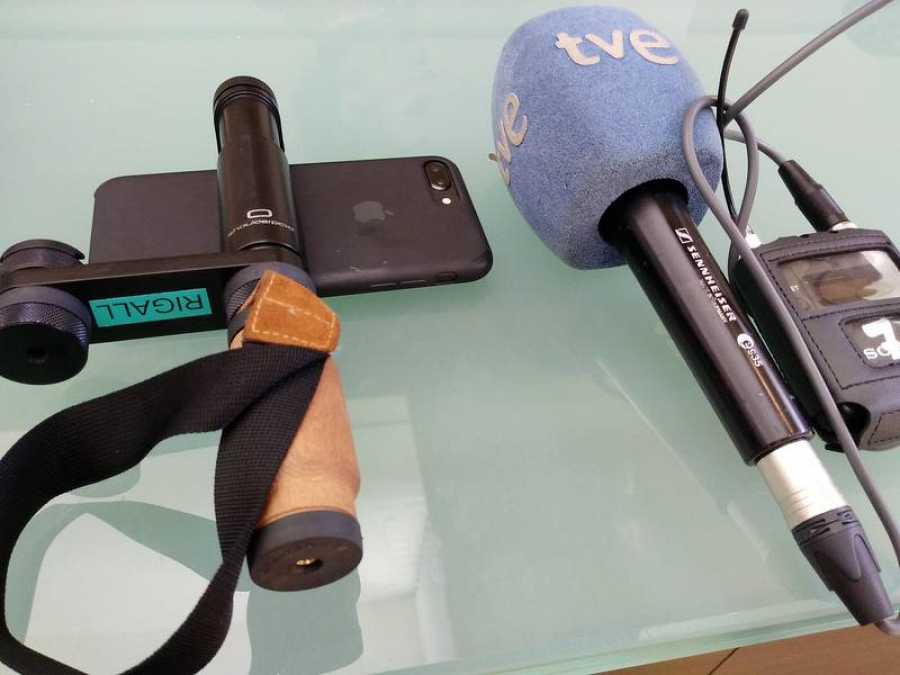
In the middle of the last decade, RTVE editors, cameras and filmmakers from the territorial centers of Extremadura and Sant Cugat (the RTVE Production Center in Catalonia), began to experiment with the possibilities that the use of mobile devices due to their immediacy, versatility, ability to provide audiovisual or text content to television, radio, web and social networks.
To give shape to these experiences, in 2016 RTVE and the Autonomous University of Barcelona created the chair for news innovation in the digital society, which has its origins in the Observatory for News Innovation in the Digital Society, Oi2, created by RTVE, the UAB and the CEU San Pablo University in September 2015 to observe informative narratives and reflect on the supports, formats and evolution of technologies. That same 2016, the “Training of trainers: Media Literacy and Humans Rights, Mobile Journalism” Conference on Mobile Journalism (MoJo, Mobile Journalism) and Human Rights was organized in Barcelona.
In this new decade, the experiences of teams, flows, etc. They remain within the scope of Innovation and the territorial centers of Castilla la Mancha, Extremadura and Valencia are used as references for the different tests. There are currently about 110 devices considered MoJo (IPhone phones, Android phones, iPads and Mevo cameras) assigned to different territorial centers, News, Programs, Digital, RNE, Innovation, Communication or News Chambers of Torrespaña (Madrid).
They are mostly intended to provide more audiovisual content on Networks and the Web and to support conventional audiovisual coverage, which they are not intended to replace. Examples include the cases of Castilla la Mancha, which in the last quarter of 2019 alone produced more than 800 content for Redes or Radio3, with its “Extra Zone” or “Es Otro Millennial Program”, among other formats.
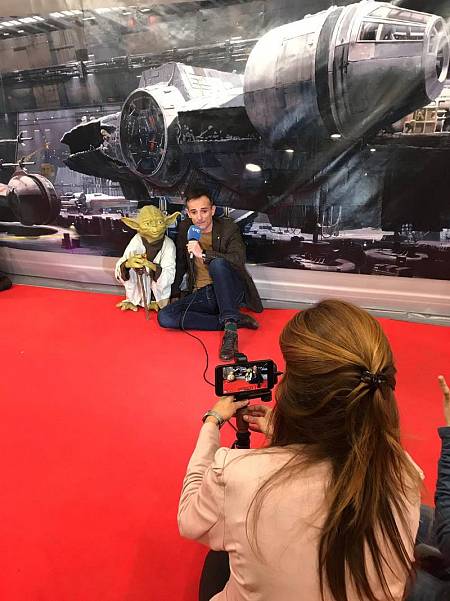 Its usefulness, and the experience acquired, have also served to provide images and testimonies of the pandemic in different RTVE spaces. To share knowledge, a group of editors, cameramen, filmmakers and technicians who work and provide training in these media have prepared a basic manual for coverage with mobile devices in times of pandemic, a text collected in a publication of the RTVE Institute. Basic and voluntary online courses are also being carried out for workers who are at home. The usual training is open to all professionals of the Corporation, whether they are editors, cameramen, producers, directors, etc. Open courses are also offered for institutions and the general public.
These years of testing and real use have shown us that mobile technologies do not subtract or eliminate jobs. They are complementary, multiplier, transversal, integrative and informative.
They allow them to complement the available equipment, which they will not replace. They allow giving more content to actions on Networks, Web and improving and “selling” the content that is broadcast on traditional Radio and TV channels. They allow images and audio to be available if there are no cameras, providing an informative opportunity until conventional media arrive (attacks, accidents, natural disasters, etc.). They allow you to send material to Networks, Web, Radio and TV from a single device, eliminating barriers, such as technological ones, within RTVE.
We emphasize that it is a complementary tool, which has multiple advantages: low cost, light, fast, provides content to multiple destinations or platforms, discreet, allows you to work with video up to 4K, offers a live signal, is a fundamental tool for Social Networks, allows greater coverage of local news, etc. If someone witnesses an unpredictable news event, and has knowledge and a decent cell phone, those images can be used to tell about it and, if you are going to use it, it is better to do it in good conditions. As Soderbergh and many RTVE professionals have already demonstrated, history and professional capacity come before technology.
The voice, access key
Telephones, watches, speakers, vehicles... we live surrounded by microphones and virtual assistants as well-known as Alexa, Siri or Cortana, which put us in contact through our voice with all the possibilities that the digital world offers us: making purchases, requesting traffic information or an address, resolving a question, obtaining information, offering us the latest news, activating the home automation in our homes or managing the agenda.
Studies carried out by consulting firms specialized in technology and strategy such as Gartner or Search Engine Watch estimate that in 2020 around 50% of all Internet searches will be based on voice and that 30% of all of them will be done using a device without a screen, figures similar to the studies carried out by Comscore, a digital marketing research company. If we talk about our country, the media agency OMD, in its latest report The Retail Revolution, maintains that the use of voice assistants has surpassed streaming music, that 69% of the population uses this technology and that smart speakers or assistants are present in 35% of homes.
Thanks to them we can not only make purchases, know what the weather will be like, play music or series and movies simply using our voice. They also have very interesting applications for older people, people with reduced mobility or disabilities by putting them in contact with their families, with medical and assistance services or so that they are “connected” with the world around them and which is difficult for them to reach. In many companies, virtual assistants and other conversational agents, chatbots, will solve tasks such as customer service or support employees to improve their work performance, as can already be seen in some healthcare environments in which they support the care of people.
Communicate and personalize These are the two main advantages that the media can obtain. In the first case, it optimizes time, as the delivery of the desired information or content is faster than typing the search and, in addition, it allows you to do other tasks while ordering or listening to or watching what you want on a smart TV, smartphones, tablets...
As different assistants evolve in capabilities and become more common, the way we consume news will change and become even more segmented across different age groups. Speed and comfort of use will be essential since there are many other offers and possibilities that will compete for the time/attention that the user dedicates to their smartphone. Navigation as we know it will shrink and become antiquated. Instead, an AI assistant will provide us with personalized experiences in content and format, especially audio in our headphones, instead of text that we have to pay attention to on a screen.
In 2017 the BBC launched its first full voice tool for Alexa to provide a news summary. It is currently developing its own assistant, “Beeb”, in homage to the nickname used in the United Kingdom to refer to the BBC. RTVE launched its first applications for Alexa in 2018. Telediario in 4 minutes is the news application installed by default on all devices sold in Spain, although users can also have access to La 2 Noticias, Operación Triunfo, Los Cuentos de Clan, Los Lunnis de Leyenda, RNE en vivo, their news bulletins, Radio Clásica, Radio 3 and Radio 5.
With the presence in these new devices, RTVE adapts to the new reality of consumption and fulfills its public service mission by being able to reach the largest possible number of homes through other channels.
Spanish and ethics
For the classics the word was matter and spirit. Today words are countless ones and zeros traveling at dizzying speeds through the digital world or large databases that feed the insatiable knowledge of algorithms. It is up to us to safeguard and defend, as a country, as citizens and as public and private media, a unique asset for us: the Spanish language.
It is strategic due to its extension, its cultural legacy and its economic impact. With nearly 450 million speakers in the world, mainly in Latin America, Spain and the United States, it is (after Mandarin Chinese) the second most spoken language in the world by the number of people who have it as their mother tongue. The number of speakers exceeds 500 million if you count those who learned it as a foreign language. It is official in 21 countries and one of the six official languages of the United Nations (UN), as well as in other international organizations such as the European Union (EU), African Union (AU), Organization of American States (OAS), Organization of Ibero-American States (OEI), Union of South American Nations (Unasur) or the sports organizations FIFA (International Football Federation) or FIBA (International Basketball Federation), among others.
Furthermore, according to data from the Cervantes Institute, in its report Spanish, a living language, is the second language in international communication with about 8% of the population, the second most studied on the planet and the one that is growing the most in the world, as is its political weight in countries such as the United States, Germany or the United Kingdom, as reflected in the analysis. Spanish as a universal language from the Elcano Royal Institute.
On the Internet, after English and Mandarin Chinese, it is the most used language taking into account Internet WorldStats records and it is the second language on Wikipedia by number of queries, as it is also on Facebook, Linkedin and Twitter, according to data from the three platforms. The different Academies of the Spanish Language, the Cervantes Institute or different public and private institutions ensure the good health of our language, its value, social and cultural importance. Maintain their proper use and economic importance in the world, 7% of the world's GDP, in the face of the large American and Chinese technology companies, as the phrase goes: “it is everyone's business (us).”
Ethics as a reference
For too long we have inadvertently trusted the innocence of our phones; in the discretion of the microphones and cameras that surround us in our daily lives (computers or assistants, for example); in the goodness of the applications that we install on our devices…
With the arrival of smart mobile phones and similar connected devices, we began to voluntarily give away all our personal data (location, contacts, where we move, where we are, what we like, what we buy, etc.), in many cases even going so far as to pay for having certain applications or access to certain websites.
When we move through the streets there are more and more cameras that do not follow and “recognize.” Even if we don't want to, we are heard because machines are designed to help us so that they "learn" our languages, how to express ourselves, our habits and preferences.
Big technology and most companies have found in our data an asset of incalculable value, the oil of the 21st century, and they are dedicated to harvesting, analyzing and exploiting it commercially, generating so much wealth that, of the ten largest companies in the world, seven are technology companies (Apple, Microsoft, Amazon, Google's Alphabet, Facebook, Alibaba and Tencent). Such is the market that, according to several studies analyzed by the Open University of Catalonia (UOC), for 870 euros it is possible to buy a person's financial data and social media profiles on the Dark Web.
The Secretary General of the UN, Antonio Guterres, has proposed that Human Rights be adapted to the digital age because many of the new technologies can be used for extortion and violate the privacy of individuals. In October 2019, Michelle Bachelet, UN High Commissioner for Human Rights, raised the possible regulation of cyberspace and artificial intelligence to prevent them from becoming “a black hole in terms of human rights.” These are the only contract that unites all people, regardless of gender, race, creed, etc. and the UN Guiding Principles on Business and Human Rights They are proposed as the minimum basis for regulation, although institutions and companies such as Amnesty International, Human Rights Watch, the Wikipedia Foundation or Access Now have signed the Toronto Declaration, a set of principles that intends for Human Rights to be the reference in the development and application of machine learning technologies.
The identity, autonomy and data of both individuals and institutions, even nations, are threatened by easy access to their data and by “fuzzy” regulations. After the disaster of Cambridge Analytica and the growing indiscriminate use of big data to commercially exploit private data. The UN, last year, already prepared its Preliminary study on the technical and legal aspects related to the desirability of having a regulatory instrument on the ethics of artificial intelligence, while in Europe the right to user privacy has become a priority and even more so if we talk about the use made of it by large American technology companies (they seek to maximize economic benefit) and Chinese (focused on control and surveillance).
The latter, in addition, have enormous support from the Government of Beijing, enormous amounts of human and economic resources, they hardly have restrictions on the use of data, they have achieved enormous technological advances and to compete globally the “anything goes” system works. The European Commission has been working for years with experts to create rules for the ethical development of technologies such as Artificial Intelligence and preserve the rights of citizens through mechanisms such as the GDPR (EU General Data Protection Regulation). For its part, the European Data Protection Committee (CEPD) considers that personal data is a fundamental right and has been against its commercialization.
In addition to respect and regulatory compliance, which is increasingly extensive and precise, institutions and society demand an ethical approach that puts the person, the individual and society first and that the use of private data is clearly protected by red lines. In his report on The true value of digital privacy The computer security company Kaspersky states that 41% of Spaniards would be willing to unsubscribe from social networks to guarantee the privacy and security of their data. This privacy management and the exponential increase in the use of AI raises, for the media, issues that will affect our activity and relationship with our viewers, listeners or readers and of them, ethics, will be decisive.
And in this search for the difference between good and evil, ethics, together with deontology, means for the media to go the long way so that content is considered correct from the moment it is produced and it is necessary to decide what is news, how it is covered, how it is distributed, etc. It must be a framework, common and known to all, that must be applied to all areas and content of a medium. AI, and algorithms, are human creations designed to solve human needs and, as such, they have the same defects and virtues as their creators, except for one great exception and difference: “humanity” and its peculiarities, such as consciousness, sensitivity, emotions, empathy, irony, unpredictability or the bad mood on Monday mornings, among many others that make us unique.
Machines are very intelligent and can do many things, but (for now) they only solve specific problems for which they have been invented, such as the management of large data banks, in which the machine surpasses the human being. They need (quality) data, training, experience, to be corrected and oriented.
Therefore, how should we act or what should we ask of our Artificial Intelligences? That they work with data and results that do not have gaps or biases (sex, race, etc.), that ensure equality or non-discrimination, that are impartial, that lack prejudice, that are transparent, reliable, open, accessible, plural, honest, technologically robust, that respect privacy and that are focused on the well-being of human beings and that they are the filter, to whom they are accountable and responsible for machine learning. We must not forget that AI is a tool and humans are the owners of this great technological advance.
Currently, AI in the media allows us to complement journalists, it does not replace them even though we already have available texts generated by algorithms of which, and the ethical question is, who is the author? The International Intellectual Property Organization believes that only human creations should be protected by law and copyright, but China has already copyrighted, through a court ruling, an economic article written by the AI tool Dreamwriter of the technology giant Tencent.
Another approach is that included in the legislation of the United Kingdom, one of the few that addresses this issue in its legislation, and which considers that creations made with AI are susceptible to protection and that the ownership of the rights belongs to those who created the machine/AI or logarithm, whether it is a person or group of them or whether it is a physical or legal entity.
Sustainability, listed brand
The technological and content issues that have been raised so far require, by social demand and pure business logic, that they be “sustainable” and that they are so in environmental, economic, social terms…Many organizations already have the reduction of their carbon footprint as a strategic and brand image priority to reduce the impact on what we know as the “Climate Emergency”. Business models, supported by available technologies, are transforming structures, ways of working or the way in which companies and users communicate, giving way to relocation, flexible schedules, teleworking or collaborative work compared to closed and fixed days of presenteeism in the office with its well-known entry and exit traffic jams loaded with contamination and loss of time.
The need to respond to crises such as the coronavirus, business demands, adaptation to conciliations or joining the sustainable development goals proposed by the UN in 2015, will allow conventional offices to give way to digital, cloud or virtual workspaces in the near future in which, with practices, tools and technologies already available, it will be possible to maintain current productivity and jobs.
But everything has a but. We can stop polluting with our vehicles, generating large amounts of waste or spending enormous amounts of energy air conditioning buildings. But the Internet, the cloud, communications in general, do not stop growing, processing, storing, and they are not free economically, environmentally, or reputationally.
The Internet already consumes three times more than all the energy produced globally by solar and wind plants. Data centers, some nine million worldwide and growing, are largely responsible for this expense. Those located in the United States alone account for 10% of the North American energy bill. If we speak globally, they represent 1% of consumption, the equivalent of 17 million homes (Spain has 18,625,700 according to the INE).
And energy consumption grows, since the volume of data grows every day, more time is spent connected, cloud computing and the files we store in it increase, interconnected devices increase, eSports, online games and platforms with entertainment content (especially audiovisual) proliferate, and we want everything now and 24 hours a day, every day of the year without errors or delays.
It is therefore paradoxical that in the sustainability debate the Web, social networks or messaging services are used to convince us not to use plastic or not to fly if it is not necessary, but to surf the Internet, view content from any platform, listen to music, chat, etc. They represent, as stated in the study carried out by TheShift Project, 4% of carbon emissions, more than a surprise! aviation emissions worldwide (when flying without the pandemic grounding most fleets). Just what we consume from video is 1% of global emissions, an amount that seems small but is equivalent to Spain's annual greenhouse gas emissions.
The solutions are mandatory, due to responsibility and cost. The first is basic, a private and work use with common sense, like any other resource. The second is better management of servers, networks, hardware, traffic, etc. In this area, the use of Artificial Intelligence has allowed savings close to 30%. The third, most common, is to look for locations where the cooling of the data centers is done naturally and with completely renewable energy. Major companies, such as Microsoft, Google, Amazon, etc. They are building in places with sustained low temperatures such as near the poles, mines, crypts, military shelters underground or in underwater plants.
Cybersecurity. The risk
Being far from the security provided by the physical and virtual walls of our companies has been one of the great challenges of confinement and even more so with the increase in teleworking, videoconferencing and similar services. Not everyone has access to VPN (Virtual Private Network) connections or advanced computer knowledge to avoid being a victim of one of the two plagues that have accompanied the coronavirus, cyberattacks (along with fake news).
It is advisable to follow the advice provided by the units in charge of cybersecurity or those provided by organizations such as the National Cryptological Center, INCIBE, the Internet User Security Office or the Spanish Data Protection Agency. Currently, the vulnerability of the confidentiality and integrity of communications is, for almost 90% of people, one of the greatest risks that citizens, governments and companies must face.
Adware, Spyware, Phishing, Pharming, Spam, Hijacking, Stalkerware, Exploit, Worms... They are different computer instruments designed to cyberattack by stealing private or business information, accessing networks, eliminating databases, extorting, being impersonated, committing fraud, causing damage to the attacked computer systems or equipment, taking control of them or preventing us from accessing our services or tools such as the cloud, among other malicious and illegal purposes. Mobile devices are not immune to these threats either.
The National Cryptological Center (CCN-CERT) of Spain, attached to the National Intelligence Center (CNI) and which detected 36 critical cyber attacks on computer systems in 2019, has warned that wireless communications will be one of the main objectives of cyber threats during 2020, mainly with malware and spyware, "increasingly more complex and sophisticated."
In its latest cyber threat report, the Spanish cybersecurity company Botech has confirmed that "stalkerware" attacks on mobile phones (software that, hidden in the phone, extracts the data therein), tripled in Spain during 2019 and that, in this same year, nearly 13,000 malicious applications were registered on Google Play and Apple Store, both official platforms of their respective operating systems (Android and iOS).
The lack of protection for mobile phones, tablets and laptops, something that was already notable before the crisis, is now a much more significant risk, as reflected in the recent Brand Phishing Report 2020 analysis by Check Point, and in which it also points out technology, banking and the media as the main objectives.
Conclusions
In this moment of crisis in the crisis, the global one caused by the pandemic and the media itself, let us look to our past to gain perspective. For thousands of years, human beings have overcome plagues, flu, world wars, tsunamis, famines, nuclear disasters... The media have existed since a transformation as disruptive as the printing press, which allowed knowledge to be "democratized", giving rise to newspapers, which did not disappear with the emergence of radio, nor this one with the disruption of television, nor this one with the disruption of the digital world...
In short, centuries of experience have accustomed us to adapt and survive, it is something that we carry in our DNA and it is what allows us, as a species, to continue populating planet Earth and to think about always going one step further, even if it is outside our atmosphere, whatever coronaviruses come and whatever technological disruptions come.
And there will be changes. If we take into consideration the official statements of the Chief of the Defense Staff, Air General Miguel Ángel Villarroya, who has made it clear from the beginning that the “Balmis” military operation against the coronavirus is for him a war, he is certainly right. We live in a classic, global conflict, in which fortunately we do not suffer the devastation of material goods but we do suffer a common enemy that causes victims, that alters societies, that forces states of emergency and confinement, that punishes health resources until they collapse, that devastates economies and capacities, that crosses borders, that forces the armed forces to take to the streets to defend us.
And to make it worse, its escort is the modernity of hybrid wars, with fake news, rumors and lies at the forefront causing havoc, tension, fear and uncertainty; with geopolitical tectonic struggles of great powers redefining their space of power; with economic interests seeking benefits from the damages of the pandemic. And the cause, at least the one we know as Covid-19, will not give up until we defeat it, together, both by finding an accessible and universal vaccine and by preventing the people, companies or states that have suffered the most from being forgotten when the next normality returns.
Times of doubts come, but it is time to keep in mind the lessons learned and think about what will come. Breakup, transformation, redefinition...? Change, and accelerated by the effects of the coronavirus. Changes that can transform the geographical distribution of the population; work to be more flexible and remote; technological and scientific progress with ethical, rational and human essence; sustainable leisure against consumerism as an economic engine and environmental safeguard; international solidarity so that the common good prevails... Tomorrow is already here, unstoppable and inevitable, and its effects are happening, even if we are only beginning to be aware of its full extent and depth.
Saadia Zahidi, director general of the World Economic Forum, explains that the jobs of the future will require soft and technological skills. Among the soft ones, the following stand out: creativity, collaboration, social skills, teamwork, those related to areas such as sales, HR, health or education. Technological skills include artificial intelligence, internet of things, cloud computing, etc.
The workers of the future will have to incorporate digital and human skills. Randstad considers that innovation, as a consequence of the unstoppable advance of artificial intelligence or robotics, among other technologies, will be decisive since 85% of the jobs of 2030 have not yet been invented. A study by the Adecco Group Institute concludes that technology will bring benefits, such as a workday from 1970 being completed today in an hour and a half. Conclusions similar to those maintained by the aforementioned World Economic Forum, which predicts a profound transformation of the labor market as a result of the Fourth Industrial Revolution and the development of AI, with a net generation of 58 million jobs in 2022.
From Accenture, in the words of its director, Juan Pedro Moreno, it is stated that "100% of companies that are market leaders use Artificial Intelligence solutions and 89% use Cloud Computing as a catalyst for innovation in products and services that they could not do before." In this scenario, our country, according to the report “Trends in the work environment 2020: the skills of the future”, prepared by Udemy for Business, is not badly placed since we are at the forefront in learning the technological skills in demand, as the fourth European country and ninth worldwide.
The media are no strangers and are already experiencing what could be or what their future could be like. Will jobs disappear? Surely. Will new ones be created? Definitely, among many other experts in user experience, new narratives (graphics, video and data journalism), Cloud Computing, 3D and 4D printing, nanotechnology, robotics, Deep Learning, CMS, mobility, IoT, Big Data, data mining, audience segmentation, Machine Learning, Blockchain, specialized linguist, virtual/augmented/mixed reality graphic designer... Accenture, in its "Tech Vision 2020: Is your company prepared to withstand the technological shock?", considers that The key challenge in the next decade will be to overcome the technological shock, even more so when 52% of consumers believe that technology plays a fundamental role or is ingrained in almost all aspects of their daily lives.
The Covid-19 has triggered the demand for truthful and verified information against rumor, lies and automated disinformation. The confinement measures have in turn triggered the consumption of conventional media, digital media and on-demand platforms although, however, investment in advertising has fallen, which could be a new, devastating blow for the media. In this pandemic, the difficulty and challenge, but also the opportunity, has been the need to work remotely, something until now unusual and that has been achieved thanks to the technology and means already available to make news or entertainment for television, radio, networks or the Web.
As has happened in almost all Spanish public and private media, in RTVE, in other members of the European Broadcasting Union (EBU) and in almost the entire world, new technologies have had to be used and new workflows developed and perfected, many based on distributed and decentralized structures (workers' homes), in order to continue offering content to their audiences.
In this context, it will be as important to define what we want to do as what we should stop doing. David Caswell, executive product manager at BBC News Labs, is committed to “existential innovation” over “ordinary” and short-term innovation (improving the media available in response to competition, changing customer expectations, regulation and technological developments), in a transition that should lead us to a sustainable future in which journalistic values and human editorial judgment will still be the guideline to follow.
The arrival of new technologies such as 5G, Cloud, “realities” (augmented, virtual…) or Artificial Intelligence, among others, will be the tools that will transform and define what the media will be like in the not too distant future, almost present. Knowing their possibilities of use, applying them in our workflows in the most convenient way or deciding what we want to do with them will allow us to be competitors in the market and not be, irremediably, outside of it and the reality of the society that will come with these technological disruptions. We have the great opportunity and ability to decide what and how we want to be. Surely better, it's in our hands.
David Corral
Innovation RTVE
Did you like this article?
Subscribe to our NEWSLETTER and you won't miss anything.
Related articles
 Asharq News seeks to redefine immersive journalism using Zero Density AR technology
 PPDS shows technological muscle at NAB 2025 by exhibiting the technology of its latest project on PBS
 The RTVE institute promotes a 360º Master's Degree in Journalism with cutting-edge technology
 Tenerife consolidates itself during the pandemic as a reference for animation productions
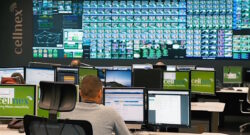 How is DTT adapting to these times of the COVID pandemic?
 Show and event technicians demand a return to work in an impeccable mobilization in times of pandemic
 XR Studios selects Disguise as tech hub for MTV VMAs
 Avid offers a series of measures to alleviate the impact of the coronavirus pandemic
 Atresmedia and Bambú film 'Times of war', a new series for Antena 3
 RTVE and the Polytechnic of Madrid renew their collaboration agreement to promote the technological development of audiovisual content
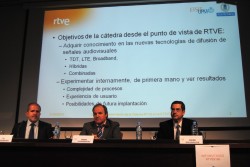 The RTVE-Polytechnic University of Madrid Chair is launched to promote audiovisual technological development
 Quality content and credibility, a lifeline for the media in times of crisis
 In difficult times, sharing technology and content is the key
 Axión creates a technological center for the promotion and innovation in DTT