





RTS launches OMS (OMNEO Main Station), its new partyline intercom family
Analog partylines users can enter the IPcal world with this solution while extending the life of their legacy equipment.
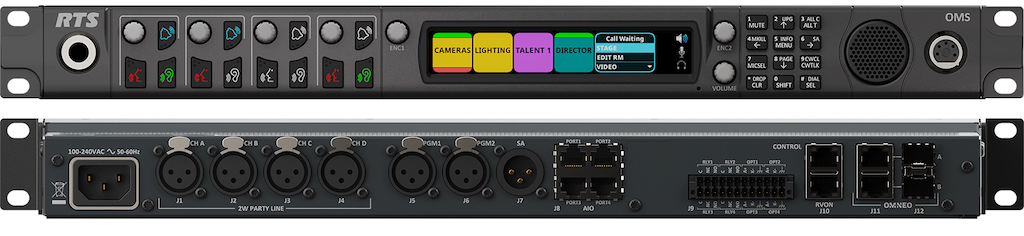
RTS lanza OMS (OMNEO Main Station), a hybrid IP/digital/analog main station for party line intercom systems and the core component of a new product family: RTS Digital Partyline.
Presented in a compact 1RU package, OMS is a versatile and cost-effective solution capable of interconnecting both wired/wireless and IP/digital/analog devices. Supports the conectividad total TCP/IP. And OMS represents the RTS philosophy of bridging all standards and formats.
The Omneo IP technology, which incorporates Dante (audio transport) and AES70 (device control) allows OMS to interface with RTS digital matrix products (including ADAM, ADAM-M, ODIN, KP series keyboards and the ROAMEO DECT wireless system) and with the upcoming new members of the RTS Digital Partyline family.
Therefore, OMS can provide a path from legacy equipment to the latest technology, allowing users to migrate to the flexibility of an IP infrastructure without the complexity of a matrix system, all while protecting the investment value of their existing partyline analog hardware.
WHO is available in five configurations con licencia para adaptarse al presupuesto del usuario y a los requisitos de la aplicación: Digital avanzada, intermedia y básica (cada una con OMNEO); Analog Plus y Analog (opciones de estación principal para sistemas partyline sólo analógicos). Las actualizaciones del software permiten aumentar la capacidad y la funcionalidad a medida que evolucionan las necesidades. Los usuarios que necesiten tanto analógico como digital deben actualizarse a OMS Intermedio o OMS Avanzado.
Todas las configuraciones de OMS cuentan con una pantalla de alta resolución a todo color en el panel frontal y una estructura de menú intuitiva basada en iconos para simplificar la configuración y el control del sistema. La disposición del panel será inmediatamente familiar para los usuarios de partylines, y tiene controles codificados por color específicos para cada canal (hablar/escuchar/llamar/volumen).
Cada uno de los cuatro conjuntos de botones puede programarse para funcionar con cualquier destino en el sistema. La fuente de alimentación de CA tiene un conector IEC de bloqueo, y el diseño de la carcasa de bajo consumo y ventilación de la unidad significa que no se necesitan ventiladores de refrigeración, lo que ahorra energía y garantiza un funcionamiento silencioso.
Además, incluye soporte para cuatro puertos de AIO analógicos de cuatro hilos, cuatro puertos de dos hilos analógicos (equipados con cancelación de eco), dos entradas de programa y una salida de anuncio de etapa.
The conectividad Ethernet es a través de cobre o fibra (para las versiones OMS Intermedia y OMS Avanzada con OMNEO). Se incluyen puertos de audio de expansión OMNEO adicionales para la conexión en red con otras unidades OMS, lo que permite una capacidad adicional del sistema y la capacidad de línea compartida como parte de un sistema distribuido o de varios sitios. Las configuraciones de OMS Intermedio y OMS Avanzado son compatibles con la interfaz de teléfono digital TIF-2000A.
La versión OMS Advanced, totalmente equipada, permite al usuario convertir entre cuatro formatos diferentes: OMNEO, RVON, AIO de cuatro hilos y de dos hilos. Se admiten los códecs G.711, G.722 y G.729AB. Se pueden conectar hasta 40 dispositivos OMNEO, incluidos los beltpacks de ROAMEO (para los que OMS también puede servir como estación base independiente), hasta ocho paneles de teclado y hasta 16 líneas parciales. OMS Advanced admite cuatro canales de RVON (RTS Voice Over Network) a través de los teclados de la serie KP de RTS, para una sólida conexión en red remota con otros equipos compatibles con RVON (no se admite RVON Trunking).
Did you like this article?
Subscribe to our NEWSLETTER and you won't miss anything.
Related articles
 Clear-Com adds a four-channel interface to the HelixNet intercom family
 The new 8380A three-way SAM monitor joins the Genelec “The Main Ones” family
 Hollyland launches its new Solidcom H1 wireless intercom
 RTS Digital Partyline family expands at NAB 2023 with DSPK-4
 RTS presents the DBP (Digital Beltpack), latest addition to its Omneo IP line
 LaON Technology launches new panels for its Genie intercom system
 RTS presents its new Odin Omneo digital intercom matrix at NAB
 RTS launches its new Roameo wireless intercom
 NewTek Launches Next Generation of TriCaster Professional Family
 First generation of Omneo compatible RTS intercom matrix products
 Quantel launches Station sQ, its new comprehensive HD news production system
 Harmonic launches new ProMedia family for multi-screen environments
 Snell Launches Morpheus-Based Family of Automation Solutions
 Prodys releases a new firmware version for its family of IP codecs