





Zixi Implements UHD Streaming over 5G Edge with AWS Wavelength
Together with a major international broadcaster, Zixi is testing live workflows for linear broadcast of 4K and 8K content with distribution over 5G.
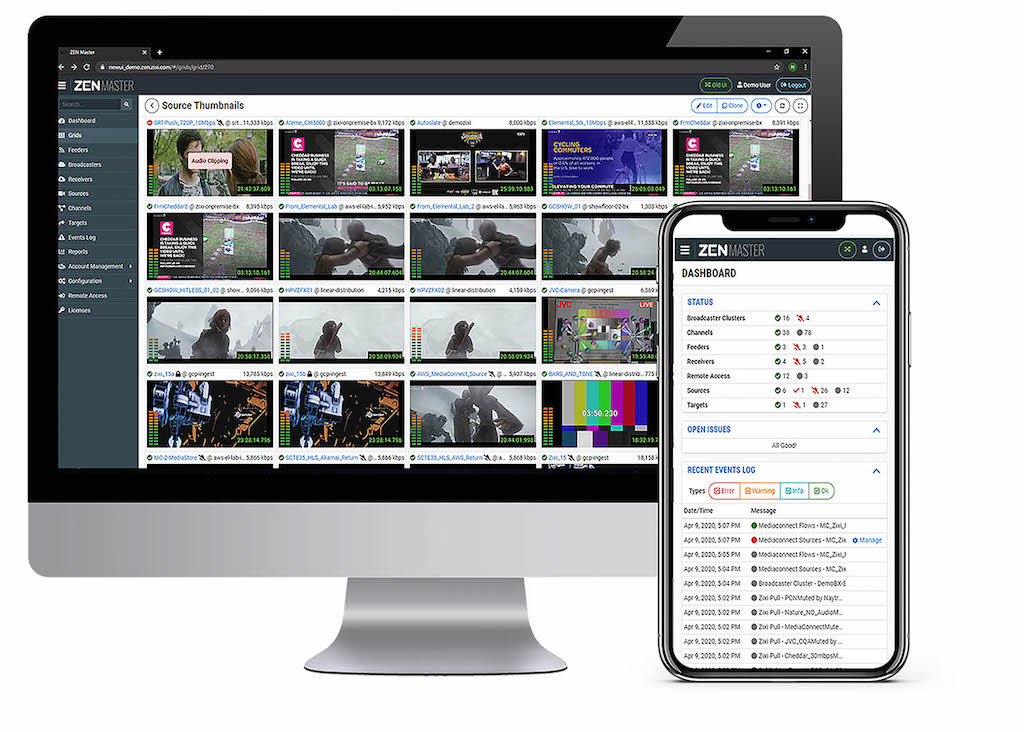
Sports fans and entertainment aficionados set a high bar for their live streaming experiences, demanding outstanding performances on any device, fast start-up times, and no latency.
Los espectadores también quieren más contenido en vivo que nunca y, cada vez más, en una resolución viva de 4K de ultra alta definición (UHD). Estas aplicaciones requieren latencias ultrabajas para poder ofrecer experiencias de visualización de alta calidad en una gama cada vez más amplia de dispositivos con capacidad de 5G.
Zixi está empleando Amazon Web Services (AWS) en el edge 5G de Verizon para producir y entregar flujos de trabajo de media UHD y producción habilitada para 5G a escala.
It is currently working with a major international broadcaster to test live workflows for linear broadcasting of 4K and 8K content with 5G distribution. Other Zixi customers are experimenting with immersive consumer-facing experiences delivered through AWS Wavelength on the edge of Verizon's 5G network.
Gordon Brooks, CEO of Zixi, comments that "today the live events business is cumbersome, infrastructure-intensive and high-cost. What we are doing with Verizon's 5G network and AWS Wavelength is streamlining that process. We are changing the economics; we are changing the way we do it and the way we experience it."
El procesamiento y la entrega de video remoto en la nube no es algo nuevo para Zixi. Los clientes utilizan la tecnología de Zixi con AWS Elemental Media Services, including AWS Elemental MediaConnect, un servicio de transporte de alta calidad para vídeo en directo. Ahora, para ayudar a los proveedores de contenido a entregar nuevos tipos de experiencias deportivas y de entretenimiento en vivo, Zixi utiliza AWS Wavelength para impulsar su Plataforma de Vídeo Definido por Software (SDVP). La SDVP aprovecha el acceso de latencia ultra baja a los servicios de computación y almacenamiento de AWS habilitados por Verizon 5G en el Edge para procesar enormes cantidades de vídeo UHD y comprimirlo para su entrega a los dispositivos móviles.
Eric Bolton, vice president of business development at Zixi, says that "with AWS and Verizon we have had a lot of success in showing how workflows could be configured to take advantage of the robust, low-latency aspects of 5G. But first you have to access it and that's where Verizon's 5G network and AWS Wavelenght computing at the edge come in. Wavelenght allows us to push video processing to the edge and deliver additional performance in every part of the content delivery chain," said Eric Bolten, VP of Business Development at Zixi.
Remote and distributed production
Zixi has also designed the SDVP to take advantage of Wavelength's ability to support a wide variety of remote and distributed production. The combination of SDVP and AWS Wavelength allows customers increase production workflow efficiency. In turn, they can innovate more quickly and offer new services as well as a higher quality of experience to their subscribers for an increasingly wide range of 5G-enabled devices.
"To be able to scale, to go from hundreds of flows to tens of thousands of flows and customers, you need the ability to have views across the organization, between organizations, and easily manage both. 5G better optimizes overhead, so you can maximize traffic spectrum and reduce latency. Now with the wavelength available at the edge of the 5G network, this combined mobile edge compute (MEC) solution predicts the future of mobile broadcast workflows," he adds. Bolton.
5G advances allow mobile edge computing para la difusión y la contribución y entrega de OTT al consumidor. “Tiene un potencial muy alto de interrupción de varias maneras para las organizaciones que están adquiriendo o distribuyendo una señal”, asegura Bolton, añadiendo que las pruebas de campo en curso muestran resultados prometedores, con una latencia por debajo de 10 ms sobre un tubo de 80-100 Mbps.
“La tecnología hace posible salas de control virtuales, donde un equipo de producción puede pedir 10 o 20 conjuntos de cámaras y tener subconjuntos curados que están disponibles para el público en general. Es entonces cuando el patrocinio y la personalización comienzan a apoyar los modelos de negocios reales. No hay duda de que MEC es el futuro de la producción y la contribución en vivo. Estamos migrando lo que ya hemos estado haciendo con AWS usando Amazon S3, y ahora haciendo una conexión con las zonas de longitud de onda en el borde de las redes 5G. Este tipo de puertas de enlace en la red 5G lo abren todo”, concluye Bolton.
Did you like this article?
Subscribe to our NEWSLETTER and you won't miss anything.
Related articles
 UHD Spain carries out a pioneering experience with UHD-HDR and 5G
 Overon carries out an extensive operation to report on Brexit from London, Brussels and Gibraltar
 Zixi reinforces its alliance with JVC to streamline media streaming
 Veset, Zixi and KnoxMediaHub share their vision on the impact of the cloud in the audiovisual sector
 Axon successfully carries out a first experience of distributing 4K signals over Ethernet AVB
 Jarkartza Media carries out the streaming of the 'regatta' of 30,000 rubber ducks in the Bilbao estuary
 Media Networks carries out the first workshop on audiovisual solutions
 Sony carries out 4K tests at the Confederations Cup
 KIT Digital carries out the automation of the Panamanian Medcom
 Hideas carries out the new study by Sergio de la Puente
 RTVE carries out a study on the use of mobile devices in children
 Colombia carries out the first mobile television test
 Chile's TVN carries out its first 3D broadcast
 Overon carries out more than 630 services from Haiti