





A Newton stabilizer and a Sony HDC-P50 camera achieve amazing results on ice in the program 'Dancing on Ice' (ITV)
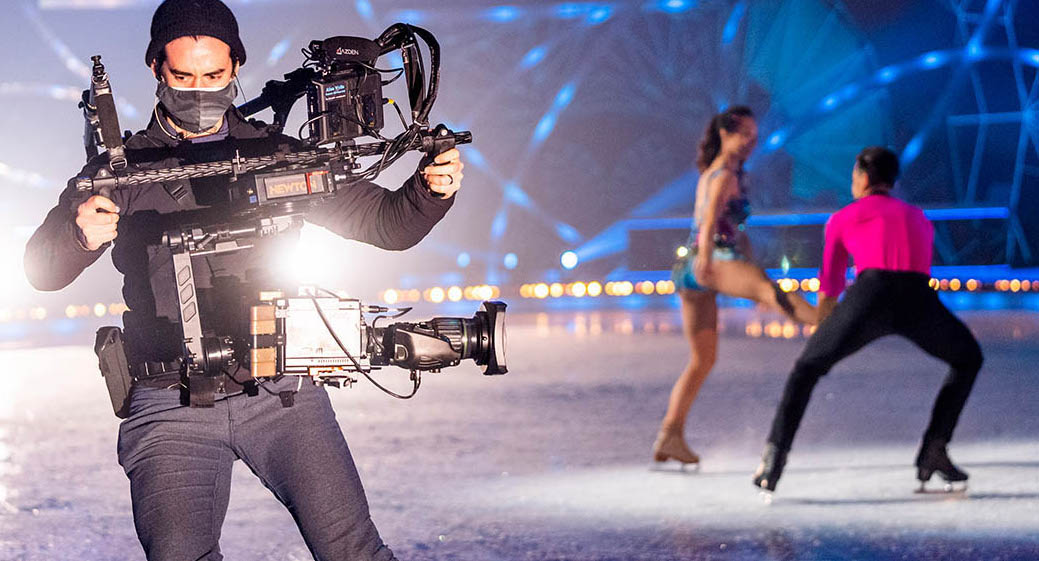
On the British live television show Dancing on Ice, a figure skater skates between the dancers with a camera Sony HDC-P50, equipped with Canon HJ14 lens, stabilized and controlled remotely using a system Newton.
In this reality show, different celebrities ice skate with pairs of professional skaters in front of a jury. Each season has ten programs that are broadcast live on ITV from January to March, gathering around 6 million viewers weekly.
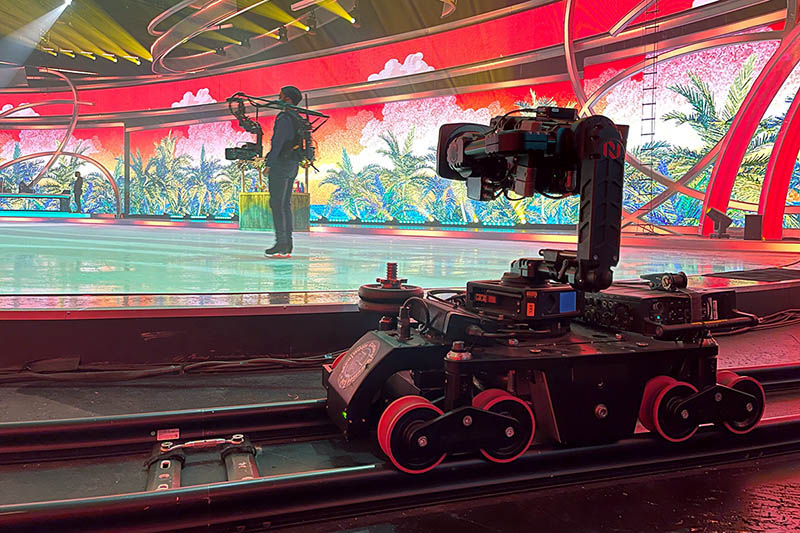 The series began in 2006 but was canceled in 2014 and then revived in 2018 with a new television studio at RAF Bovingdon. With the reactivation, production hired Alan Wells Camera Services, which provides a tracking shot along the skating rink and since the 2019 season has helped introduce a new camera angle to the program, the Ice Cam.
The figure skater Jordan Cowan carries the Ready Rig that holds a Newton stabilized remote head next to the Sony HDC-P50 and a Canon HJ14 lens that is controlled remotely by the cameraman Dominic Jackson, via the Newton control panel on a normal operator desk.
Cowan is an American figure skater who used to compete on the national team and, for a few years now, has been taking cameras onto the ice to film figure skaters under the name On Ice Perspectives. In mid-2018, Cowan learned from a friend that the producers of the reality show Dancing on Ice In London they were looking for a cameraman who knew how to skate. Jordan explains, "I contacted the producer and showed them some of my recent video productions. They liked it and hired me for the 2019 season, making me the first skating camera operator for a live televised skating show."
More agility on ice
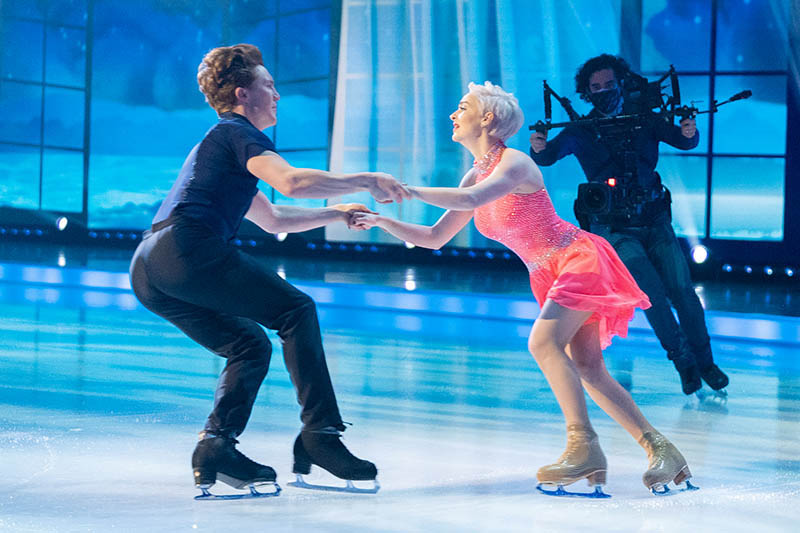
Domenic Jackson had operated a Steadicam in Dancing on Ice for several seasons. In October 2018, ITV asked Alan Wells to put together equipment that could move faster on the ice and replace the Steadicam. Wells then opted for a Ready Rig. To this end, carbon fiber mounts were added so that it could hold a Newton stabilized remote head, which is rarely used manually.
Unlike typical handheld stabilizers, the Newton has a control panel that features broadcast-standard settings for camera angle and lens, which is much more suitable for professional television cameramen.
The final wireless camera kit, the Ice Cam, weighed 15 kilos and included an RF system for data communication, a Boxx Link for the video, batteries and a monitor so Jordan could see the image.
Cowan comments that "the rig could be lighter, but the Newton was the only gimbal that could maintain a stable horizon through all the twists and turns at high speeds on the ice, while carrying the standard 4.3-60mm zoom lens. The Newton also required less space for the 3-axis motors which, although requiring counterweights, meant I could let the rig hang close to my body and thus keep it close to my center of balance."
Dancing on Ice
Behind the scenes
https://www.youtube.com/watch?v=M9Y5Kkp3t0Y
Did you like this article?
Subscribe to our NEWSLETTER and you won't miss anything.
Related articles
 Ateme helps Slovak Telekom in streaming the 2025 Ice Hockey Championship
 Net Insight and Mobilelinks: IP UHD remote ice hockey production
 'Camera-kinesis': Manuel Balseiro compiles an entire treatise on camera movement
 StreamTeam performs remote production of the Finnish Ice Hockey First Division with AEQ Olympia 3
 Arkaos' new 4K multimedia servers “dance on ice” on television in Germany
 Streamteam chooses Nevion Virtuoso for remote production of the Finnish Elite ice hockey league
 Streamteam Nordic and Broadcast Solutions open 4K remote production center for ice hockey
 Sony organizes a series of courses on IP live production at Pinewood Studios
 Edmonton Oilers use Fujinon lenses for ice hockey game broadcasts
 Mac Expert develops a gimbal stabilizer with 360º free movement on the X, Y and Z axes
 JVC and Sportzcast present the GY-HM200SP (Sports Production) 4K camera with real-time scoreboard
 Imagine releases the results of a macro survey on hot spots in the sector
 Media Business School and Four Corner obtain aid from the MEDIA Program for training
 An aerial camera on cables falls onto the playing field in the US.