





RTVE joins Call to Europe 3 to continue defending free-to-air TV
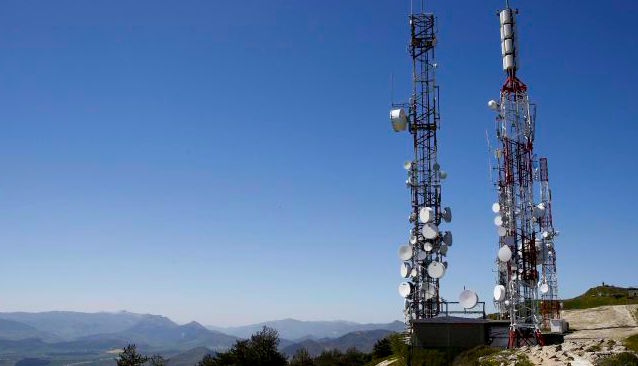
More than one hundred organizations and media outlets from all over Europe, including RTVE and the free-to-air television sector in Spain, are part of the third edition of the Call to Europe campaign.
The objective of Call to Europe 3 is to “save the spectrum” to maintain the presence of television in the UHF band, which will allow, in the words of RTVE, continue offering an “open, free and open” television service to European citizens.
In the third edition of this campaign, which begins on May 2, it is requested in a manifest that Europe and its institutions act and position itself to guarantee DTT access to the radio spectrum in the World Radiocommunication Conference 2023 (WRC-23)” as has been maintained to date.
This is the full text sent to the people who will be part of the World Radiocommunication Conference next autumn 2023:
“The show must go on: vote to protect culture and the media
In May 2023, more than 100 cultural organizations and media across Europe called on policymakers, governments and regulators to protect production and distribution through the lower band of the UHF spectrum (470 and 694 Megahertz).
At the World Radiocommunication Conference next autumn 2023 there is a risk of transferring this frequency band to mobile broadband services.
This attribution, called “co-primary”, will mean a de facto exclusion of the audiovisual media and the cultural sector from the airwaves.
For media distribution:
– Terrestrial television (DTT) in the UHF spectrum is simple, inclusive and cheap: by connecting a television you have instant access to a wide variety of public and private programs.
– DTT in the UHF spectrum is reliable in all situations: even in natural or man-made disasters, the broadcast distribution is very robust.
– DTT in the UHF spectrum is a sustainable distribution method, and the most sustainable when it comes to distributing the same content to everyone.
– DTT is innovative: it requires constant innovation and the development of new digital technologies such as, for example, UHD-4K or 5G broadcasting.
For media and film production, cultural shows and other live events:
– Frequencies are necessary for wireless means of production.
– They are important for: theater, musicals, live events, festivals, conferences, radio and television reports and media production.
– Technical equipment is used over a long period of time and often passes from professional to non-professional organizations, thus applying the concept of circular economy.
 The mobile services sector already benefits from significant spectral resources in UHF, i.e. the 700 MHz and 800 MHz bands. These spectrum allocations, previously used by DTT and PMSE (Programme Making and Special Events), were justified by the need to develop rural broadband, but current rural deficiencies can only be resolved by further developing infrastructure, and this can be done with the spectrum already allocated to mobile broadband.
Every day, millions of people across Europe benefit from terrestrial television, media productions and enjoy live cultural events. For the media and cultural sector to prosper, he advocates maintaining the lower UHF band for television distribution, audiovisual productions and cultural events:
Take a stand in favor of “Do not change” the Radio Regulations at the World Radiocommunication Conference next fall 2023 (WRC-23).”
Did you like this article?
Subscribe to our NEWSLETTER and you won't miss anything.
Related articles
 RTVE invests in free-to-air football, adding LaLiga and Primera RFEF matches
 RTVE joins the trend of vertical microdramas with 'Estúpido Cupido'
 Paramount Creative adds 15 nominations at the Promax Europe Awards
 For-A reveals new alliances to continue promoting IP at NAB 2022
 The cinema participated by RTVE has 17 Goya Awards with 'The Girls' as the great winner
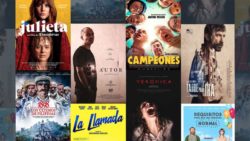 RTVE Digital launches the portal 'We are cinema' with more than 60 free and open Spanish films
 Mediapro and RTVE reach an agreement to share the broadcast of one free-to-air match on each day of the Copa del Rey
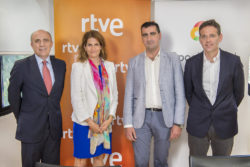 Google joins RTVE's 'Journalism Innovation HUB' project
 RTVE, finalist in the PromaxBDA Europe awards with the campaign 'We live our time'
 RTVE launches Playz, a new open digital space with original and interactive content
 José Antonio Sánchez: “RTVE wants to continue being the engine of innovation in audiovisual matters”
 SES broadcasts openly and throughout Europe the TVE International Channel and the RTVE Channel 24 Hours
 Digigram Iqoya CALL/LE: coding for IP audio with total flexibility
RTVE joins the hybrid TV project of Telefónica and Mediaset
Digigram Iqoya CALL/LE: coding for IP audio with total flexibility
RTVE joins the hybrid TV project of Telefónica and Mediaset