





RTVE and FORTA join forces to test DVB-I, a standard that takes the union of TV and Internet to the next level
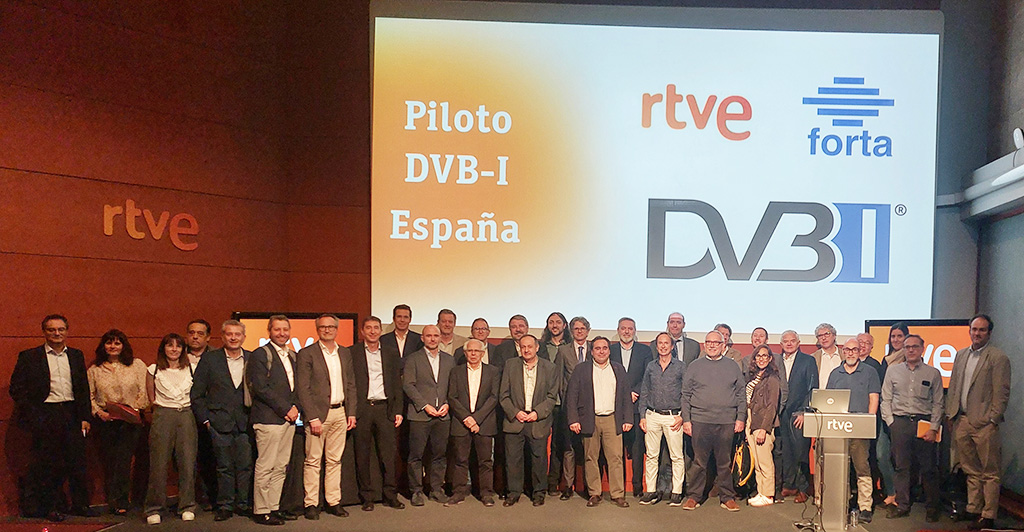
The Spanish DVB-I Pilot RTVE y FORCE, an initiative that was born within the so-called “Compostela Convention”, will involve broadcasters, consumer electronics manufacturers, broadcast network operators, technology providers and service managers to test the possibilities, limitations and opportunities of the European standard.
RTVE and FORTA have presented to Madrid a pioneering initiative in Spain aimed at carrying out technical tests of the standard DVB-I, in order to evaluate its suitability as a strategic tool that allows improving the visibility, access and relevance of audiovisual content. All this, adapting to the new forms of consumption, trying to improve the prominence of your services and trying to optimize both the discovery and location of its contents, while maintaining the free access model of Digital Terrestrial Television.
It is pilot was born within the scope of collaboration of both entities established in the so-called 'Compostela Agreement' and with a vocation to constitute in the national initiative in this field in which all relevant agents involved in the provision of health services participate. audiovisual communication, both the public as offered under license. It will have an estimated duration of nine months and will have the collaboration of broadcasters, consumer electronics manufacturers, broadcasting network operators, technology providers and service managers, as well as the participation as observers of the National Markets and Competition Commission and the Ministry for Digital Transformation and Public Service.
The first steps of the Spanish DVB-I Pilot contemplate the constitution of a Implementation Group, as well as gather information about other European DVB-I pilots or establish contacts with manufacturers and technology suppliers. The Pilot's presentation included a demonstration in which the guests and participants at the event They have had the opportunity to learn about and interact with the relevant functionalities that the standard allows.
What is DVB-I?
DVB-I is a open specification for the discovery of services and program metadata developed by the DVB project. The DVB-I specification defines the ways in which Internet-connected devices and displays can discover and access sets of audiovisual media services. These may include services provided in line through fixed and wireless Internet protocol connections, as well as radio and television channels received over radio frequency networks using traditional cable, satellite or terrestrial transmissions.
DVB-I define un request and response mechanism online through which available audiovisual multimedia services can be discovered through a registry of service lists. The specification defines the scheme and signaling to describe an ordered list of audiovisual multimedia services, with provision of logical channel numbers and service logos, together with technical parameters by which one or more instances of a service can be accessed over various networks.
It also defines methods and metadata to enable online access to program information for channel lineups and program catalogs that may be presented in electronic program guides (EPGs). This allows services to be accessed in a coherent and consistent manner across various networks. Support for lists of regulated services provides a method for national regulators or their representatives, operators and trademark licensees to provide a list of reliable, legitimate, authorized or regulated services.
As an open standard, based on HTTPS and XML, DVB-I can be freely deployed on any app, device or screen, allowing for a competitive consumer market. It does not impose any form of presentation on how the client displays the information provided. This can be supported directly within the software's operating environment, a native application, or within a web browser.
Today, the standard HbbTV for hybrid broadband television has been expanded to offer full DVB-I compatibility. Multimedia services can be accessed using several established standards, including the DVB specification set for satellite, cable and terrestrial broadcasting, and DVB-DASH for online distribution via adaptive bitrate streaming.
Did you like this article?
Subscribe to our NEWSLETTER and you won't miss anything.
Related articles
 Marshall takes smart camera control to the next level with RCP Plus
 FORTA and RTVE join forces to support the development of DAB+ digital radio
 7thSense uses Phabrix technology to test its ST 2110-based solutions
 FORTA and RTVE will promote new policies to promote equality in public radio and television
 Genelec helps Sound Rush take their studio to the next level
 AWS and Riot Games will leverage the cloud to take eSports to the next level
 Distributors and exhibitors come together to launch the #YoVoyAlCine campaign
 RTVE migrates its satellite broadcasts for Africa to the DVB-S2 standard
 Definitive agreement in the European Union to guarantee free Internet access points
 Sony and Panasonic join forces to develop the Archival Disc standard for optical discs
 Kabel Deutschland tests the DVB-C2 standard in Germany
 TVE carries out the first 3D technical test at the national level
 Akamai and Brightcove Team Up to Raise the Bar for Online Video Experiences
The CMT once again puts the fee on the table to finance RTVE
Akamai and Brightcove Team Up to Raise the Bar for Online Video Experiences
The CMT once again puts the fee on the table to finance RTVE