





LED: myths, facts and future
Grau Luminotecnia has published on its blog this interesting article about the advantages of LED lighting written by Dedo Weigert, director and founder of Dedo Weigert Film, which we reproduce for your interest.
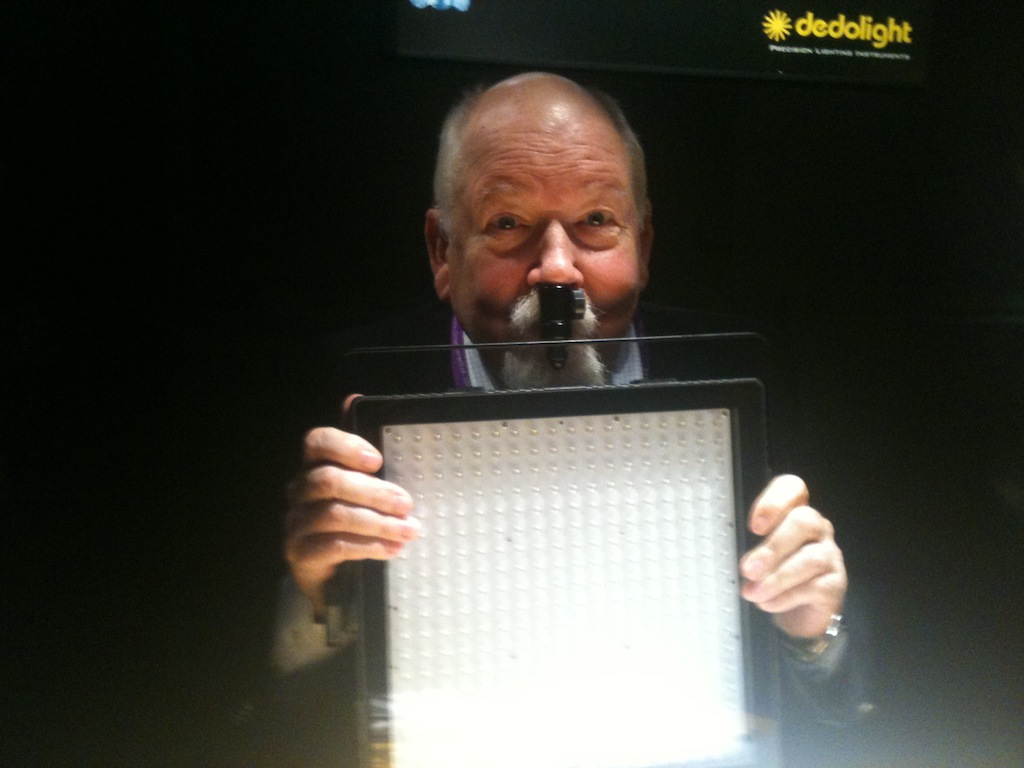
Alfons Grau, managing director of Grau Luminotecnia, echoes on the blog of this company specialized in professional lighting a very interesting article written by Dedo Weigert, founder of Dedo Weigert Film, where a comparison is made between the different light sources to later focus on LEDs.
The comparison between the various light sources has been carried out twice: on the one hand, the Color Rendering Index (CRI) (CRI in English) and, on the other, the performance per watt (W) of consumption, that is, lumen per watt.
Comparison of light sources
- The Sun: has a CRI (CRI) of 100 because it shows us the entire color spectrum, and therefore it is the perfect light. If we add to that that it has no consumption for us, we will see that it is also perfect in terms of performance.
- Halogen lamp: It has an almost perfect CRI of 98 but a very poor performance of 20 lumens per watt (W).
- Low voltage halogen lamp: It maintains a CRI of 98 but doubles the number of lumens per watt, remaining at 40.
- Daylight metal halide lamp (HMI): We lower the CRI a little, leaving it at 92, but we double the performance per watt again, now at 80.
- Dedolight tungsten light metal halide lamp: Maintaining the CRI of 92 and the same performance of the HMI light. The difference is that it gives us a temperature of 3200K; It works with the same HMI ballast.
- Kino Flo type fluorescent lamp: There are three different models marked by their color temperature, 5600K, 3200K and 2950K with very good performance for skin tones. CRI 92 and performance of 80 lumens per watt.
It must be remembered that a CRI of 90 or higher is considered good for film and photography. On the other hand, performance refers to pure light sources, let's say, the lamp without a device; But what is the performance or effectiveness of this light emitting point when mounted on a projector? Well, in a Fresnel projector we have an efficiency of only 6% while in a Dedolight bifocal projector with a double aspherical lens we obtain 18% efficiency; It's not fantastic, but it's 3 times better than Fresnel.
 LED myths
I forgot, let's go back to the LED and dispel some myths. To begin with, special attention must be paid to the selection of LEDs to combine those that have similar characteristics/dominance.
- The LED offers more light: This is not entirely true since most LEDs give a performance of 60 lumens per watt.
- The LED does not emit heat: This is a myth. Heat generation is lower than other sources, but the biggest problem with LEDs is cooling. A huge cooling surface area is needed if any consistent color and light output is desired. This also applies to small light sources, preventing manufacturers from using fans, which are always “prohibited” for professional lighting, especially for torches that are normally placed next to the microphone.
- The Eternal Life LED: In principle it is true. It is given a life of 30,000 to 50,000 hours, but here we must consider how fanatically LED manufacturers are working on future developments. We are not just talking about the four manufacturers with whom we are developing common projects. We hope to make great strides in the coming years
Benefits and evaluation
- Adjustable from 0 to 100 without perceptible variation in color temperature
- Color consistency for many years. In many well-known systems this seems to be a problem, having had to dismantle studios completely equipped with LEDs. With our continuous longevity tests, today we can only say that we have not encountered these problems
- Color analysis. No thermocolorimeter gives a reliable reading with LEDs. Spectrum analysis provides detailed information on color coordinates and values from R1 to R14 but is not fully valid for evaluating color performance for film, video and photography. Video tests and comparisons of individual colors (card masking) carried out first with reference light and then with LED lighting; It is subsequently superimposed with the help of Final Cut Pro to be able to see the duplicate color (with reference light and LED). This also does not give us a final result and is only valid for sleepless nights. If we analyze individual chips for digital cameras we observe that for daylight, halogen, HMI or Kino Flo it gives us the same result but with LEDs it shows differences
This gets complicated, now the traditional CRI values do not serve to evaluate the color quality of the LED. We have to learn the difference between R1, R2, R3… up to R14. Now we can see that with practically all “white” LEDs the R9 value (which is the value of red) drops drastically below 40. Fortunately, white balance saves us from major disasters as long as we do not mix several light sources, otherwise we will have to accept differences in the color performance of the same image and the “we fixed this in postpo” will not offer us a solution.
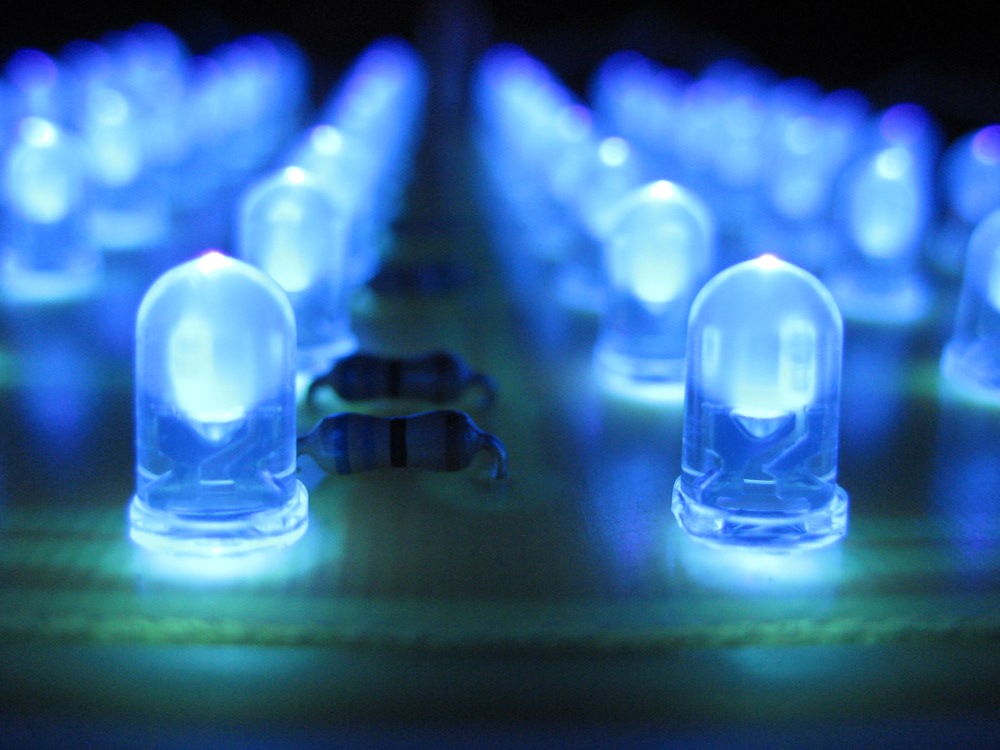
Creative control with LED matrix sources (multiLEDs)
- MultiLED panels offer us few light beam control solutions; The most appropriate is to choose the light source with the fixed angle that interests us most: 15, 30 or 50º.
- Visors produce very annoying multiple shadows and therefore become a purely decorative object.
- Looking directly at the projector is very annoying, blinding. This gives us the sensation that the light emitted is much greater than it actually is when we rotate it from our visual axis.
- Los difusores montados directamente sobre el panel no producen el efecto deseado. Sólo alejando el difusor de los LED’s conseguimos una luz agradable sin molestias ni el efecto cegador (por este motivo los Felloni utilizan difusores en forma de “caja”).
- Los filtros holográficos de apertura de haz consiguen abrir el haz en un eje. Son unas buenas herramientas pero tienen un alto coste.
El futuro pasa por los LED focalizables
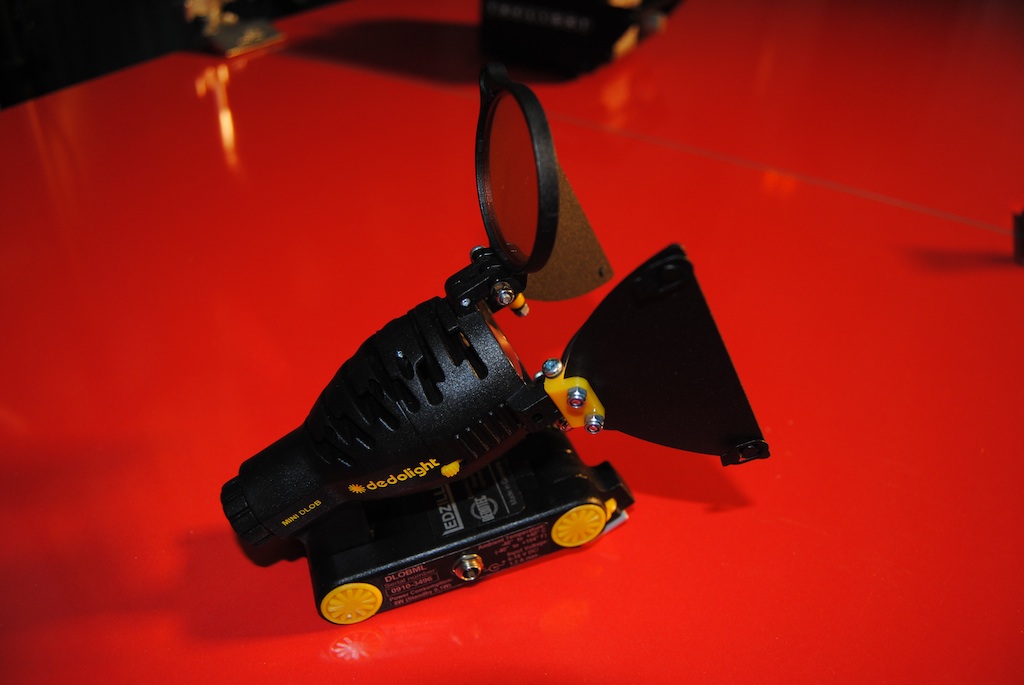
- Hemos desarrollado proyectores LED con tecnología de un solo chip y el sistema óptico doble asférico de Dedolight, y son compatibles con todas las conocidas opciones de control Dedolight.
- Nuestro proyector más pequeño, el LedZilla, ha salido vencedor en todas la comparativas a las que se le ha sometido.
- Ahora mismo estamos trabajando en kits del estilo de los Dedolight serie Clásica, en los proyectores de estudio y…t odos estos futuros equipos irán equipados con las ópticas patentadas de Dedolight, con un amplio rango de foco, luz y color perfectamente distribuidos, y compatibles con todos los accesorios de control actuales
Nos espera un futuro cercano apasionante y os lo iremos desvelando poco a poco…
Dedo Weigert
director y fundador de Dedo Weigert Film
Did you like this article?
Subscribe to our NEWSLETTER and you won't miss anything.
Related articles
 Bambú Producciones shoots 'The crime of Pazos', a new Netflix series inspired by real events
 The Mediapro Studio and 3Cat film 'El mal', an eight-episode thriller based on real events
 When fiction is inspired by real events: legal conflicts and a key ruling
 AV and broadcast: a common future
 The present and future of televisions goes through IP
 Three myths about the use of foreign elements in audiovisual productions
 The future of 5G in RTVE, revealed at the 5G Forum
 Mediaocean identifies the six false myths of Connected TV
 Verdades, medias verdades y mitos de las ópticas cinematográficas
 Is the future of audiovisual lighting only LED?
 NATPE hosts the presentation of 'Puerto Vallarta', the miniseries about ETA based on real events
 IP is not the future, it is already here
 DaVinci Resolve Studio provides new virtual reality experiences in the 'Mythbusters' series
 Perfilando el futuro de la radio… en digital