





Ten keys that will set trends in the ICT sector
Javier Nadal, executive vice president of Telefónica, coinciding with the presentation of the twelfth edition of the Annual Report on the State of the Information Society, has indicated the ten keys that mark future trends in the ICT sector.
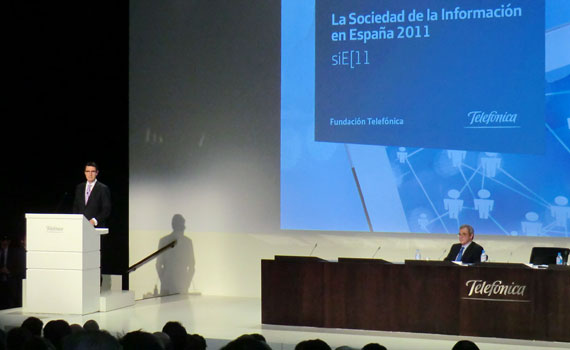
In an event attended by the president of the company, César Alierta and the Minister of Industry, Energy and Tourism, José Manuel Soria, Telefónica presented the twelfth edition of its Annual Report on the State of the Information Society in Spain.
As highlighted, the Digital Leisure and Entertainment Observatory (Killed), Alierta has highlighted the 8% drop in telecommunications prices in the last ten years and the increase in mobile broadband by 18% compared to 2010.
Furthermore, Javier Nadal, executive vice president of Telefónica, has indicated the ten keys that mark future trends in the ICT sector:
- Mobile broadband, which has become the king of broadband Internet access, surpassing fixed broadband by 3 million accesses in 2011.
- The post-PC era; Last year, smartphones surpassed the PC as the best-selling smart terminal in the world.
- Increase in electronic commerce, which is likely to continue increasing due to the popularization of collective purchasing and discount coupon models, from companies such as Groupon and Letsbonus.
- The trend towards smart cities, achieving savings in the provision of services.
- The use of the Internet associated with productivity rather than leisure.
- Decrease in the storage of files from the Internet and a tendency towards access and not possession.
- New user profiles permanently connected and communicated through social networks. 9% of social network users do not disconnect and the use of these new services also increases, while phone calls and SMS decrease.
- Las brechas digitales asociadas a las nuevas tecnologías se dan especialmente en las brechas de género, puesto que los early adopters suelen ser más hombres que mujeres; aunque cuando se estabiliza su uso, aumenta el número de mujeres que acceden a estos servicios.
- La ralentización en la salida a bolsa de las grandes de Internet, motivada por la situación de crisis actual.
- Por último, Javier Nadal ha señalado la atención que merece por parte de las autoridades la concentración de mercado de las grandes empresas de Internet, como Google, Apple y Facebook.
Por su parte, el Ministro de Industria ha señalado el compromiso del Gobierno por aumentar la igualdad en el acceso a contenidos para disminuir la llamada “brecha digital”, también ha mostrado la intención de incorporar los servicios públicos de municipios y autonomías a los proyectos smart city.
Seguir las recomendaciones de la Agenda Digital Europea, en materias como el “dividendo digital” es otro de los retos a los que se enfrenta el ministerio, además de impulsar las redes sociales como herramienta de comunicación en libertad.
Did you like this article?
Subscribe to our NEWSLETTER and you won't miss anything.
Related articles
 RTVE joins the trend of vertical microdramas with 'Estúpido Cupido'
 Change in trend: VOD viewing time decreases, but its quality improves
 Change in trend: series production decreases by 6% throughout Europe
 Cisco identifies the 5 technological trends that will mark 2023
 Four IBC 2022 trends that will mark the path of the sector
 5 technologies that will mark (or not) the future of movie theaters
 Grouping telecommunications services into a single operator is consolidated as a trend
 IAB Spain advances the digital trends that will mark 2017
 Four pillars that will set trends in video advertising in the coming years
 Cloud, IP, 4K and multiplatform distribution will mark NAB 2016
 The hyperpersonalization of content, a future trend according to Irdeto
 Tangram Solutions celebrates ten years earning the trust of the sector
 Life on Mars and Visualzink create a trend with the on-air rebrand of Antena 3
 Gartner identifies the ten technologies that will mark the coming years