





Consumers are looking for their own ways to access entertainment
According to an Arris study, binge consumption, second-screen shopping, PVR use and multi-screen or multi-room consumption are growing trends, as is the demand for entertainment anytime, anywhere, on any device and in any quantity.

The 2014 Entertainment Consumption Index Arris, released this Wednesday, reveals that consumer demand for personalized entertainment is driving a number of key trends in global content consumption, with significant implications for the entertainment services of tomorrow.
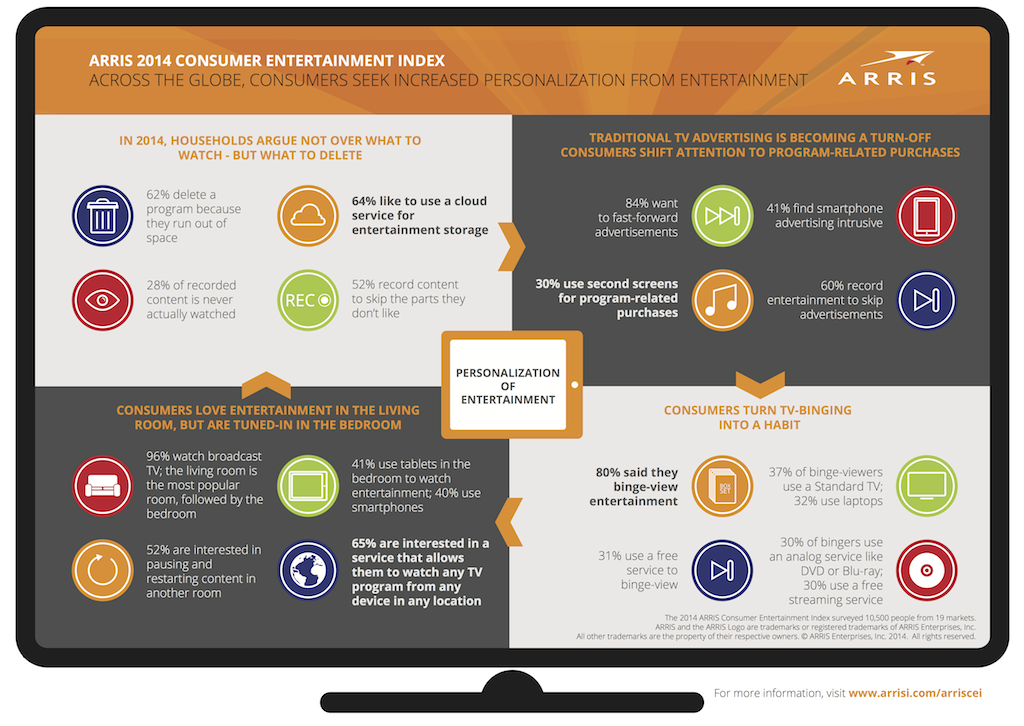
Television remains a staple in home entertainment, with a global penetration rate of around 96% and new implications for multi-screen and multi-room viewing. The majority of consumers binge-watch television: 80% globally (82% in Spain) watch multiple television episodes or even an entire series in a single sitting. Meanwhile, a growing aversion to traditional television advertising is opening the door to multi-screen marketing. And the biggest challenge in today's multi-screen world is finding the space to store everything we want to see.
The Arris Entertainment Consumption Index 2014 is an independent study of global media consumption habits, interviewing 10,500 consumers in 19 countries. The study monitors interaction with different components of the entertainment experience (including multi-screen, advertising and Personal Video Recorder) to offer insight into the trends that are driving the evolution of content consumption.
Main results
Consumers turn binge-watching into a habit: 82% of those surveyed in Spain (80% globally) admit that they binge-watch entertainment, while 18% (14% globally) say they do so at least once a day.
For its part, traditional television advertising is fading; Consumers turn their attention to purchases related to the program: 60% of consumers record entertainment to skip commercials. 41% say that ads on their smartphones are intrusive. However, 17% use secondary devices to purchase products related to the shows they are watching. In Spain, 11% of those who have used a second screen while watching television have bought a song related to the program, while 11% have bought a product related to it.
Spanish consumers like to watch entertainment in the living room but also connect in the dining room and kitchen: television is here to stay, but this carries new implications for multi-screen and multi-room viewing. Globally, the living room remains the most popular room for watching TV, while 41% of tablet owners use them in the bedroom to watch entertainment. In the case of Spain, the living room is also the preferred location (55%), followed by the kitchen (28%) and the dining room (17%).
In 2014, in homes there is no discussion about what to watch but about what to delete: 62% of PVR owners say that they have had to delete programs because they did not have more space, according to global results, a figure that in Spain only reaches 21%, despite the fact that 28% of the recorded content (24% in Spain) has never been seen. Globally, 52% say they record content so they can skip parts of the program they don't like. In the case of Spain, 59% of respondents say they download or record TV programs to be able to skip ads.
Sandy Howe, senior vice president of Global Marketing at Arris, comments: "The rapid growth of mobile devices, increasing the reach of high-speed bandwidth networks, and the ease of accessing content is transforming the way people engage with entertainment. Consumers now expect entertainment on their own terms; controlling what they watch, where and how they watch it, and how much. Our Entertainment Consumption Index reveals that consumers express these expectations in the way they interact with it. “We have found a healthy appetite for traditional forms of entertainment, such as television, and this is the foundation of new ways of consuming that content, such as multi-screen, multi-room or binge-watching. Meanwhile, we are seeing an increase in conversion towards second-screen marketing.
For his part, Pablo Guaglianone, general director of Arris in Spain, points out that "after this study, we know that a growing number of people watch television 'binge', record content to watch later and that consumers seek information about what they see on secondary devices. As a result, we understand that consumers are open and interested in opportunities to introduce that allow advertising to always be relevant, not only for the person who is consuming it, but also in relation to the context and the moment. As it is content recorded for enjoy later, the advertising it includes will most likely already be irrelevant at the time of being viewed. At Arris, we are focusing on advanced and interactive technologies that provide a better experience to the user in the consumption of advertising to prevent them from wanting to skip the ads and improve the return on investment of advertisers, programmers and service providers.

TV binge
Binge-watching has become widespread and is especially popular among female and young audiences in the living room. 80% admit that they have consumed entertainment 'binge'. In Spain, the figure reaches 82% and it is worth noting that, within the group between 16 and 24 years old, this figure rises to 94%. One in five (18%) of respondents aged 25 to 34 watch television 'binge' once a week. Globally, 14% of those surveyed (18% in Spain) say they do it at least once a day. In Spain, it stands out that 58% of those surveyed indicate that they 'binge' watch television at least 2 or 3 times a month and that, within the group between 35 and 44 years old, 30% do so once a week.
Within the overall results, the most popular way to binge-watch content is downloading via free catch-up services (31%) or via DVD/Blu-ray (31%), closely followed by free streaming (online) viewing services. Only 10% say they have binge-watched TV through paid download services, and only 8% say they have done so through paid streaming services. Looking at data from Spain, the two most common forms are free streaming viewing services (30%) and free downloading services (25%).
Binge viewing takes place mostly on standard television (37% globally; 42% in Spain), rather than on computers, smartphones and tablets. According to global data, traditional connected devices remain the second most used, with the laptop (32%) and desktop computer (27%) at the top of the list. In the case of Spain, it is the desktop computer that tops the list (29%), followed by DVD/Blu-ray (24%), smart television (17%) and PVR (17%). Both globally and in Spain, only 11% say they have 'binge-watched' television on a tablet.
Movies and series are usually the preferred content to binge watch for 51% of respondents (54% in Spain), followed by entertainment programs (38% globally; 31% in Spain).
16% of respondents globally and 10% in Spain say they would pay for a service that allows them to immediately download or watch complete television series online, and 21% (12% in Spain) would pay a little more for it if it comes as part of a package. 21% (19% in Spain) also say that they would choose a provider that offers this type of service.
Curiously, women binge watch more television than men, a figure that coincides both globally and in Spain. 35% of women (51% in the case of Spain) say they do it at least once a week, compared to 32% of men (37% in Spain).
Younger groups are more likely to binge-watch entertainment, with 44% of 25- to 34-year-olds and 41% of 16- to 24-year-olds saying they do so at least once a week.
Traditional advertising turns off
The study suggests that traditional television and mobile advertising is reaching its saturation point, while consumers appear to embrace new forms of personalized and program-related marketing.
84% of those surveyed (86% in Spain) admit that they want to skip the ads they see. 65% say they want to do it more than half of the time they watch television, according to the total results, and, in the case of Spain, 58% say they want to do it always or almost always.
Consumers consciously look for ways to avoid advertising. This is why most people record or download programs. 60% of those surveyed say they record content so they can skip ads.
41% of consumers believe mobile advertising is intrusive, while 49% of consumers never click on or follow a TV ad on their other connected devices.
Increasingly, consumers are using more than one device to interact with the television program they are watching. Of those who have done so, 36% have used a second device to access live information about the program (34% in Spain); 32% (34% in Spain) have interacted in a text conversation about the program; and 21% (18% in Spain) have interacted in a voice conversation using a second device.
Interestingly, 30% of consumers who use second devices (20% in Spain) have done so to buy products offered in the programs they are watching, while 20% have played an interactive game or an application related to the program (22% in Spain).
Traditional television remains a staple in the home entertainment ecosystem and the living room remains the preferred location for home entertainment viewing, but consumers are extending this paradigm to other devices in more rooms. Watching TV is often a secondary action that provides background entertainment, and smart mobile devices have become more of a distraction, often taking consumers away from the content they are watching on the main screen. This makes traditional television something that is easy to stop or pick up. Internet television is also booming in the living room and remains stable in the bedroom.
The living room remains a central place for consuming entertainment, with most types of content being viewed in that space. Thanks to new devices, respondents are diversifying outside the living room: according to global data, 41% of tablet owners watch content on them in the bedroom, and 22% in the kitchen. In Spain, this trend changes: the living room is also the preferred location (55%) to watch television, followed by the kitchen (28%) and the dining room (17%).
66% of those surveyed (55% in Spain) say that, in the living room, they watch traditional television, while 61% say they watch pay television. Regarding the specificities of Spain, the moment of lunch or dinner seems to be an important part of the consumption experience: the most popular room to watch pay television is the dining room (43%), followed by the living room (38%) and the kitchen (21%).
The use of tablets and smartphones to view media and content is growing in rooms that are not traditionally associated with this activity: the dining room, kitchen and bathroom. About half of smartphone owners watch TV on these devices at least a few minutes a week. This is also the case for six out of ten tablet owners.
65% are interested in a service that allows them to watch any television program from any device in any location. Television is here to stay and 96% of respondents from around the world watch at least one hour of traditional television every week. 52% (45% in the case of Spain) say that they would be interested in being able to pause and resume the content in another room. 56% of those surveyed (52% in Spain) have used a device to perform a task while watching television.
The device that most distracts consumers is the laptop, with 29% of people saying they have used it to have a text conversation, buy a song, play a game or access data about the program. Surprisingly, smartphones are the preferred distraction device for only 18% of the population.
37% of those surveyed (52% in Spain) say they were browsing the Internet in a way unrelated to television content using a second device; 37% (31% in Spain) also say that they sent messages or emails with friends or family; 33%, who used social networks, both globally and in the case of Spain; 29% who bought online; and 29% who played a game (27% in Spain). Furthermore, in Spain, 22% of those between 25 and 34 years old say they have worked while watching television.

What to see?… no, what to delete!
Recording content is causing frustration in homes. With so much content to watch, and a limited amount of time in the day, households argue over what should be sent to the trash.
62% of those surveyed record content every week (58% in Spain). However, of this recorded content, about a quarter is never seen (28% globally; 24% in Spain). 52% say that they record content to be able to skip the parts of the program that they do not like (51% in the case of Spain).
40% of those who delete programs before watching them say that the reason is because they are no longer interested (39% in Spain); 28% (32% in Spain), because they saw the content elsewhere; 23% (21% in Spain) because they needed space for other programs; and 10% (8% in Spain) because you will order it on demand.
74% of respondents who have deleted a show from their PVR before watching it say that having to delete shows to free up space causes frustration at home.
Consumers are quickly running out of space when it comes to recording television shows. 62% have had to delete or move old television shows and movies to make room for new content (21% in Spain). 64% (62% in the case of Spain) say they would like to use a cloud service to store entertainment. 47% of those surveyed say that they would like to be able to record two or more programs at the same time, a figure that in Spain reaches 36%. Globally, almost a third of these people (38%) would be prepared to pay for this service; In Spain, this percentage is only 24%.
29% of respondents say they would switch to a different service provider or complete registration with a provider if they could store content remotely! Furthermore, 33% say they would be prepared to pay for this service, according to global data, while in Spain 20% would pay for it. 62% of those who are interested in a service like this (55% in Spain) could tolerate some advertising in exchange for a free storage solution for their content.
Did you like this article?
Subscribe to our NEWSLETTER and you won't miss anything.
Related articles
 74% of sports content consumers access exclusively from mobile devices
 Airbus, Eutelsat, Hispasat, SES and Thales seek to build the IRIS2 constellation
 LaLiga Tech and SportBoost look for new disruptive proposals
 Gazprom Media migrates its Huawei OTT service to its own software solutions and Uma.Media
 57% of consumers watch videos on their mobile phones every day
 70% of consumers claim that the free-to-air offer is enough for them not to contract pay television.
 Consumers demand that operators improve the online experience
 237 documentaries seek financing at DocsBarcelona
 Adstream performs in-house standards conversion with Teranex 2D processor
 The use of tablets to access the BBC iPlayer increases
 Audiovisual creators look for new business models on the Internet
 Internet video accounts for more than a third of all traffic generated by consumers
 Consumers now spend the same amount of time on the Internet as they do watching television
 The Sony PROduction Awards seek the audiovisual talent of young people