





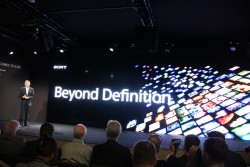
Image, IP, workflow: three pillars on which Sony proposes to build a future “beyond definition”
Among the new features that Sony presents at IBC 2015, the new PXW-FS5 camera stands out, with a Super35 sensor and built-in electronic variable neutral density filters that allow you to achieve a cinematic look without the need for additional equipment or accessories.
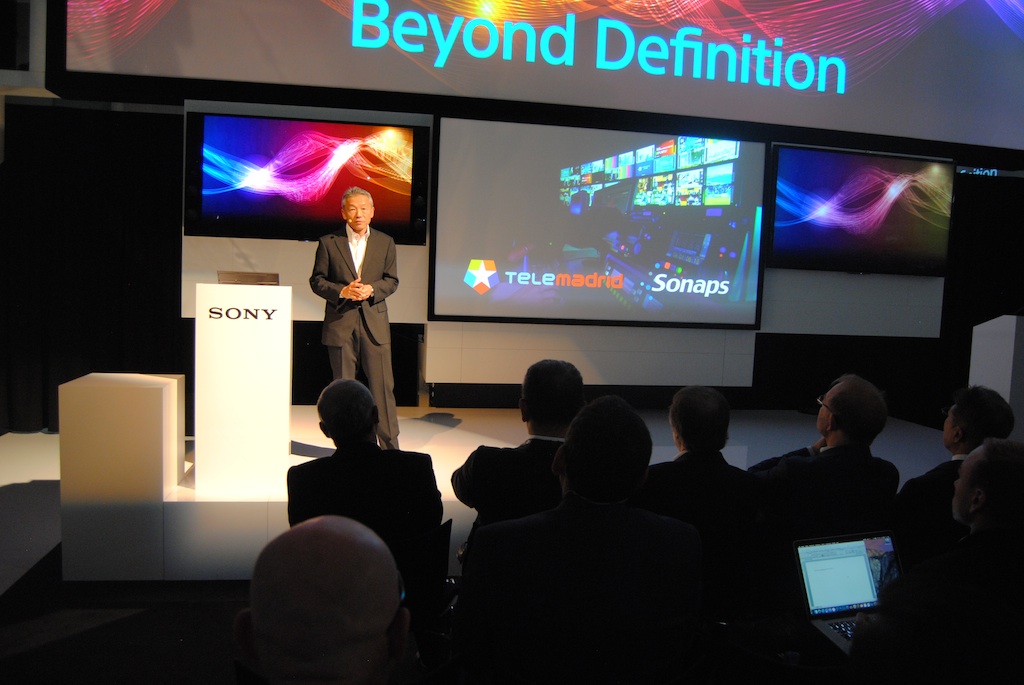
Katsunori Yamanouchi, vice president of professional solutions in Europe at Sony, highlighted at the beginning of this IBC 2015 that "image, IP and workflow are the three pillars on which Sony proposes to build a future 'beyond definition'. Precisely, this term perfectly describes our passion for always offering our clients the best image, with innovative technologies and being part of their day at hand in close collaboration."
In line with this trend, Yamanouchi has given the example of the project that the Japanese multinational has launched in Telemadrid. The Madrid autonomous community has installed the Sonaps networking solution, comprising an environment that integrates the planning, capture, editing, reproduction, distribution and archiving of audiovisual content, in a perfect workflow based on files for all platforms.
Telemadrid was the first regional channel to adopt a networking environment. After having used Sony's NewsBase system uninterruptedly for 15 years, Telemadrid put out to tender the provision of this service, which was awarded to Sony, with its Sonaps system. In the opinion of Sony managers, Sonaps offers all the advantages of digital technology and drastically improves its speed, quality and creativity in audiovisual content, reducing, in turn, operating costs. Furthermore, because the entire system is designed with open standard software and uses standardized hardware, it is not only compatible with legacy systems and easily scalable, but can also offer cost-effective starting points and avoid the risks associated with traditional infrastructure projects.
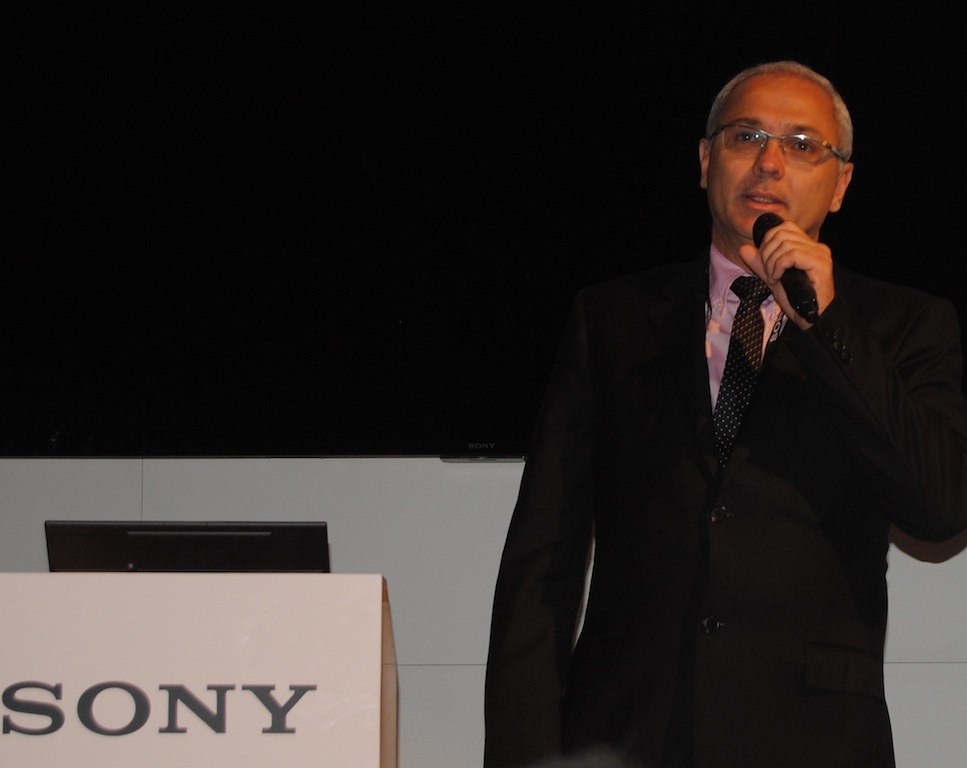
On the other hand, in relation to the rise of Ultra High Definition, Adam Fry, director of media solutions at Sony in Europe, has put on the table some of the broadcasters and platforms that are already betting on 4K such as Netflix, Hulu, Canal+ France or Sky Germany or service companies such as Timeline TV.
Fry has also given the UEFA Champions League final as an example of success in a 4K broadcast. Following the success of the 2014 UEFA Champions League final in Lisbon, the 2015 final in Berlin was the second time that European football's most prestigious match has been produced in 4K.
For the final in Berlin, the new HDC-4300 cameras and the popular PMW-F55 4K live system camera were used for 4K production. UEFA's complete live production workflow included PWS-4400 4K servers and MVS-X series multi-format switchers. To ensure the unparalleled footage captured in the stadium matched the production team's view of the action, UEFA used Sony's BVM-X300 30″ 4K OLED monitor to perform live monitoring within the mobile unit.
 Collaboration with TV Globo
At this year's IBC edition, Sony announced that TV Globo, Brazil's main network, has chosen the Japanese manufacturer as its IP migration partner. TV Globo recently signed a contract with Sony to develop the world's first mobile unit specifically designed for 4K/IP, which will be available in 2016.
Raymundo Barros, technical director of TV Globo, highlights that "this new mobile unit will be a key component of TV Globo's production plans for the major sporting events that will be held in Brazil from 2016 onwards. Sony has always been a reliable partner of TV Globo, so having Sony as a strategic partner in this project gives us the confidence to know that it will be a success. What's more, Sony's vision regarding 4K/IP technology is very similar to ours. The range of products “Sony’s newly announced 4K/IP is especially suitable for this 4K/IP mobile unit project.”
 PXW-FS5
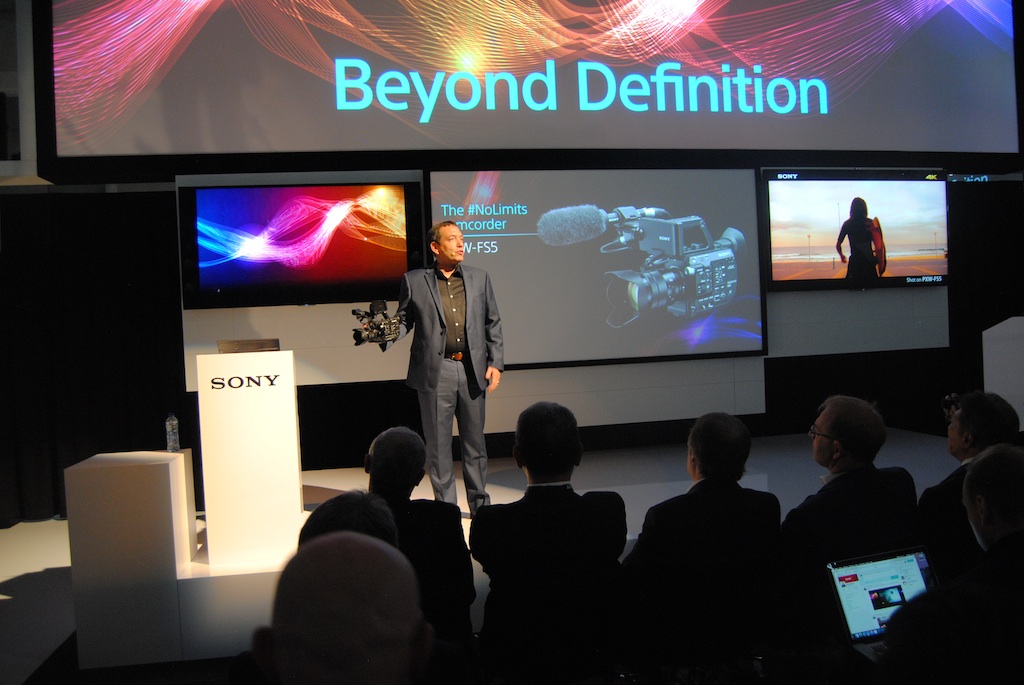
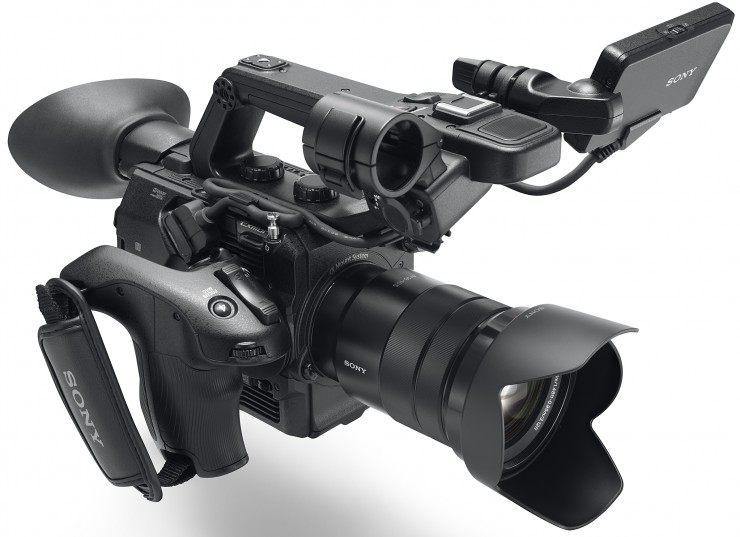
In addition to the new Alfa 7sII, with high sensitivity up to ISO 409600 and wide dynamic range, Sony debuts the PXW-FS5 at IBC. The versatile style of the PXW-FS5 camera allows you to record in all types of conditions with multiple options and multiple creative options.
This camera complements its older sister, the PXW-FS7, and is a compact device that allows you to produce high-quality images that can be used for multiple professional applications such as social events, corporate and online video production.
The PXW-FS5 is ergonomically designed with the user in mind, with excellent weight balance, ensuring equipment reliability and all-day handheld work in virtually any location, even mounted on a drone or gimbal. The equipment has a rotating grip that allows easy use and handling, since all the controls are at the operator's fingertips, allowing very high flexibility and instant change between different ways of filming. In response to the requests of many users, the 3.5″ LCD panel can be placed in different positions either on the handle or on the camera body, which also allows you to customize the way you work.
The camera can record in 4k XAVC Long Gop, using the Super35 sensor with 11.6 million pixels of which 8.3 million are effective, allowing it to capture detail and texture that even the best HD sensors cannot see. The high sensitivity of the sensor allows you to work in low light situations without problem in addition to having selective control over the depth of field with great image quality.
Additionally, the camera allows you to record in super slow motion up to 240fps in Full HD 10 bit 4:2:2 in blocks of 8 seconds, without having to crop the sensor.
The PXW-FS5 is the first Super35 camera in the world to incorporate electronic variable neutral density filters within the equipment, giving absolute control over the image and allowing you to achieve a cinematic look without the need for additional equipment or accessories.
The camera comes equipped with the PZ 18-105 F4 G OSS electronic zoom lens, which can be controlled from the grip with just one hand.
The camera has an E mount, which allows you to use any Sony E or A mount lens, as well as any type of Canon or any other brand lens using electronic adapters.
In terms of connections, the camera has SDI, HDMI output and dual SD slots in addition to WiFi and a wired network connection, which allows streaming and transmitting files via the network.
Future IP
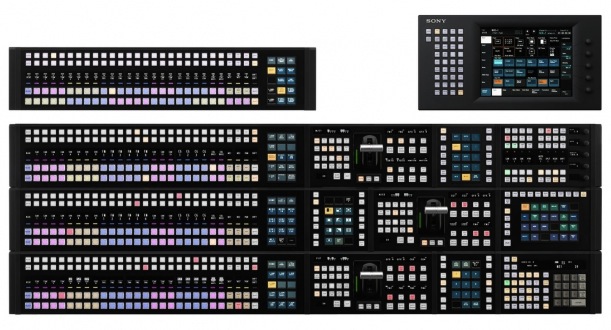
Sony has added new equipment to its IP live production system that unifies and modernizes live broadcast workflows, as well as supporting next-generation technologies emerging in the field of content creation.
Attendees of this year's edition have the opportunity to see the XVS-8000, an IP/4K live mixer; the BPU-4500, an IP/4K baseband processing unit; and the PWS-4500, a multiport IP/4K AV server. These products come together to form a complete ecosystem that delivers an IP live production system that is efficiently managed and distributed through Sony's IP Live System Manager.
At the same time as solutions have been developed for IP live production, Sony has created a new AV streaming interface called the Network Media Interface. Network Media Interface will transform all signals for live recording to PI, such as video, audio, metadata, synchronous signals and control signals. This will allow resource sharing with other production systems, allowing file-based systems and live production systems to be integrated into one. In this way, not only is productivity improved, but it represents significant savings for the chains, since they will no longer need to double their investment for each production system.
Sony BPU-4500The advances made with Network Media Interface also reflect technological advances within the sector, which respond to the growing demand for content with higher frame rates and higher resolutions. Network Media Interface is a future-proof interface supporting SD, HD, 4K, 8K and high frame rates for both compression and non-compression. Plus, it streams 4K over IP with a single Ethernet cable and using a low-latency video codec.
By introducing IP live production, broadcasters ensure that their infrastructure is efficient and scalable, and that their investment will last beyond the next decade, efficiently replacing the current capabilities offered by the SDI interface. The scalability of the system is reflected in the migration from SD/HD to a new generation video format.
As part of Network Media Interface, Sony has submitted technical specifications of the low-latency video codec that was developed for 4K transmission over IP at 10 Gbps to the SMPTE (Society of Motion Picture and Television Engineers) as a registered declaration document (RDD). In addition, Sony has proposed a series of technological elements necessary for live production over IP, which will be included in the definition of the SMPTE ST 2022 standard.
Access to the IBC 2015 SPECIAL in Panorama Audiovisual
Did you like this article?
Subscribe to our NEWSLETTER and you won't miss anything.
Related articles
 Good Mood (Daniel Écija and Javier Lorenzo): franchises and brands, pillars of the future of the series
 Artificial intelligence, cloud and hyperconverged solutions, the main pillars on which NAB 2024 is based
 The WUC launches three television studios with a workflow based on Blackmagic
 Digitalization and innovation: the pillars on which regional public radio and television stations plan to grow
 Amazon will invest 2.5 billion to build its three data centers in Spain
 Grass Valley proposes to accompany the industry looking to a future defined by software
 Rohde & Schwarz propone construir un futuro IP en base a una sólida herencia SDI
 Sony live in 4K, HDR and IP… “beyond definition”
 VSN software drives automated workflow for mexican Imagen Televisión
 Sony will take a step further in its 'Beyond Definition' strategy at NAB
 5G, IoT and cloud, main pillars on which the ICT industry will be based, according to Hans Vestberg
 Sony unveils HDC-4300 camera, first with three true 4K image sensors
 Sony PSLA lanza el Beyond Definition Latin American Tour
IEC and Sony organize an advanced seminar on the XDCAM workflow
Sony PSLA lanza el Beyond Definition Latin American Tour
IEC and Sony organize an advanced seminar on the XDCAM workflow