





Panasonic takes an image step with the development of the new CMOS sensor (APD-CMOS)
Utiliza fotodiodos en avalancha (avalanche photodiodes, APD) en cada píxel, lo que permite obtener señales eléctricas multiplicadas 10.000 veces.
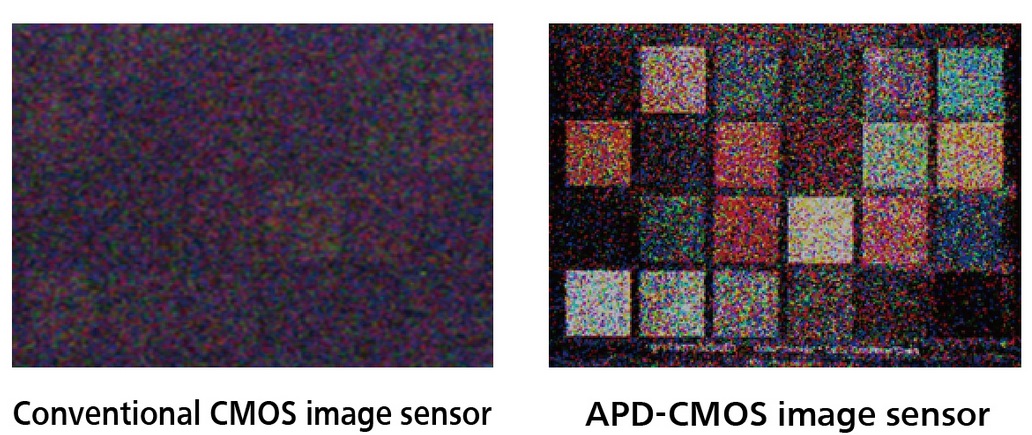
Panasonic ha anunciado en la Conferencia internacional de circuitos de estado sólido 2016, celebrada la pasada semana en San Francisco, que ultima el desarrollo del sensor de imágenes CMOS (APD-CMOS) que utiliza fotodiodos en avalancha (avalanche photodiodes, APD) en cada píxel.
La empresa tuvo éxito al obtener señales eléctricas multiplicadas 10 000 veces mediante la multiplicación APD de fotoelectrones generados por conversión fotoeléctrica en el fotodetector. Esto permite obtener imágenes con colores definidos incluso bajo la luz de las estrellas (iluminancia de 0,01 lux) o en otros lugares oscuros.
Este nuevo sensor de imágenes permite la generación de imágenes altamente sensibles a través de la multiplicación de fotoelectrones, obteniendo imágenes en color de alta gradación sin la necesidad de aumentar el tiempo de exposición incluso en lugares oscuros. Además, la multiplicación de fotoelectrones puede ser controlada instantáneamente al cambiar el voltaje aplicado a los APD dependiendo de la iluminancia al momento de captar la imagen, lo que permite tomar imágenes en varias iluminancias desde lugares iluminados a lugares oscuros. Sus aplicaciones esperadas incluyen cámaras de vigilancia que exigen imágenes en color con un amplio rango dinámico y cámaras industriales que exigen la toma de imágenes ultra sensibles.
Este desarrollo permitiría lograr imágenes en color altamente sensibles (40 mill./lux・sec・μm2, 10 000 veces más sensible en comparación con dispositivos convencionales) y con un alto rango dinámico (100 dB, 40 dB por encima en comparación con sensores de imágenes CMOS convencionales)
Este desarrollo está basado en dos tecnologías. Por un lado, la tecnología de diseño de elementos de fotografía APD en donde se incorporan fotodiodos avalancha y almacenamientos de carga son incorporados en el conversor fotoeléctrico no sólo para multiplicar sino también para acumular fotoelectrones que contienen información de color generada.
Por otro la tecnología de sensibilidad variable en la cual la multiplicación es controlada en un milésima de segundo mediante el control del voltaje aplicado a la APD, obteniendo una imagen de video de 30 cuadros por segundo que puede seguir los cambios en la iluminancia
Con sensores de imagen convencionales, los fotoelectrones que son convertidos mediante fotoelectricidad durante la captura de imágenes en lugares oscuros pueden estar por debajo del nivel de ruido y, por lo tanto, limitan el entorno de captura de imágenes a no menos que la luz de la luna (iluminancia de 0,1 lux). Este es el motivo por el cual fue posible captar imágenes bajo la iluminación de una fuente de luz casi infrarroja y mediante el uso de multiplicadores fotográficos.
Sin embargo, las fuentes de luz casi infrarrojas tienen la desventaja de su incapacidad de captar imágenes a color, mientras los multiplicadores fotográficos tienen la desventaja de forzar el aumento de tamaño de las cámaras debido a la necesidad de una fuente de potencia de mayor capacidad.
Did you like this article?
Subscribe to our NEWSLETTER and you won't miss anything.
Related articles
 DJI launches Mini 5 Pro drone: UHD recording and one-inch CMOS sensor in mini size
 Sony PXW-Z300, the new 4K 60P XDCAM camcorder with 17x zoom, 1/2-inch triple CMOS sensor and AI subject tracking
Sony PXW-Z300, the new 4K 60P XDCAM camcorder with 17x zoom, triple 1/2-inch CMOS sensor and AI subject tracking
Sony PXW-Z300, the new 4K 60P XDCAM camcorder with 17x zoom, 1/2-inch triple CMOS sensor and AI subject tracking
Sony PXW-Z300, the new 4K 60P XDCAM camcorder with 17x zoom, triple 1/2-inch CMOS sensor and AI subject tracking
 Panasonic Lumix S1RII: a hybrid camera with full-sensor 8K recording
 Panasonic bets on UHD with a new studio camera with a 35mm sensor and a PTZ
 The Sony HDC F5500, with 4K Super 35mm CMOS sensor and global shutter, is now available in Europe
 Sharp 8C-B60A: an 8K camcorder with 33 million pixels and a Super 35 CMOS 60p sensor
 World's first 8K 60 fps HDR CMOS sensor based on organic photoconductive technology
 The versatility of Panasonic's new compact EVA 1 with Super-35 sensor captivates the IBC
 This will be the new Panasonic AU-EVA1, with 5.7K Super 35 sensor and EF mount
 Sony PXW-Z450: a 4K XDCAM shoulder camcorder with a 2/3″ 4K image sensor
 Canon develops APS-H size CMOS sensor with 250 million pixels
 The sky like never before, thanks to Canon's ultra-high sensitivity CMOS sensor
 Panasonic takes a new step in the Smart TV revolution