





FAPAE celebrates 25 years defending the interests of Spanish producers
Audiovisual producers take stock of Spanish cinema from 1991 to 2016, a period in which the number of spectators has doubled.
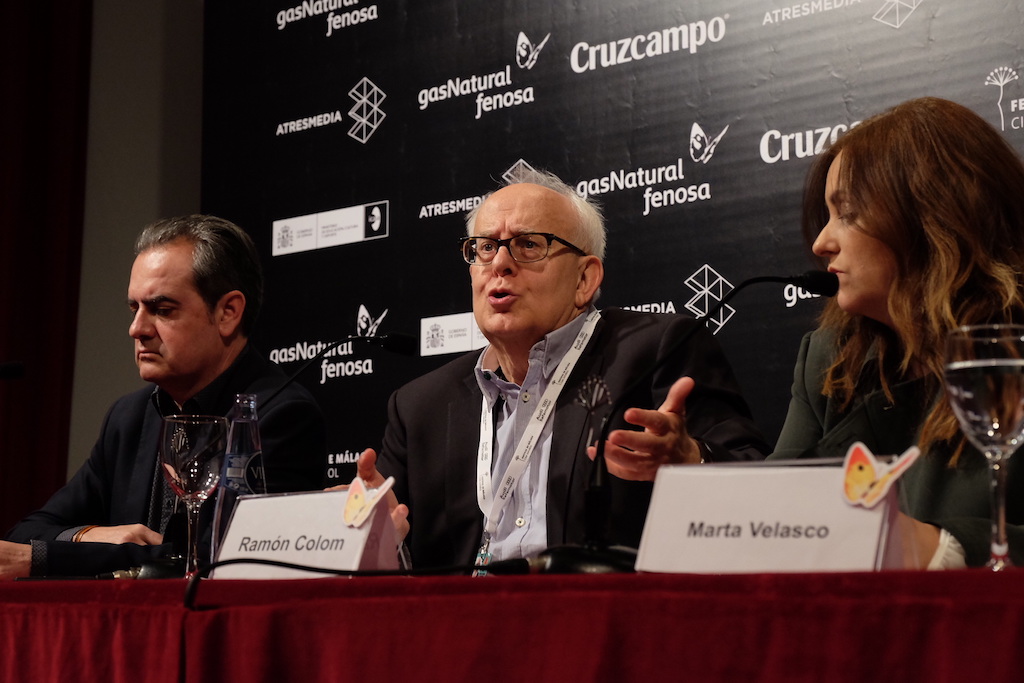
The FAPAE Confederation, which brings together Spanish audiovisual producers, celebrated today, at the XIX Malaga Festival. Spanish Cinema, its 25th anniversary. In April 1991, FAPAE was born with the same objective that it maintains today: to defend the interests of Spanish audiovisual producers.
At the press conference that took place today, Ramon Colom, president of FAPAE, appeared along with Marta Velasco, who attended on behalf of the Association of Audiovisual Production Companies of Andalusia (AEPAA-APRIA).
Throughout these years, in addition to its institutional representativeness, FAPAE has managed to position itself as a reference in the sector's data source. In this sense, the Confederation has taken stock of the last 25 years of Spanish cinema.
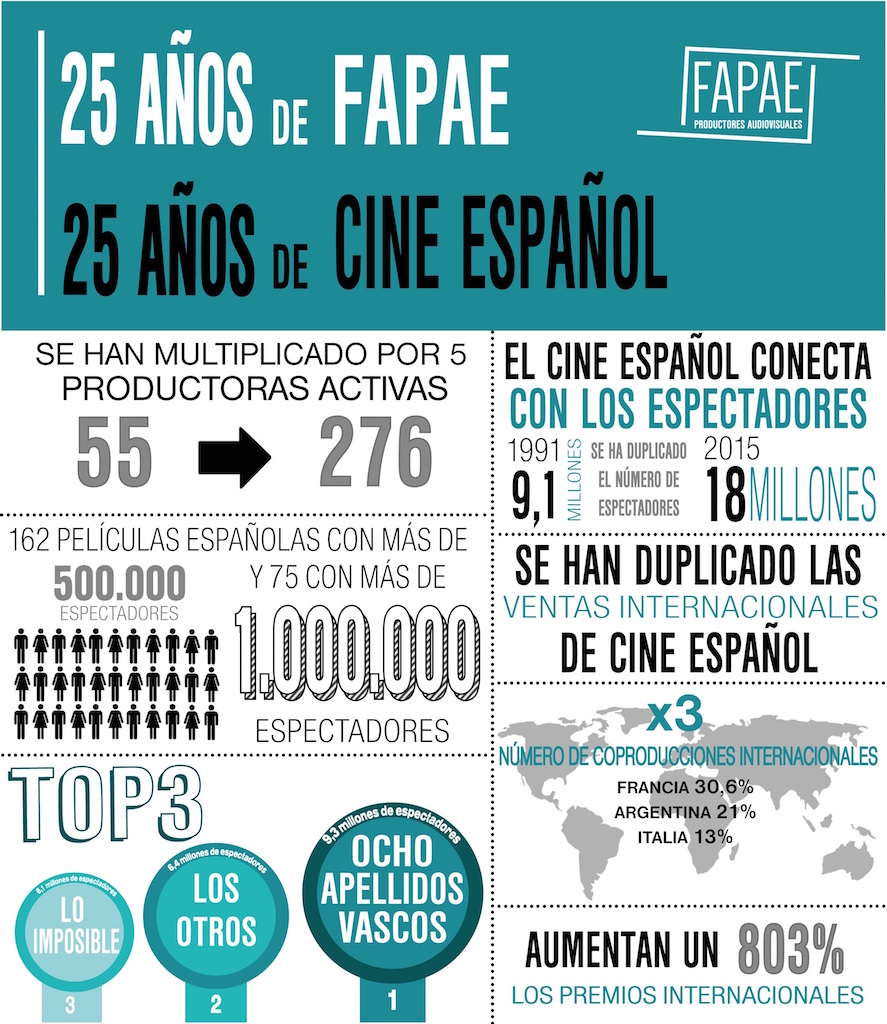
Ramon Colom highlighted that "Spanish cinema has managed to connect with viewers and there has been a change in the perception and appreciation of our cinema." The number of spectators has doubled; In 1991 there were 9.1 million viewers and in 2015, 18 million. Thus, in 1991 the market share was 10.9% and in 2015 it was 19%.
According to the data provided in this balance sheet, which is available on the FAPAE website, over these 25 years the number of active film companies that produce a greater diversity of genres has multiplied by five and the number of international co-productions has tripled. However, the average cost of Spanish films has decreased in recent years, returning to the levels of 2000, with 1.8 million euros.
162 Spanish films were seen by more than half a million viewers and 75 of these exceeded one million viewers over the last 25 years. In 1991, only one Spanish film surpassed one million viewers, Far Heels. In 2015, five feature films have surpassed this bar: Eight Catalan surnames, Capture the flag, Losing the north, Regression y Now or never, as in 2006, 2008, 2009 and 2014.
It is worth highlighting the 803% increase in international awards for Spanish cinematography, despite the decrease in the presence of Spanish cinema in international festivals, which has fallen by 36.7%, from 147 in 2000 to 93 in 2014.
New aid model
Ramon Colom has also carried out an analysis of the current audiovisual situation with special attention to the new model of aid for cinematography that is being implemented.
Once again, the data for the year in Spanish cinematography has been released; In these three and a half months of 2016, no substantial changes are currently reflected compared to the same period in 2015 in the reported shootings of Spanish cinema, 38, and the productions made, 51.
The collection of Spanish films in theaters reaches 36 million euros, almost double that of 2015 at this time. The share of Spanish cinema, as of April 18, amounts to 19.3%, similar to the share that ended in 2015 and higher than that obtained on the same date last year, which was 10% (according to data provided by ComScore).
Andalusian cinematography
Ramon Colom has been accompanied by Marta Velasco (representing the Andalusian association of producers, AEPAA-APRIA), who has insisted on the need to develop the two laws that are in the Andalusian Parliament (the Audiovisual Law and the Cinema Law) that have to be approved, among other issues, "in view of the application for new aid from the ICAA, which requires a certain level of guaranteed financing to overcome the planned cuts," he indicated. AEPAA-APRIA had a commitment from the Andalusian Government that the new aid regulations would be published in the first quarter of 2016 and, to date, no announcement has been made.
Regarding the data provided in the balance sheet, it stands out that in these 25 years, Andalusia has gone from two active film companies in 1995 to 23 in 2014.
Did you like this article?
Subscribe to our NEWSLETTER and you won't miss anything.
Related articles
 RTVE celebrates its 3rd day of international content distribution with prominent Spanish producers
 Onda Cero turns 30 years old
 Sol Música celebrates twenty years supporting Spanish artists
 Spanish audiovisual content travels to the Asia Tv Forum market with the help of FAPAE
 Vantec turns 25 years old
 Godzilla turns 60
 RNE's 'The Critical Eye' turns thirty years old
 Orad turns twenty years old
 Spanish producers make Spanish cinema fashionable in the US and Latin America
 Maxon turns 25
 Boadcast 2011 will host FAPAE, the producers' association for the first time
 Radio Galega turns 25 years old
 Photoshop turns 20 today
 DVS turns 25 years old