





RTVE y Story Producciones coproducen el documental ‘La historia secreta de las momias’
Cuatro momias de la colección del Museo Arqueológico Nacional han sido analizadas con las técnicas de radiología más avanzadas.
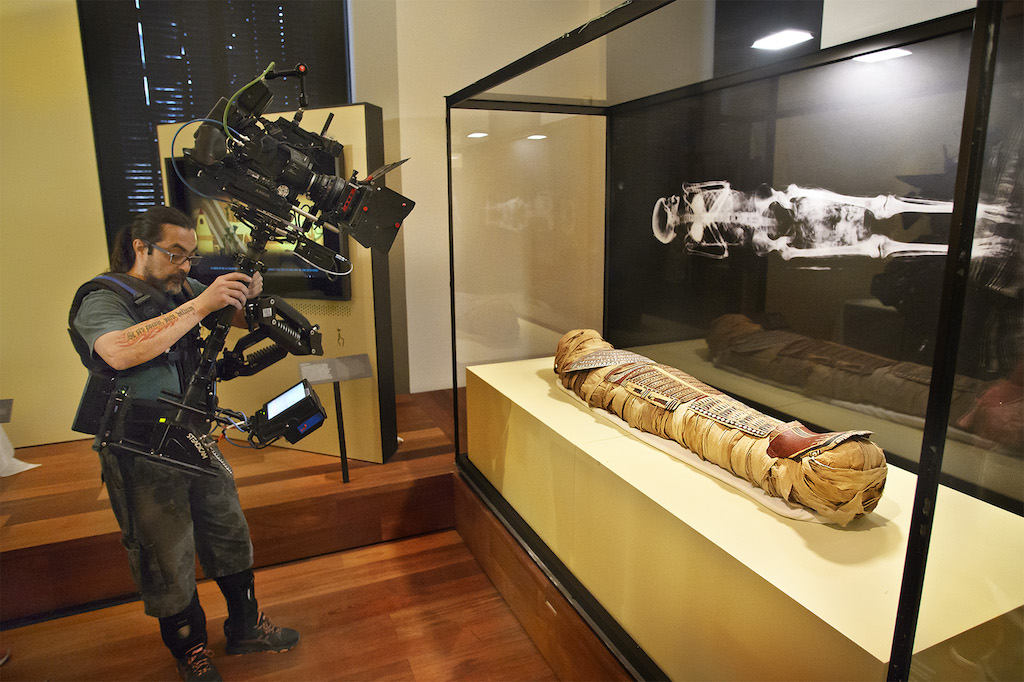
RTVE coproduce junto a Story Producciones La historia secreta de las momias, un documental que mostrará la historia más desconocida y sorprendente de las momias y del antiguo Egipto a partir del análisis de cuatro momias de la colección del del Museo Arqueológico Nacional (MAN) en una investigación pionera realizada en el Hospital Universitario Quirónsalud de Madrid.
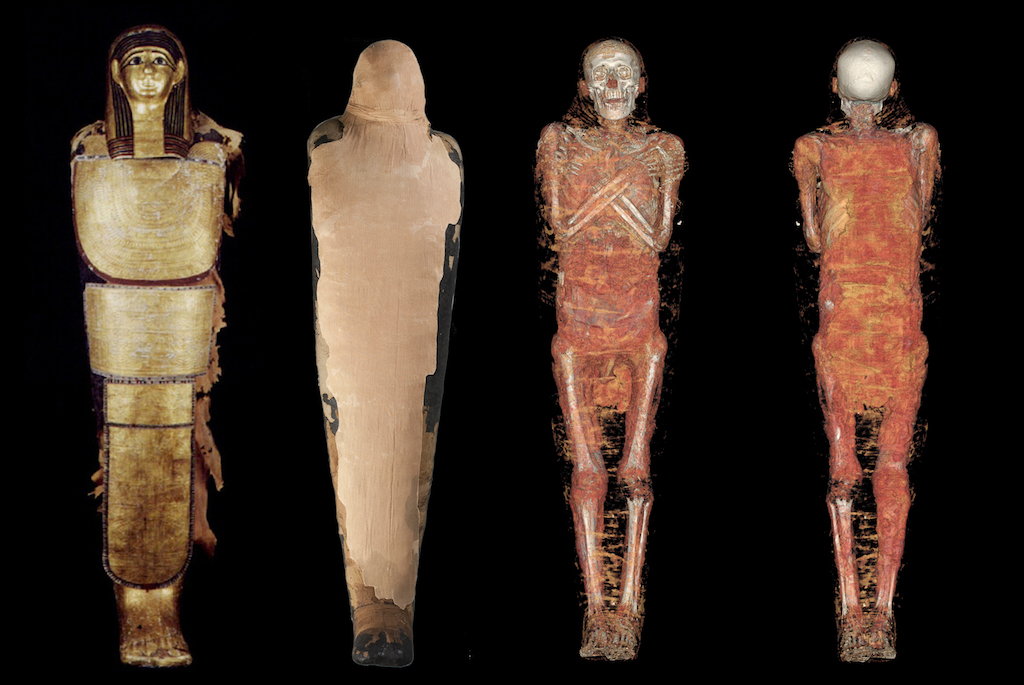
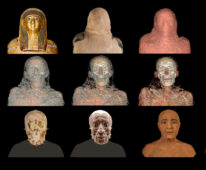
Cuatro momias, tres egipcias y una guanche, de la colección del Museo Arqueológico Nacional, han sido trasladadas este domingo al Hospital Universitario Quirónsalud de Madrid para ser analizadas con las técnicas de radiología más avanzadas del mundo: un equipo de tomografía computarizada de nueva generación, que permite escanear a las momias y generar su representación volumétrica y tridimensional a partir de la adquisición de más de 2.000 imágenes transversales.
El estudio ha permitido obtener imágenes de alta resolución de los cuerpos, aportando detalles inéditos de su fisionomía, que necesitarán ahora un análisis minucioso para determinar posibles causas de su muerte, enfermedades, hábitos de vida, …
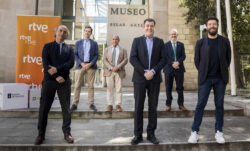
Vicente Martínez, jefe del Servicio de Diagnóstico por la Imagen del Hospital Universitario Quirónsalud Madrid, dirigirá el equipo responsable de la investigación médica. El director del Museo Arqueológico, Andrés Carretero y su equipo especializado en el estudio y conservación de las momias, interpretarán los resultados científicos en su contexto histórico para su uso en el MAN, que después se mostrarán en el documental.
El proceso se llevó a cabo una vez cerrado el MAN, entre las 3 de la tarde del domingo y las 4.30 de la madrugada del lunes, siguiendo un estricto protocolo para garantizar las mejores condiciones de conservación de las momias durante las cuatro horas que permanecieron fuera del museo.
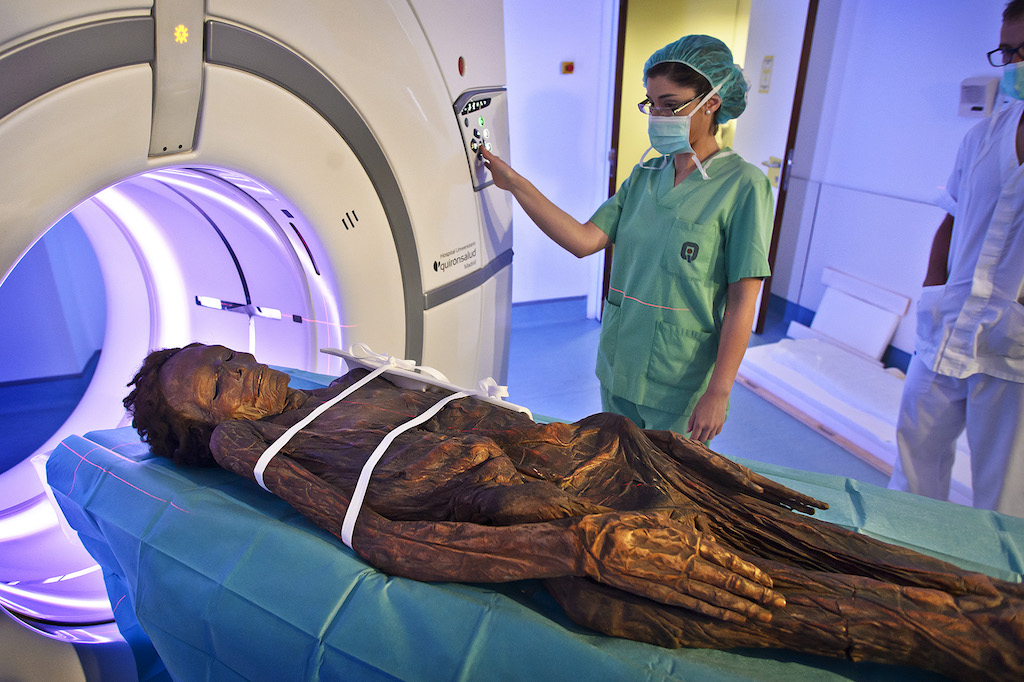
El traslado
El traslado se llevó a cabo por un equipo especializado de 11 personas, coordinado por la jefa del Departamento de Conservación del Museo Arqueológico, Teresa Gómez Espinosa, la jefa del departamento de Antigüedades Egipcias y Oriente Próximo, Carmen Pérez Die, y la conservadora de la misma sección, Esther Pons.
El traspaso de las momias desde sus vitrinas al tomógrafo se realizó gracias a un embalaje y transporte muy sofisticados diseñados para mantener las condiciones de conservación idóneas. Se trata de un estudio no invasivo en el que las momias no han sido manipuladas en ningún momento: llegan cuidadosamente envueltas, son escaneadas y posteriormente vuelven al museo.
Dos de las momias estudiadas pertenecen al periodo ptolemaico (332 a.C.-30 a.C.). La primera corresponde a Nespamedu, sacerdote de Imhotep el Grande, y procede de la necrópolis de Saqqara (Menfis). La segunda pertenece a una mujer adulta, de unos 65 años.
La tercera es una mujer joven, que vivió durante el Tercer Periodo Intermedio (845 a.C.-664 a.C.) y procede de Tebas.
La última en ser analizada es la momia guanche del Barranco de Herques, hallada en 1776 en Tenerife y la mejor conservada que existe en el mundo.
Did you like this article?
Subscribe to our NEWSLETTER and you won't miss anything.
Related articles
 The TV Academy resumes the recordings of 'Tesoros Vivos', its documentary archive on the history of television in Spain
 La historia de Carme Elías en ‘Mientras seas tú’, Mejor Película Documental de los Goya 2024
 RTVE y Portocabo coproducen ‘Argonautas’, primer live action infantil para Clan
 Movistar+ repasará la historia de Raphael a través de una serie documental original
 Ya se rueda ‘Piratas en Baleares’, la nueva serie documental de Canal Historia, IB3 y Mapa Films
 Story Producciones, the University of Granada and RTVE co-produce a documentary on the origin of Columbus
 La 2 estrena el documental ‘La momia dorada’ que RTVE ha producido en 4K junto a Story Producciones
 Zebra Producciones premieres the documentary series 'The extraordinary powers of the human body' on Movistar+
 David Shing, en MABS2017: “hay que concentrase en la historia y menos en cómo contarla: más story y menos telling”
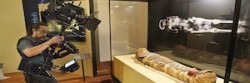 Spanish Television discovers in 4K 'The secret history of the mummies' from the Archaeological Museum
 Jorge Garrido, María Lamuy and Afioco direct a documentary about the history of the demands of the LGTBI collective
 RTVE forma parte, por primera vez en su historia, del Comité Legal de la UER
 Sergio Oksman, Goya al Cortometraje Documental por ‘A story for the Modlins’
 'Presumed guilty', the most viewed Mexican documentary in history