





The SGAE Foundation presents its Yearbook on Performing, Musical and Audiovisual Arts
The work presents information perfectly analyzed in quantitative and structural terms on the following sectors of the cultural panorama: performing arts (theater, dance and opera), classical music, modern music, cinema, recorded music, television, video, radio and new technologies.
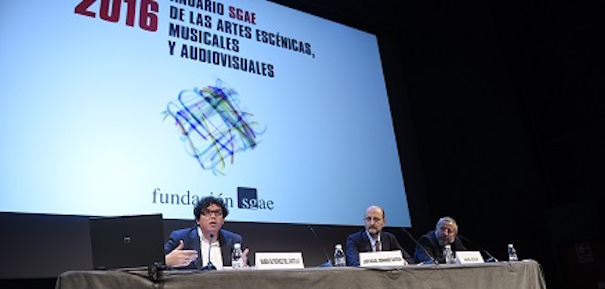
This Thursday in Madrid, the SGAE Foundation presented the SGAE 2016 Yearbook of the Performing, Musical and Audiovisual Arts, a volume that offers basic statistical data to characterize the cultural sector. It is a consolidated research, now in its sixteenth edition, and which constitutes one of the basic resources to learn about different areas of the cultural sector.
The Yearbook offers rigorous and detailed information on the main sectors of the performing, musical and audiovisual arts, with tens of thousands of numerical data and more than 310 graphs and statistical tables. It arises as a result of a laborious process of capturing and processing data, compiling sources and analyzing this information. This publication, born in 1999, has already become a fundamental tool for scholars of the Spanish cultural market.
The work presents information perfectly analyzed in quantitative and structural terms on the following sectors of the cultural panorama: performing arts (theater, dance and opera), classical music, modern music, cinema, recorded music, television, video, radio and new technologies. For each section, it presents a report that analyzes the main data of that sector, highlighting its characteristic aspects throughout 2015 and providing elements for comparison with the 2014 exercise.
Manuel Aguilar, president of the SGAE Foundation, has pointed out that "Meanwhile, the evolution of the cultural sector, as expressed in the figures of the Yearbook, shows signs of stagnation: if 2014 was a year in which, for the first time in several years, positive variations in some of the main indicators could be observed, the year 2015 is characterized by a very timid positive evolution of some indicators, which coexists with slight decreases in others. Reading the Yearbook makes it clear that, either this situation is taken advantage of, something more favorable than that corresponding to previous years, or it will be difficult for us to get the cultural areas that we study here to even approach the level corresponding to the years 2008 or 2009. But, for this, a clear policy is essential which, we insist, has not so much to do solely with the increase in budget items as with defining a clear strategy.
Cine
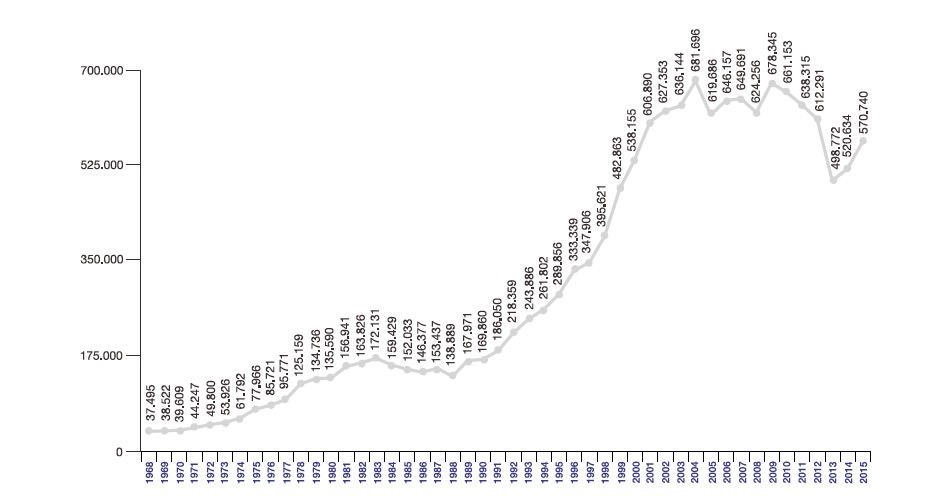
Since 2004 there had been declines in all film indicators in Spain, however, the last two years have witnessed rises. However, the 2015 figures are far from those obtained in 2008, the year selected for our comparisons. Since then, 372 movie screens have been lost (13.7%), while the number of sessions has fallen by 21.4% (38,201 fewer). Attendance also continues to be 12% lower in 2015 than in 2008, despite the positive figures of the last two years (in 2013, this difference reached 28.9% less). Collection has lost 8.6% since
same year, which means revenue of 53.52 million euros less in 2015 (in 2013, the difference reached -20.1%, which means 125.49 million euros less in revenue per year).
In 2015 we have witnessed a new decrease in the number of screens, which have dropped to 3,597 (64 screens were lost, 1.8% less than in 2014). On the other hand, the number of digital screens in Spain continues to grow, reaching 3,502 in 2015 (10.1% more than in 2014). They also increase again the number of films screened, which reaches 2,040 (303 more films than in 2014).
The number of sessions has also fallen again, reaching 3,873,859, 1% less than a year before (38,201 less). On the other hand, in 2015, 95,043,710 tickets were sold, increasing the figure obtained in 2014 by 7.8% (6,898,213 more). The CCAA with the most tickets sold were: Madrid, with 18,720,384 (19.7% of the total); Catalonia, with 18,579,804 (19.5% of the total), and Andalusia, with 13,817,850 (14.5% of the total). The annual average of entries per inhabitant of the Spanish territory grew from 1.88 in 2014 to 2.01 in 2015. Six Autonomous Communities exceed this average: Madrid (2.9), Catalonia (2.5), Aragon, Balearic Islands, Valencian Community and Navarra (the last four, with 2.2).
Video
In 2015, 67.15 million euros were collected, 1.85 million more than a year before (growing 2.8%). Of this figure, only 3.2% belongs to the revenue obtained from rentals (2.12 million euros), which again decreased compared to the previous year (18.2% less). The proceeds obtained from the sale are, therefore, 96.8% (65.03 million euros, growing by
3.7% compared to 2014).
After two years of increases, the number of audiovisual files downloaded has decreased by 20.7%, reaching 772.10 million audiovisual files downloaded in 2015. Of these, the majority are still free downloads, specifically 96.2%. Despite this, we observe a positive fact, paid downloads increase for the third consecutive year, 4.8% compared to 2014, obtaining the highest figure in the series (30.5 million paid downloads of this type of files).
Television
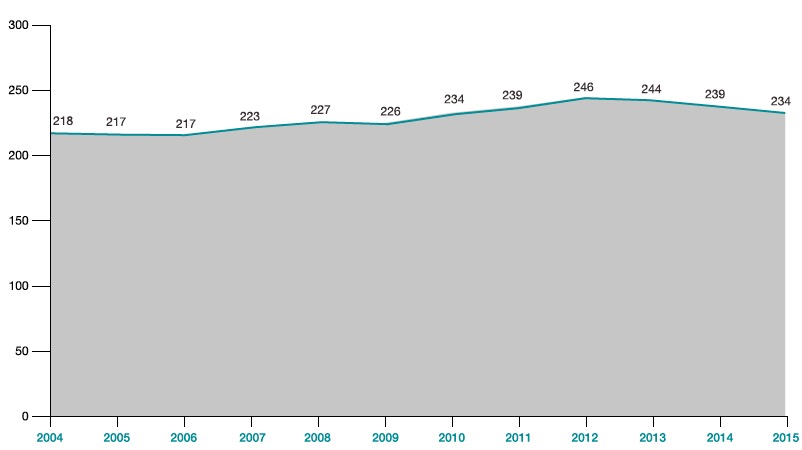
According to the SGAE Yearbook, in 2015, for the third consecutive year, television consumption decreased, falling to 234 minutes per person per day (five minutes less than in 2014). Despite this, this figure is still seven minutes above what was obtained in 2008 (227 minutes). Among the Autonomous Communities with the highest average television consumption are Castilla-La Mancha (251 minutes) and Andalusia (244). On the opposite side we find the Canary Islands (220), Madrid (221) and the Basque Country (224).
Despite this decline in television consumption, advertising revenue is growing, just as it was the previous year.
During 2015, 2,011.3 million euros were obtained from television advertising revenue. This figure, despite increasing by 6.4% compared to 2014 (121 million euros more), is still 29.3% lower than that obtained in 2008. Of the advertising revenues, 89.8% is obtained from free-to-air national television, followed by regional channels, which collect 6.6% for this concept. The income that increased the most in percentage terms was that of local television stations, which earned 53.9% compared to the previous year. Those of pay television also grew by 21.3%, already exceeding the figures obtained in 2010.
Radio
Radio consumption imitates the trend of television consumption, falling again to 105 minutes per day per inhabitant from Monday to Sunday (three less than in 2014), it only needs to drop one more minute to reach the 2008 figure. The Autonomous Communities with the highest radio consumption (Monday to Friday) are La Rioja (136 minutes), Navarra (128) and the Basque Country (124). On the opposite side, the Autonomous Communities with the least consumption are the Balearic Islands and Extremadura (both with 102) and Andalusia (103).
The Yearbook points out that the behavior of radio listeners continues to be similar to other years, the period that accumulates the most audience is weekday mornings (74.4% of the total, up one percentage point compared to 2014). Saturday and Sunday mornings also accumulate more radio listeners than the rest of the time slots (65.3% and 56.1%
respectively).
Advertising revenues also increased by 8% in 2015 compared to the previous year, a trend that continues for the second consecutive year, reaching 454 million euros. Despite increasing these incomes by 12.4% in two years, it is far from reaching the 642 million euros of 2008 (29.3% less in 2015 in relation to that year).
Access to the SGAE 2016 Yearbook
Did you like this article?
Subscribe to our NEWSLETTER and you won't miss anything.
Related articles
 The SGAE 2025 yearbook certifies a new decline in cinema and television in 2024
 Vienna University of Music and Performing Arts adopts Lawo consoles
 The SGAE Foundation presents 32 scripts at Conecta Fiction 2023
 RTVE Impulsa presents its Sandbox on automated monitoring of audiovisual content
 LIPA performing arts school (liverpool) chooses Neumann's state-of-the-art audio
 The SGAE Foundation calls for the first time 'SGAE Documentary 2019'
 The SGAE Foundation opens the call 'SGAE en Corto 2018'
 Triodos Bank and Crea SGR launch a specific financing line for the performing arts
 The SGAE Foundation announces the XII SGAE Script Award for Feature Film Julio Alejandro
 The SGAE takes stock in its Yearbook of the accumulated effects of the crisis on the sector
 The SGAE Foundation announces the XI SGAE Script Award for Feature Film Julio Alejandro
 The SGAE Foundation presents Spanish cinema in Argentina and Brazil
 The Author Foundation now undertakes a new stage as the SGAE Foundation
 The SGAE Yearbook takes the pulse of audiovisuals