





Digital acceleration would boost GDP by 3.6% in 2021
The report 'Digital Economy. An opportunity for Spain' highlights that achieving this objective involves generating talent, increasing investments, adapting regulations to new technologies and promoting digital platforms.
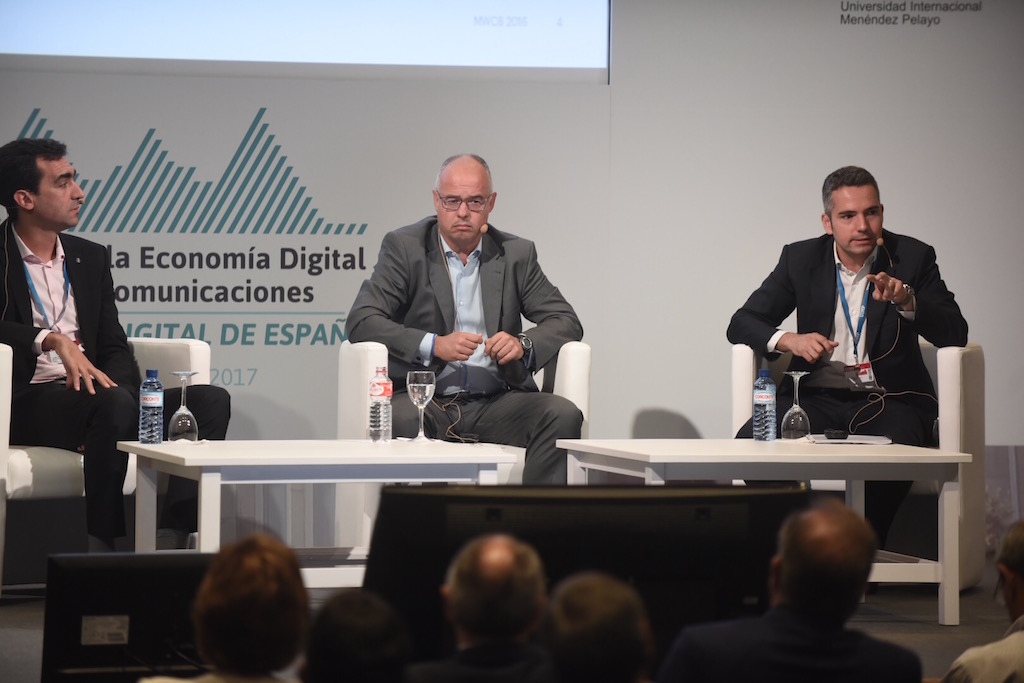
An acceleration of digitalization could increase GDP by 3.6% in 2021, according to the study Digital Economy. An opportunity for Spain prepared by Accenture Strategy for Mobile World Capital Barcelona, which was presented today for the first time at the 31st Digital Economy and Telecommunications Meeting organized by AMETIC in Santander.
The report, whose main lines have been released by the managing director of Accenture, Alberto Zamora, estimates that this additional increase in the national economy would translate into about 48.5 billion dollars.
All in all, this work shows that the digitalization of the Spanish economy is lagging behind the leaders. Thus, through the analysis of 36 variables, the study concludes that Spain ranks 11th out of 14, with a digital contribution to GDP that in 2016 was 19.7%, fourteen points below that registered in the United States.
As Zamora explained, this delay is identified with four limitations: the need for a clear digital strategy in companies (only 38% of executives in Spain say they have a Digital Transformation Plan. In fact, the lack of digital vision of organization leaders is still one of the main reasons for this low digital adoption in Spain), limited investment in innovation (according to Eurostat, Spain invested 1.2% of GDP in R+D+i in 2013 compared to 2.9% in Germany or 2.2% of France, an investment that the European statistical agency recalls comes from 28% of universities, 19% from public administration and the remaining 53% from the private sector, when in Europe the average weight of this sector amounts to 63.2%), insufficient digital talent (which the report attributes in part to the high level of youth unemployment, which exceeds 43% when in Germany it does not reach 7%); low geographic mobility and lower investment in digital training due for the effects of the 2008 financial crisis. According to the EC's E-skills for Jobs in Europe report, it is estimated that in 2020 there will be one million jobs in Europe that will not be filled due to the lack of digital talent), and to the existence of regulatory frameworks that, it highlights, are not evolving as quickly as technology, especially in areas such as taxes, the creation of a single digital market or the adoption of new business models such as the circular economy.
To try to overcome these barriers and accelerate the digitalization process in Spain, the study recommends actions by companies and public administrations through a program focused on three levers: talent, investment in technology and accelerators.
In the first case, the proposal of this study involves generating digital talent in universities and capturing it in companies – “they must go more together,” said Zamora –, training existing talent in the digital field and developing new forms of work “more horizontal and more project-based”, as well as increasing teams dedicated to innovation.
In the field of technologies and investment, the aspect in which Spain is “most behind in relation to the United States and leading countries,” as admitted by the Accenture executive, the lines of action would focus on digitizing the relationship with the client, promoting collaboration in the company with digital tools and increasing investment in key technologies such as cloud, advanced analytics, artificial intelligence, IoT, mobility or social media.
Communications infrastructure
Finally, the report calls for facilitators or accelerators that promote digitalization, among which Zamora cited the deployment of a communications infrastructure at the level of digital leaders, the adaptation of regulation to new technologies, new business models and models based on the collaborative economy, as well as the promotion of the use of digital platforms and the promotion of new businesses.
"There is no single solution. But it is everyone's job to prioritize and find what the fundamental ones are," concluded the Accenture Strategy manager.
Before this report was released, the Strategy Director of Mobile World Capital Barcelona, Jordi Arrufí, opted to “raise awareness about everything that digital transformation means and represents” because, as he stressed, “everyone talks about digitalization but not everyone knows how to do it.”
Furthermore, Arrufí highlighted the role that the Administration must play in this purpose not only to generate digital public services, but also as “catalysts” of this new culture, and identified the automotive industry – immersed in the “greatest technological advance in its 130 years of history” he indicated – and banking, with “new digital services that place the customer at the center of the business”, as the two sectors that “are doing well”.
Finally, Celsa Group's Innovation Director, Ignasi Salvador, explained the program that this company belonging to the steel sector has implemented in this field with a presence in different countries, a staff of 9,000 workers and a turnover of around 3.6 billion euros annually.
Did you like this article?
Subscribe to our NEWSLETTER and you won't miss anything.
Related articles
 Ikegami's latest projects confirm an acceleration of mixed and IP environments
 Spanish radio demands the acceleration of digitalization at the III Radio Forum
 OTT, podcasts and digital transformation, axes of the new Strategic Plan 2021-2026 of RTVA (Canal Sur)
 Dalet AmberFin adds Dolby Vision and acceleration with Socionext
 The 31st Digital Economy and Telecommunications Meeting will focus on the transversality of digital transformation
 Sennheiser Digital 6000: a digital wireless microphone system that is all about performance
 Aaton Digital will present new options for its CantarX3 digital recorder at IBC
 The explosion of digital consumption: now we are all screenagers
 José Manuel Soria at the 1st Digital Economy Meeting: “the digital economy is no longer a challenge, it is a reality”
 Lavinia Interactiva creates Digital Factory, a comprehensive digital marketing service
 Quality control, acceleration and fingerprinting for VSN Spider with Tektronix and Civolution
 Sony Digital Cinema presents its 4K digital projector SRX-R515
 Prehistoric Digital chooses Barco's DP2K-P digital post-production projector
 The digital dividend marks the new challenges in digital television