





Contribution and distribution over IP: a transformative change
Jiri Matela, CEO de Comprimato, analiza en esta Tribuna cómo la conectividad IP brinda una nueva flexibilidad tanto en los circuitos de distribución como de contribución. La codificación JPEG2000 proporciona una alta calidad de vídeo con una relación de compresión de 10:1 para aplicaciones críticas donde la calidad no pueda verse comprometida.
Mucho se está hablando en la industria en este momento sobre las infraestructuras basadas en IP. Habitualmente, el debate se centra en la producción en vivo y la interoperabilidad entre sistemas. Esto es, por supuesto, extremadamente importante. Pero hay otra área en la que el IP tiene el potencial de generar un cambio transformador.
Para enviar el contenido de una ubicación remota al centro de producción, tradicionalmente se venía empleando un circuito de contribución (denominado backhaul en los EE.UU.).
Esto solía ser solo eso: un solo circuito. Por ello, si cubríamos, por ejemplo, un gran partido de fútbol, recibíamos una sola señal desde la unidad móvil a los estudios centrales.
Los broadcasters desplegaron desde los principales lugares de contribución circuitos permanentes. Estos eran cables de video y, por lo tanto, no tenían utilidad para ningún otro propósito, lo que significaba que el proveedor, generalmente la compañía de telecomunicaciones local, tenía que cobrar una suma considerable para cubrir los costes de instalación y suministro.
Cuando no había circuitos de video disponibles, las producciones se veían obligadas a utilizar enlaces de microondas con visibilidad directa (con un alcance y una ubicación limitados) o enlaces ascendentes satelitales. Al igual que los enlaces fijos, ambas soluciones de radio eran costosas, arriesgadas en términos de vulnerabilidad y, en el caso de los enlaces por satélite, añadían una latencia significativa.
Con la llegada de la conectividad en tiempo real para audio y video profesional, todo esto ha cambiado. Al convertir el feed en IP, ya no es necesario un enlace dedicado pudiéndose transportar la señal como datos sobre cualquier portadora con suficiente ancho de banda. En particular, dado que las empresas de telecomunicaciones han instalado fibra oscura de alta capacidad en todos sus territorios, y particularmente en áreas metropolitanas que albergan los principales estadios deportivos, la transmisión puede transportarse como datos junto con el resto del tráfico.
Esto ha significado un ahorro de costes ya que las telcos han optado por cobrar por los datos transportados, pagando los broadcasters únicamente por lo que usan. También ha aumentado la resiliencia, ya que es posible usar rutas redundantes geográficamente diversas, con el dispositivo receptor cambiando sin interrupciones entre las señales más potentes.
Múltiples feeds
La entrega exitosa de la contribución sobre IP depende de un buen enrutamiento de la señal y de una codificación de alta calidad para lograr la mejor transmisión con la tasa de bits más óptima. Si bien la codificación H.264 ha sido ampliamente utilizada, y ante la irrupción del H.265, se plantea una aplicación ideal para el JPEG2000. Este códec proporciona una alta calidad de video con una relación de compresión de 10:1 para aplicaciones de contribución y, en general, se considera que sus algoritmos de wavelet se degradan en menor medida que la transformada de coseno discreta utilizada en la compresión de tipo MPEG.
JPEG2000 también permite la entrega sin comprimir pero empaquetada, cuando no se pueda tolerar comprometer la calidad.
Una vez que los broadcasters aceptaron el concepto de compresión leve en los circuitos de contribución, y el transporte de IP de esas transmisiones, surgió la pregunta obvia: ¿podemos llevar más de una transmisión desde el lugar donde se celebra un evento a los estudios centrales? Esto podría transformar la producción.
Este códec hace posible la capacidad de entregar múltiples feeds paralelos de un evento. En el rugby o el fútbol, podríamos tener diferentes cortes para cada equipo. Para un evento de atletismo, podríamos tener señales orientadas a diferentes pistas o canchas en un recinto. Podríamos contar con una fuente internacional junto con una producción nacional que incluyera señal desde un set en el sitio para debates y presentaciones.
También significa que podemos entregar contenido alternativo junto con el feed principal, lo que permite al titular de los derechos empaquetar un evento de diferentes maneras para diferentes plataformas. Todo esto proporciona nuevas formas de interactuar con la audiencia y monetizar la cobertura del evento.
Distribución local y remota
Otro requisito importante es entregar múltiples feeds en el propio lugar donde tiene lugar un evento. Un caso obvio podría ser el uso del video referee o vídeo asistido para arbitraje, donde el árbitro podría acceder al momento a diferentes ángulos de cámara.
Instalar una gran cantidad de fuentes de vídeo es desafiante y lleva mucho tiempo mientras que trabajar con una sola fibra es mucho más simple.
Si bien los sistemas de videoarbitraje se encuentran en el propio estadio o pabellón deportivo, con el tiempo es posible que los deportes más importantes sigan el ejemplo de la NBA en Estados Unidos, que tiene un centro de videoreceptores centralizado que recoge todas las señales de todos los partidos que se celebran de forma simultánea.
Los broadcasters habitualmente brindan imágenes de cortesía a las pantallas del estadio y a otras áreas como la sala de prensa o los puestos de comentarista. Nuevamente, la distribución de múltiples feed sobre fibra es mucho más fácil de implementar.
Este concepto puede trasladarse a la distribución, con la distribución de streams por parte del broadcaster. Nuevamente, esto es tradicionalmente una salida de canal único sobre un circuito de video, que luego se modifica para la plataforma en cada cabecera individual. Por lo tanto, la señal de transmisión será comprimida por hardware en las cabeceras terrestres, por cable y por satélite antes de la multiplexación; y se transcodificará para almacenamiento para video bajo demanda y para transmisión en vivo a través de múltiples plataformas.
Esta arquitectura es intrínsecamente costosa, ya que requiere dispositivos dedicados para cada flujo en cada cabecera. También es un riesgo para la calidad, porque los transcodificadores están fuera del control físico del broadcaster, ya que son remotos.
Esta misma arquitectura de presentación de múltiples flujos de video a lo largo de una o varias cadenas de fibra oscura se puede aplicar a la distribución. Esto permite que el broadcaster o proveedor de contenido mantenga el control de calidad sobre toda la codificación interna, distribuyendo los diferentes formatos requeridos debidamente empaquetados.
Codificación de software
Para trasladar estas ideas de una discusión teórica a una solución práctica es fundamental la capacidad de codificar y transmitir un gran número de líneas de alta calidad de manera rentable.
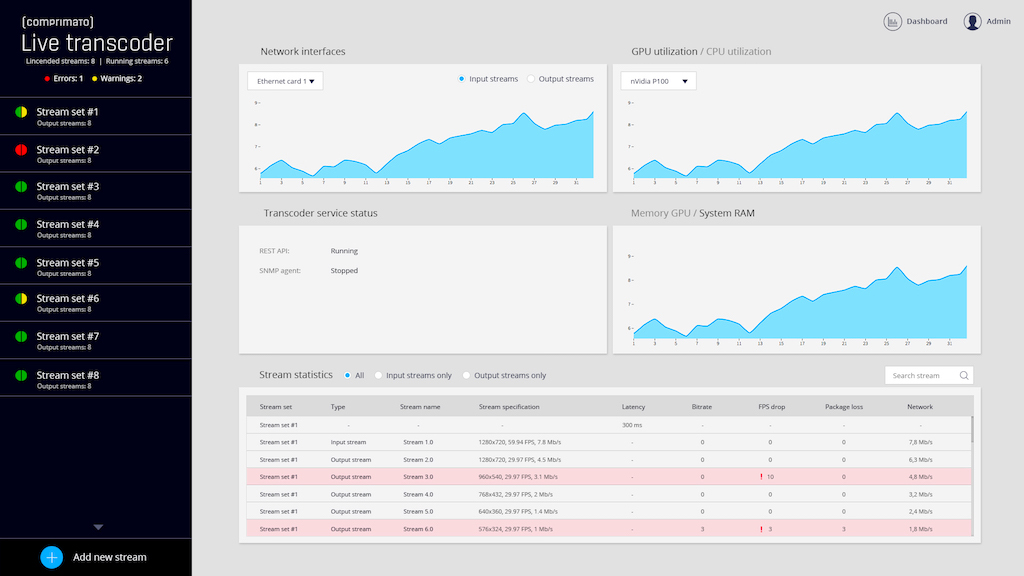
Precisamente el punto fuerte de Comprimato radica en la implementación de códecs de alta calidad basados en software, para ejecutar en plataformas de TI estándar, y particularmente sobre GPU. Esto nos ha permitido desarrollar el transcodificador Comprimato Live, que es un modelo de cómo esta solución ahora se puede entregar de manera práctica.
Se ejecuta sobre cualquier arquitectura de servidor estándar x64, que puede ser un dispositivo físico o virtualizarse en un centro de datos. El software admite hasta 70 señales Full HD en un único servidor de 1U, por lo que es extremadamente compacto.
Toda la funcionalidad se implementa en el software: no requiere hardware propietario adicional. El software es ágil: se pueden agregar nuevas señales en menos de un minuto. También es fácilmente extensible, lo que permite que nuevos formatos como HDR o 4K se incorporen al instante tan pronto como se desee desarrollar una estrategia empresarial.
Finalmente, es un códec independiente, compatible con MPEG-2, H.264, H.265, Google VP8 y VP9, y JPEG2000. Los flujos de salida individuales pueden proporcionar una entrega adaptable de velocidad de bits según sea necesario.
Al adoptar esta solución de software, el transcodificador Live brinda alta calidad a baja latencia: generalmente menos de 700 ms de extremo a extremo en una cadena de entrega de video. También es extremadamente rentable, eliminando el costo de capital de múltiples codificadores y decodificadores. Al ejecutarse en servidores estándar de la industria, el costo total se reduce a unos cientos de dólares por stream.
La conectividad IP brinda una nueva flexibilidad tanto en los circuitos de distribución como de contribución, permitiendo a los productores crear contenidos más selectivos y atractivos, al tiempo que garantiza que la calidad se controle al detalle ya que todo el procesamiento se lleva a cabo de forma interna. Los sistemas de software que se ejecutan en hardware estandarizado se benefician de la mejora continua en el rendimiento de la industria de hardware IT así como de las actualizaciones de software regulares que ofrecen la capacidad de agregar nuevas funcionalidades de forma rápida, segura y rentable.
Use Matela
CEO of Comprimato

Did you like this article?
Subscribe to our NEWSLETTER and you won't miss anything.
Related articles
 Aicox, VITEC and Datapath shed light on the management, contribution and distribution of video over IP in Madrid
 Telefónica Servicios Audiovisuales (TSA) will manage the contribution and distribution of LaLiga matches with Appear
 AWS debuts Elemental MediaConnect Gateway, its latest contribution and distribution solution, at NAB 2023
 The Valencian Community hosts the filming of 'Canvi', a documentary film about climate change
 Globecast strengthens its management team in contribution and distribution
 Vitec brings its ecosystem of HEVC distribution and contribution solutions to Amsterdam
 5G will open a new frontier for audiovisuals both in contribution and distribution
 Tmediat will bring to BIT Experience the latest in contribution and distribution from Aspera and Intinor
 The Xarxa Audiovisual Local replaces satellite with IP networks in distribution and contribution
 V-Nova aims to redefine the contribution and distribution of live 4K signals
 Stream “R” us: an alternative for television contribution and distribution
 Ericsson to provide contribution and distribution to NBC during London 2012
 Video over IP contribution at TSA
 Ericsson facilitates 3D contribution and distribution on ESPN