





Is the rapid growth of OTT platforms affecting pay television?
Jim O'Neill, Principal Analyst at Ooyala, analyzes in this Tribune how over-the-top (OTT) video on demand services, both subscription-based (SVOP) and advertising-based (AVOD), continue to gain market share.

Pay TV operators in Europe have not experienced the trend of abandoning cable as has happened in North America, however, over the top (OTT) video on demand services - both subscription-based (SVOP) and advertising-based (AVOD) - continue to gain importance in the old continent.
A new report from Dataxis showed that the pay television market in Europe grew by only 0.3% in the first quarter of 2018 compared to the last quarter of 2017, the smallest increase recorded between quarters, ending the quarter with 185 million subscribers. Since the first quarter of 2017, the pay television subscriber base has grown by 3.3%.
However, OTT platforms have grown by 50% since the first quarter of 2017 and up to 188% since the first quarter of 2016.
Dataxis indicates that 35% of pay television subscribers receive a cable connection, 31% receive a satellite connection and 28% receive IP television (IPTV); DTT represents 3% of total subscribers.
According to Dataxis:
- Direct cable subscriptions represent 64.8 million subscribers, including 42 million digital cable subscribers, slightly decreasing in the first quarter of 2018 compared to the fourth quarter of 2017. 31% of subscribers do so through Vodafone/Liberty Global.
- Indirect hiring (distribution to tenants through owners) amounts to 18 million.
- Satellite connectivity has declined more substantially in 2018, losing 400,000 subscribers since the fourth quarter of 2017 and falling by 544,000 subscribers since the beginning of 2017. Dataxis estimates that Sky Group and Tricolor (Russia) together hold 50% of the market and have lost 140,000 and 80,000 subscribers respectively.
- The DTT market remains stable in 2018, losing only 0.35% of its subscribers. It is down 1.5% in the last two years despite the launch of Freenet in Germany in 2017, which has 18% of DTT customers and gained 47,000 subscribers in the first quarter.
- IP television continues its growth in the first quarter, adding 1 million subscribers last quarter. Orange (France) and Rostelecom (Russia) have 10% and 13% of IPTV respectively.
Will European operators suffer the same fate as North American operators?
In the United States, pay TV operators lost more than 622,000 subscribers in the first quarter and have seen subscriptions fall as customers have steadily migrated to OTT platforms.
The disengagement with pay television in Europe is milder than in the United States and Canada, where pay television bills are more than double those in Europe. Still, the allure of original content from Netflix, Amazon and others – and the single-digit pricing on their services – is having an effect.
A recent report by analyst Mason states that the value of OTT video payment services will increase from €8.1 billion at the end of 2017 to €18 billion in 2022, accounting for more than 80% of the growth in video and television distribution. Three-quarters of this growth comes from subscription video-on-demand services, but operators shifting pay TV services to OTT broadcasting will also drive multi-million dollar growth.
A principios de este año, Dataxis comentó que el crecimiento lineal del mercado de la televisión de pago OTT fue impulsado por contenido especializado como los deportes y los servicios para niños. Ambos son puntos clave para los suscriptores de OTT y en general se espera que tenga impacto en las suscripciones de la televisión de pago.
Jim O’Neill
Principal Analyst de They spread it

Did you like this article?
Subscribe to our NEWSLETTER and you won't miss anything.
Related articles
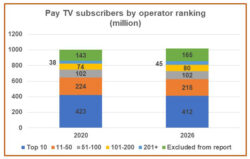 Pay TV in 2026: 64% more subscribers, but fewer users on leading platforms
 Vodafone leads the growth of pay television customers in Spain
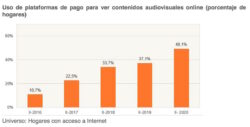 Half of households with Internet consume audiovisual content on online payment platforms
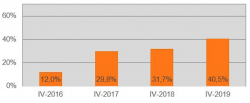 Four out of every ten households with Internet consume audiovisual content on online payment platforms
 Dalet drives rapid development of Ooyala Flex Media Platform
 European public media warn about the rapid rise of global platforms without regulation
 Apple releases the fastest MacBook Pro in history
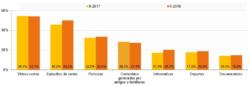 1 in 3 households connected to the Internet use payment platforms to watch audiovisual content online
 Mobile video consumption skyrockets with year-on-year growth of 9.8%
 IP: who is really taking advantage of this technology in broadcast?
 After 22 consecutive quarters of growth, consumption on mobile devices remains stable
 Ultra HD 4K takes off at a much faster pace than HD did
 Why HEVC is coming faster than you think
 Veo Tv will become AXN under the Dahlia payment platform after an agreement between it and Sony Pictures