





Los secretos del éxito de las noches electorales de TV3
En las pasadas elecciones del domingo 26 de mayo, TV3 volvió a liderar la audiencia del día en Cataluña de manera destacada, con una cuota del 20,9%. La excelencia en el uso de las herramientas de tecnología virtual basadas en la solución Orad HDVG de Avid, entre las claves del éxito.
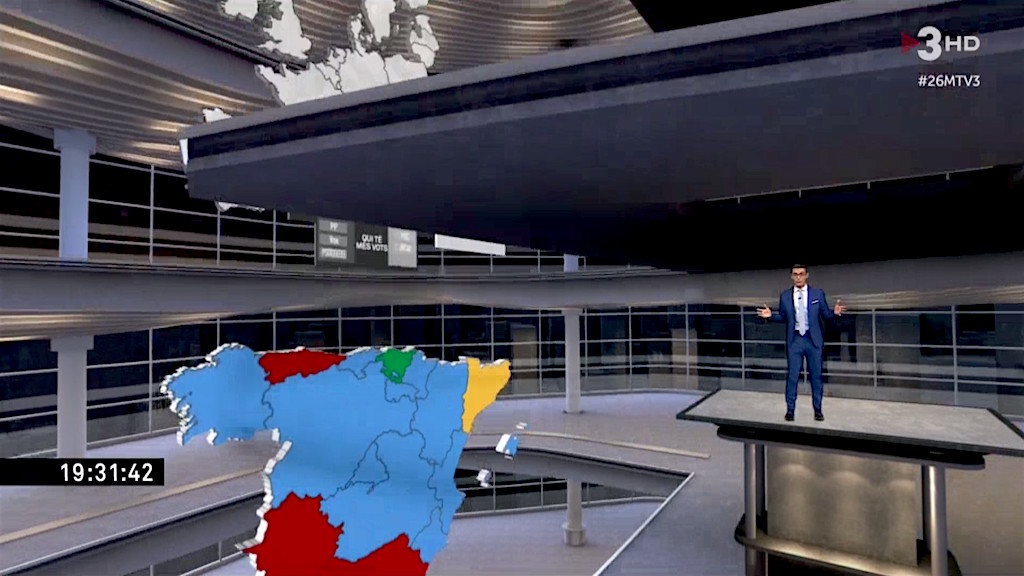
Las claves del éxito de TV3 en la creación de programas electorales las encontramos, principalmente, en la eficacia y el rigor informativo en el tratamiento de los datos y en la excelencia en el uso de las herramientas de tecnología virtual basadas en la solución Orad HDVG of Avid.
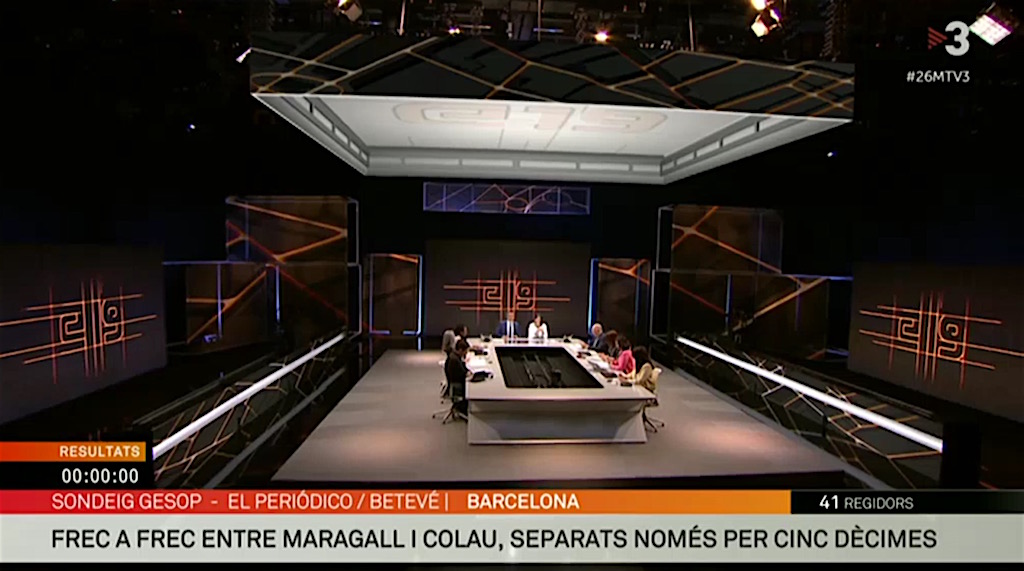
Dirigido por Dani Bramon, realizado por Paulí Subirà y presentado conjuntamente por los periodistas Ramon Pellicer y Lídia Heredia, en el plató principal, y por Núria Solé, Carles Prats y Raquel Sans, en el plató virtual, el programa especial electoral en la noche del pasado 26 de mayo volvió a ser el más visto en Cataluña, con una cuota del 20,9%, el mejor resultado en unas elecciones municipales desde 2003.
La creación del E19: 26M supuso la coordinación, antes y durante el programa, de once especialistas del equipo de realización y realidad aumentada, diecinueve al equipo de datos, ocho a la producción y cerca de 150 profesionales a los equipos de redacción y producción. Un trabajo que se vio recompensado con la respuesta indiscutible de la audiencia, que, una vez más, confió en TV3 para informarse, en una importante y compleja jornada electoral. El grupo de la CCMA, con una cuota del 26%, lideró ante los otros grupos de comunicación. 3.252.000 espectadores conectaron en algún momento con TV3 y el 3/24, y el minuto más visto fue a las 22:21, con 1.303.000 espectadores y un 39,2% de cuota.
Segunda pantalla
En estos últimos comicios, TV3 quiso dar más importancia a la “segunda pantalla”. La idea era que el espectador pudiera seguir la televisión mientras miraba el iPad o el móvil, pudiendo ser partícipe de contenido complementario. “Dos Instagram ‘live’ para conocer cómo se hace por dentro del programa, y la posibilidad de recibir los ‘push’ (notificaciones) electorales con los últimos resultados, basados en la geolocalización, son algunos de los ejemplos de este valor añadido que aporta la segunda pantalla”, explica Dani Bramon, director del programa E19: 26M. “Además, se está empezando a trabajar con ‘big data’ de tal manera que se pueden ir creando datos de la población (paro, edad, etc.) con los resultados obtenidos”, destaca Bramon.
Esta nueva forma de informarse, que va más allá del programa televisivo, fue todo un éxito. 490.000 usuarios únicos accedieron a sus contenidos en medios digitales, una cifra un 37% superior a la registrada el 28A. La app del 3/24 también registró una audiencia de 82.000 usuarios únicos, un 50% por encima de la media, y la app de TV3 tuvo 60.000 usuarios únicos, lo que supone un 90% por encima de su media diaria. En Twitter, el programa especial de las elecciones registró 15.000 mensajes y fue el cuarto programa de televisión más comentado del día en toda España.
Realidad virtual aumentada
Hace más de 15 años, en 2003, con las elecciones municipales y autonómicas, TV3 se convirtió en la televisión pionera en España en el uso de gráficos de realidad aumentada en tiempo real. Asimismo, también en 2003, TV3 asumió, por primera vez, la gestión propia de datos.
En 2010, en las elecciones al Parlamento de Cataluña, TV3 y el canal de información 24 horas, 3/24, crearon la marca “E”, de “especial elecciones”, con un equipo de profesionales que desde entonces trabaja de forma cohesionada para seguir evolucionando programa a programa. El director de informativos de TV3, David Bassa, explica que “se trata de un equipo y un formato estable desde hace años”. “En este sentido, seguimos la estrategia de la BBC: su programa de elecciones hace muchos años que funciona y va evolucionando sobre la misma base. Así, el espectador aprende a interpretar tu forma de explicar los datos (como medio de comunicación) y se mantiene esa esencia”, añade.
Dani Bramon explica que “a partir de estudios cualitativos que se van haciendo sobre las percepciones de los espectadores en este tipo de programas, se vio que la gente no entendía las informaciones que se contaban en época de elecciones, y se buscó un nuevo sistema y otra forma de trabajar, donde la audiencia se acostumbrara a entender los datos de manera pedagógica, con la ayuda de las herramientas de realidad virtual”. Bramon también pone énfasis en la importancia constante del rigor informativo: “Sobre todo, lo que más nos preocupa es la información; no nos podemos permitir que haya ningún dato incorrecto en toda la emisión del programa”.
En 2012, TV3 dio un paso grabando con drones para la creación de la careta inicial del programa y trasladándose al Parlamento de Cataluña. Se decidió trabajar con la realidad aumentada sobre el hemiciclo (un escenario real), en una apuesta sin precedentes. “Nos hubiera gustado volver a grabar, los años siguientes, con realidad aumentada dentro del hemiciclo, pero sólo lo pudimos hacer en 2015. Suponía un gran montaje y, en Cataluña, la situación política se precipitó. Ya no había elecciones cada 4 años como es habitual y no podíamos hacer siempre un despliegue de estas proporciones, y convirtiendo el Parlamento en un plató de televisión durante tantos días”, explica Bramon.
En 2015, TV3 marcó un punto de inflexión e innovación, con el uso que hizo de la augmented reality, lo que quedó confirmado con la nominación a los Premios Europeos TVB Awards, donde TV3 quedó finalista junto a televisiones como la BBC o SkyNews. A partir de este momento, TV3 ha recibido numerosas visitas de televisiones internacionales.
El mismo 2015, TV3 también diseñó un robot que de alguna manera sustituía a los periodistas, y que generaba titulares. Se trata de un algoritmo que gestiona una gran cantidad de datos y que, una vez programado con datos pregrabados antes por el equipo de profesionales del programa, es capaz de escribir un titular que resuma el resultado de cada uno de los 947 municipios catalanes. “Este robot se había utilizado en otros países para generar titulares económicos o de deportes, pero no se había utilizado antes para generar titulares en el ámbito electoral”, destaca Bramon. “Gracias a esta tecnología –explica también David Bassa–, no sólo podemos actualizar automáticamente todos los municipios y comarcas durante el programa, sino sobre todo en el portal y en las redes. En este sentido, el volumen de información inmediata que gestionamos y ofrecemos es claramente superior al resto de medios de comunicación. Es nuestro valor añadido: la capacidad de explicar a toda la audiencia, a toda la población catalana, los resultados de todas partes. Vivas donde vivas, sabes que en TV3 seremos los primeros en informarte de tus resultados, y lo hacemos a través de todas las plataformas”.
Novedades del E19
Tras el macroprograma de televisión que TV3 hizo el pasado 28 de abril, parecía imposible que pudiera superarse de nuevo. Y una vez más, el E19: 26M fue un referente. TV3 hizo un amplio seguimiento de lo que pasaba en Cataluña y Europa con conexiones con las sedes de todos los partidos y el centro de datos, con un equipo de redactores, productores y grafistas que interpretaban todos los datos que les iban llegando a tiempo real, y con un seguimiento constante de las redes sociales, además de varias mesas de debate con expertos y analistas políticos.
El especial mantenía la misma estructura de los anteriores programas electorales, dividiéndose en cuatro grandes bloques: “la cuenta atrás”, “los sondeos”, “los resultados” y “el análisis”. Pero evolucionó hacia una nueva forma de trabajar más eficaz que permitía al espectador concebir los datos de manera muy clara y comprensible. Una de ellas fue el hecho de añadir una nueva sala de control.
Paulí Subirà, director de realización del programa explica que “nos centramos en lo que hemos hecho en otros programas, intentando mejorar lo que no ha salido bien, o lo que creemos que podemos hacer mejor, pero obviamente siempre buscando nuevas formas de mostrar al espectador lo que se quiere informar. Hay que pensar primero en los que nos miran. Por eso en este programa hay tres salas de control, y una es específica para los grafismos”.
Como ya se hizo en 2015 a las elecciones al Parlamento de Cataluña. Más allá de los dos controles que se utilizaban, el control principal, donde llegaban los más de 60 señales exteriores y donde hay “robot de datos”, y el segundo control, situado en el plató principal donde está la mesa de análisis, se creó un tercer control. “Se volvió a trabajar, pero esta vez en las instalaciones de TV3, con un control exclusivo especializado en grafismo, que funcionaba como sala de realización centrada en generar visualmente los datos que se proyectan en el plató virtual de realidad aumentada”, destaca Paulí Subirà. “Dispusimos un equipo de 10 personas trabajando en el control de grafismo. El hecho de tener una persona de grafismo y un redactor encargados de suministrar, testear y asistir a cada uno de los presentadores, facilita poder trabajar de forma separada cada ‘set’ de realidad virtual aumentada. Vimos que era la solución para poder probar la escena específica mientras el programa estaba en marcha con los otros presentadores”, acaba Subirà.
Otra novedad de este 2019 fue la creación, por primera vez, de un “pactómetro” por municipios, que permitió saber quién podría ser alcalde o qué mayorías eran necesarias para hacer alcalde a cada candidato. Asimismo, este “pactómetro”, también permitía hacer una comparación con los resultados de años anteriores.
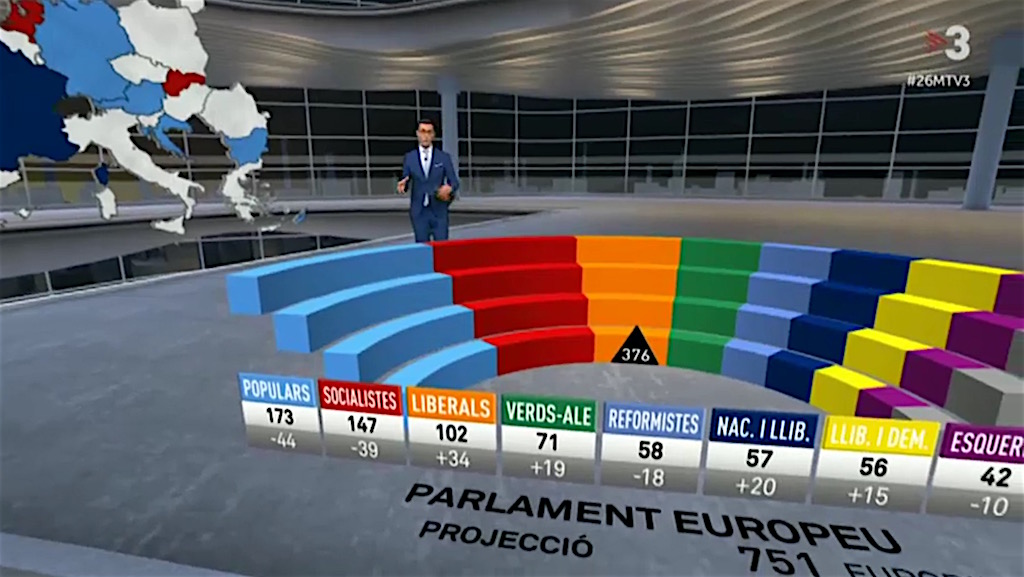
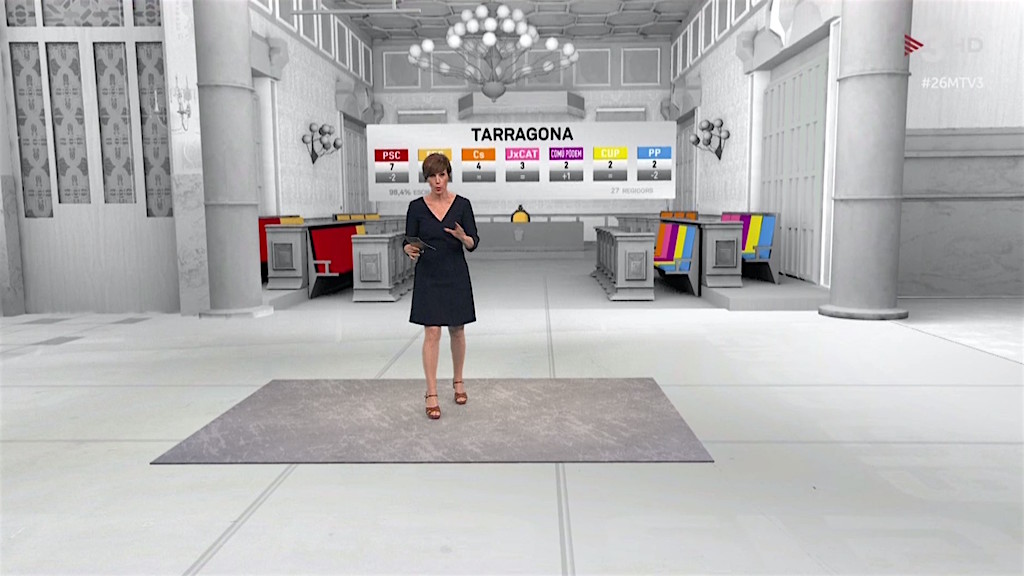
El 26 de mayo volvía a ser una fecha clave, y TV3 quiso sorprender incorporando también escenarios nuevos, mediante la realidad aumentada. Entre ellos, un “ascensor” mejorado –respecto al del 28A–, que subió una planta más para interpretar los resultados europeos. Y una planta de las municipales, que incluso permitía entrar de forma virtual dentro de la sala de plenos de los ayuntamientos de Barcelona, Tarragona, Girona y Lleida.
El equipo de grafismo virtual a tiempo real de TV3 cuenta con alguno de los mejores expertos en este campo de Europa. El software de control sobre las máquinas de grafismo es propio y esta creado por un ingeniero programador del equipo de TV3, es por eso que se puede ir evolucionando y se pueden conseguir más opciones de control sobre las escenas y su presentación.
“Gracias a los grandes cracks que tenemos en el equipo somos capaces de ser la referencia en la liga española de programas electorales, y seguir jugando de tú a tú a la Champions europea. Tenemos el mejor equipo imaginable, gente que suma su creatividad a un dominio tecnológico fuera de lo común. Ya sea el ingeniero programador, el responsable de grafismo virtual o la misma realizadora integrada al equipo de grafismo. De todos ellos nace y se hace posible este programa”, puntualiza Paulí Subirà.
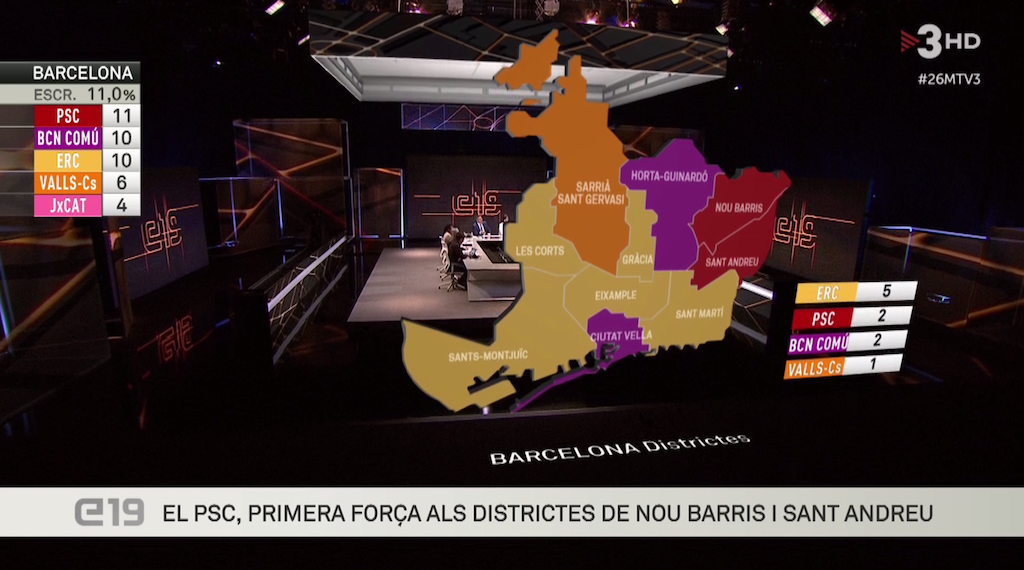
El gran equipo de profesionales de que dispone TV3, ha conseguido crear gráficos de formatos muy variados para mostrar los datos de manera pedagógica y comprensible. Se han utilizado desde las típicas barras volumétricas, pasando por los ‘donuts’ de colores, los mapas con las poblaciones catalanas o los diferentes países de Europa, a un iPad gigante, un techo virtual con la marca del programa, o una representación texturizada del Congreso de Diputados, del Parlamento de Cataluña o de los plenos de los ayuntamientos, entre otras creaciones.
De los dos platós, el plató principal de datos, el plató con croma verde, tenía una dotación de 6 cámaras con capacidad de recreación virtual, esto quiere decir con sistema de “tracking” y “render engine” de Avid (Orad) para cada cámara. Una cámara sobre grúa y una de cenital eran parte de esta disposición, donde se sumaban dos “renders” más para producir grafismo a pantalla completa.
Tracking
En el plató principal, el programa mantuvo, ya de las pasadas elecciones del 28A, la integración de datos y gráficos de realidad aumentada en el entorno físico de la mesa de análisis. “En este plató se puede encontrar una de las joyas tecnológicas del programa, sobre una grúa telescópica Excalibur de la empresa Muxart, montamos el sistema de control de ‘tracking’ ‘red spy’ de Stype Gripe, de esta manera el sistema es capaz de suministrar continuamente los datos de posicionamiento de la cámara, apertura de zoom, enfoque… de manera que el ‘render engine’ de Avid, que trabaja con esta cámara, puede posicionar cualquier gráfico con sus referencias y en el espacio deseado”, explica Subirà.
“Las posibilidades narrativas que se consiguen con una grúa ‘sensorizada’ y el sistema de Stype Gripe son casi infinitas. Se puede traspasar la barrera de la explicación básica a través del grafismo, avanzando hacia un escenario donde la suma de herramientas y elementos generen una aclaración de lo explicado. Es un salto cualitativo en el que TV3 hace tiempo que está trabajando, y en el que quiere seguir evolucionando”, explica Paulí Subirà. ”
“Estas herramientas nos dejan mover las cámaras con casi toda la libertad imaginable, manteniendo los gráficos incrustados. De esta manera, el salto es más espectacular en cuanto al lenguaje televisivo. Sólo con una puesta en escena sorprendente, dinámica, atractiva, y al mismo tiempo precisa y comprensible, se puede conseguir la misión informativa encargada como medio de servicio público. En televisión o arriesgamos o no hacemos televisión”, finaliza Subirà.
En un futuro, TV3 está estudiando incorporar nuevos motores gráficos con tecnología “unreal”, unos nuevos “engines” basados en los gráficos casi reales con que se crean los videojuegos, funcionando a tiempo real.
https://www.youtube.com/watch?v=l8Ry-tOU-sU&hd=1
Did you like this article?
Subscribe to our NEWSLETTER and you won't miss anything.
Related articles
 ‘Las noches de Tefía’, premio GLAAD por su representación de la comunidad LGTBIQ+
 ‘Las noches de Tefía’ (Atresmedia) recibe un galardón en MIPCOM por su visibilidad LGTBIQA+
 Motion graphics en programas electorales: buenas prácticas, desafíos y futuro
 Atresplayer Premium y Buendía Estudios arrancan el rodaje de ‘Las noches de Tefía’
 El director de fotografía Migue Amoedo desvela los secretos para conseguir una superproducción de éxito
 Al Jazeera mejora las coberturas electorales en todo el mundo con Aviwest DMNG PRO180
 Brainstorm muestra cómo el grafismo es un elemento en los especiales electorales
 Los Secretos, por vez primera en 3D
 Los secretos de guión de una miniserie de éxito
 Intensa actividad de Vértice en los especiales electorales
 WTvision, confianza total en las citas electorales
 La estereoscopía, sin secretos
 Los secretos del XDCAM HD con Sony y Ovide BS
 Vizrt en las noches electorales de América Latina