





Flexibility in the use of tools is the key for high dynamic range environments
Guy Ducos (Philips), Matthew Causon (AJA) y Miguel Churruca (Brainstorm) comparten su visión en un panel en la 4K-HD Summit sobre los retos que supone trabajar con alto rango dinámico.
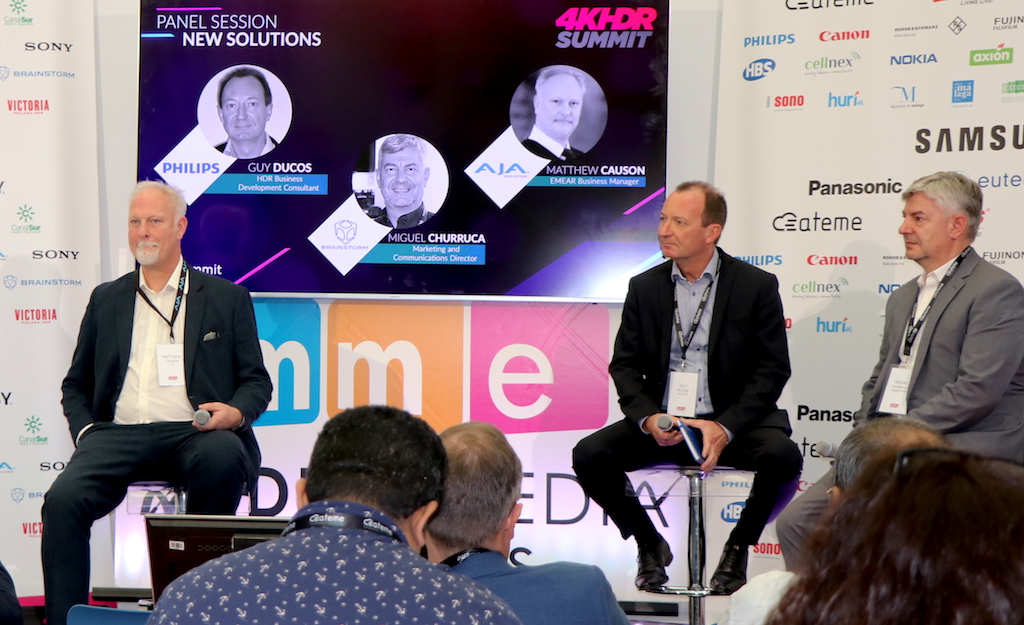
Guy Ducos, HDR Business Development Consultant en Philips; Matthew Causon, EMEAR Business Manager en AJA; Miguel Churruca, director de marketing y comunicación en Brainstorm ha participado en un panel en esta segunda jornada de la 4K-HDR Summit que tiene lugar en Málaga.
Causon has acknowledged that when HD arrived, "we thought we had a single standard, then we realized that it was not a consolidation of formats but quite the opposite. With HDR we see that new solutions are presented every time that have their own appeal but force us to work differently."
For his part, Ducos has stressed that "until now SDR was calibrated and everyone did the same thing. HDR is opening many doors and options in production and distribution. Producers must decide what type of HDR they want to produce. We still have to learn many things. Given the fact that there are many standards and possibilities for filming, the important thing is to provide a flexible solution. HDR is still in the learning phase and there is still a lot to learn how to merge it with SDR."
Miguel Churruca has highlighted the fact that "HD also evolved into different standards... it is only now, years later, that we are beginning to have a common basis that everyone can accept. However, now that we are beginning to enjoy the calm, a new avalanche of formats and standards in relation to 4K HDR is upon us."
From the point of view of the end user, Ducos believes that what will happen is that different standards will be consolidated in each region. "In each country for the end user there will be two or three options. The important thing for us is to provide solutions that satisfy the requirements in each country in each context," he noted.
Causon wanted to emphasize that AJA has dedicated "a lot of time to training professionals in HDR workflows. They have to take into account that if we only have SDR on set, in post-production it will take a long time to correct images. Some of the tools we have help to improve these flows, route signals in HDR and SDR and have reliable analysis tools that study pixel quality both on set and in the studio or post-production."
"The tools are there and people must be trained to try without fear of delving into HDR. We must not forget that HDR already represents two thirds of production in the United Kingdom," he added.
The AJA manager has also stated that "let's not forget that, as was the case with 3D, very good HDR can be produced... but also very bad."
Churruca has commented that having a better latitude and larger images is always positive. "In production we want the best possible image, however in the delivery that reaches the end user there are a series of compromises. In production the different options are under control by making decisions between the alternatives... but in distribution things change." “It is important to work with a common base and deliver an appropriate master that can be issued in the format required at any given time,” he added.
Did you like this article?
Subscribe to our NEWSLETTER and you won't miss anything.
Related articles
 Christie will bring its Variable Dynamic Range (VDR) technology to CinemaCon 2025
 AI Glue and StypeCentral, key tools for the future of Stype
 Panavision Link HDR system uses Leader LV5350 to monitor high dynamic range
 'Creating the HDR Experience': a professional meeting that will analyze the workflow in high dynamic range
 Hans Hoffman (EBU): “HDR will be essential but we still have to experiment much more with high dynamic range”
 The Vatican Television Center broadcast the closing of the Holy Door in Sony 4K Ultra HD and high dynamic range (HDR)
 Sony demonstrates the creative potential of high dynamic range at the 4K-UHD Summit
 ITU publishes recommendation on high dynamic range in television
 Hitachi incorporates high dynamic range into its line of HD and 4K cameras
 Sony bets heavily on high dynamic range
 The opening of the Holy Door, in 4K Ultra HD and high dynamic range HDR
 “The Barber of Seville”, the first opera to be filmed with Sony's 4K high dynamic range technology
 Is high dynamic range the next evolution in the industry?
 Spheron HDRV: a curious proposal that offers 30 fps and 20f stops of dynamic range