





The 10 keys that have marked the television industry in 2019
Uncertainties remain in the Spanish audiovisual ecosystem: advertising investment and traditional television consumption decline.

Windward Communication has made public its traditional analysis of the television industry about to end the year.
In it, he recapitulates the main concepts of the market, in terms of investment, consumption, operators, as well as the enormous influence of OTT companies, along with an analysis of audience performance and viewer behavior.
The analysis highlights that the television economy will lose more than 100 million in advertising investment in 2019 compared to the previous year, reaching the same level of billing as in 2015 (about 2,000 million euros of income).
As for the consumption drops in 13 minutes compared to last year, recording 222 minutes per viewer per day, similar to what was recorded in 2007, taking into account the usual measurement, plus the concepts of guests and deferred.
Barlovento highlights that the National Market and Competition Commission (CNMC) has been the protagonist of 2019 by fining Mediaset and Atresmedia 77.1 million euros.
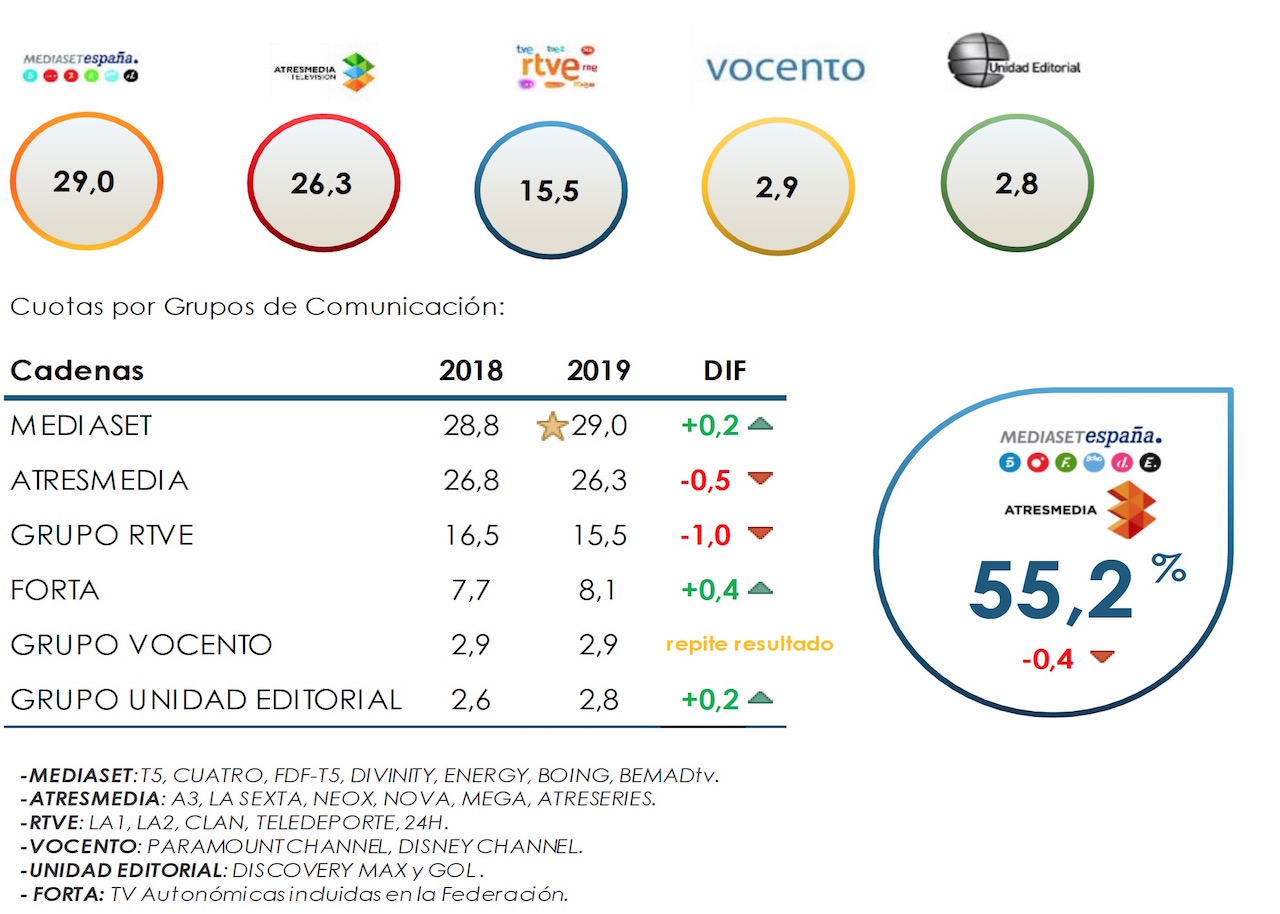
Both groups retain their hegemony in advertising revenue by obtaining 85% of the total advertising broadcast on conventional television.
He also notes that public television, TVE, completes a turbulent year given the drop in La 1's audience, which marks its annual historical low, and the interim management of the Corporation.
As for the pay television, reaches 6.8 million homes and 18 million potential viewers.
Competition grows in streaming companies in the dispute for the new economic “manna” in the digital age. Each Internet user spends an average of 40 minutes watching audiovisual content on the Internet and watches eleven videos per person per day.
2019 has also meant the establishment of a new reality and that is that hybrid consumption (offline and online) is gaining weight by leaps and bounds.
Advertising revenue
The advertising investment recorded in 2018 was 2,123 million euros, a decrease of 20 million euros compared to 2017, following the nomenclature of advertising investment published by INFOADEX, an amount that ratified the change of sign in the billing of the media king, even in contrast to one of the market axioms: when GDP grows, companies' spending on advertising, and even more so on television, always grows.
It should be taken into account as a reference for the sector in television advertising investment that the turnover of 2013, the year in which, after the economic crisis, income of 1,702 million euros was recorded, less than 50% of what the television industry earned in 2007, when it weighed 3,418 million euros, the year in which television advertising reached its best historical income figure.
In the years 2017 and 2018, advertising revenue did not exceed the Consumer Price Index (CPI). In 2017, an increase of 1.0% was recorded, an increase less than that year's own inflation, a trend that is consolidated in 2018, not only by not exceeding the CPI but by reducing investment by -0.8%, from 2,143 million to 2,123 million euros: that is, as indicated, a new drop in income of 20 million euros.
In 2019, the investment of brands and advertisers in the television medium decreases by an estimate of – 5% / – 6% on what was achieved in the previous year: from 2,123 million euros in 2018 to raising +/- 2,000 million, always in accordance with the data published by INFOADEX in September 2019 and weighted its results until the end of the year.
That is, if the CPI is not exceeded in the years 2017 and 2018 to 2019, where the trend of lower advertising investment is consolidated, with a decrease of +/- 120 million euros in losses for the television sector.
All of this happens after the recovery of television advertising investment recorded in 2014, 2015, 2016, and even 2017, although nominally, which reached up to 440 million euros: from 1,702 million euros in 2013 to 2,143 million euros in 2017
That advertising investment decreases and this fact is consolidated as a trend in the last three years is not good news for the television industry, immersed as it is in major transformations of the business model of the audiovisual ecosystem.
Although it is also very true that Advertising investment in television continues to be the first medium-support for brands and advertisers. Thus, in the January-September 2019 period, the total investment in conventional media reached the amount of 3,032.7 million euros, a decrease of 3.0% compared to what was registered in the 2018 financial year, that is, 3,125.2 million euros.
Consumption
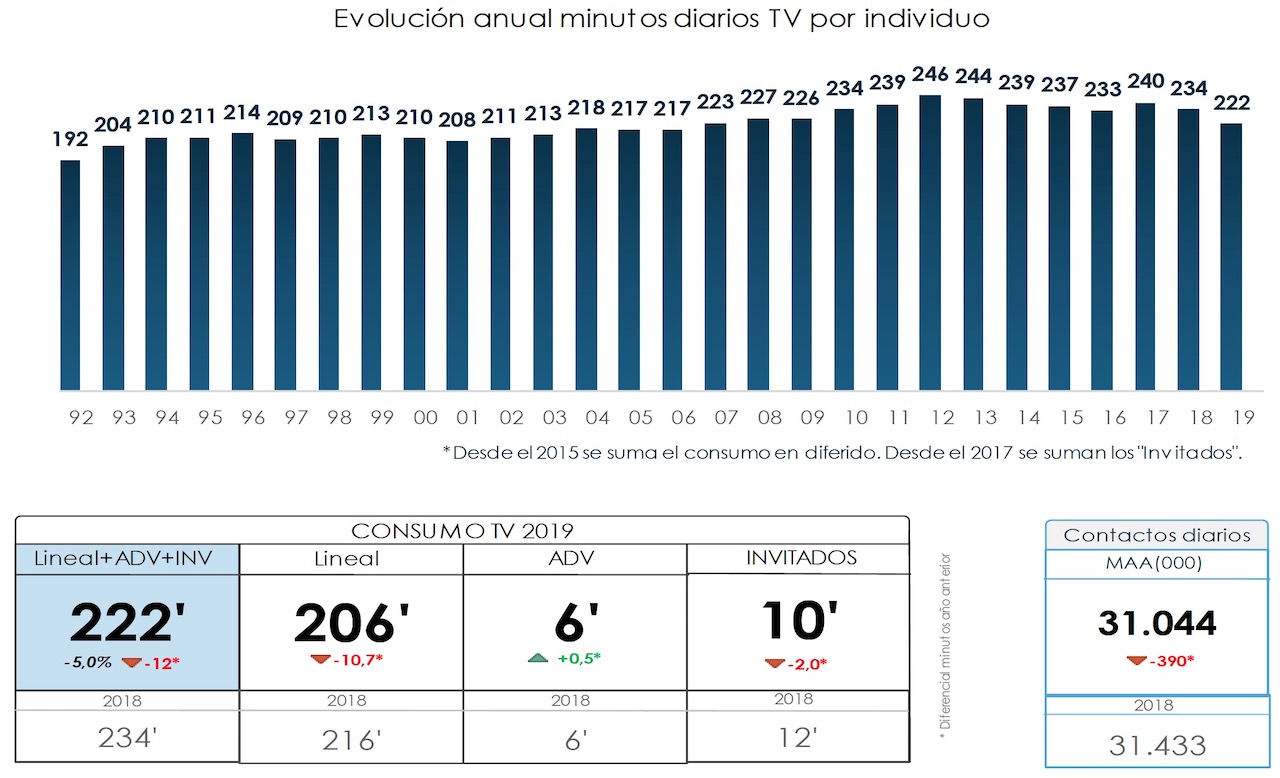
He average daily television consumption is 222 minutes per individual, which represents a detriment of -12' compared to 2018 (234'). Furthermore, the number of people who contact the media daily is 31,044,000 viewers, 390,000 less compared to the previous year.
The composition of consumption by form of viewing corresponds to 215' linear and 7' delayed (viewing of the contents over the 7 days following the linear broadcast), the latter therefore represents 3% of the total and has experienced a slight growth in comparison with the previous year.
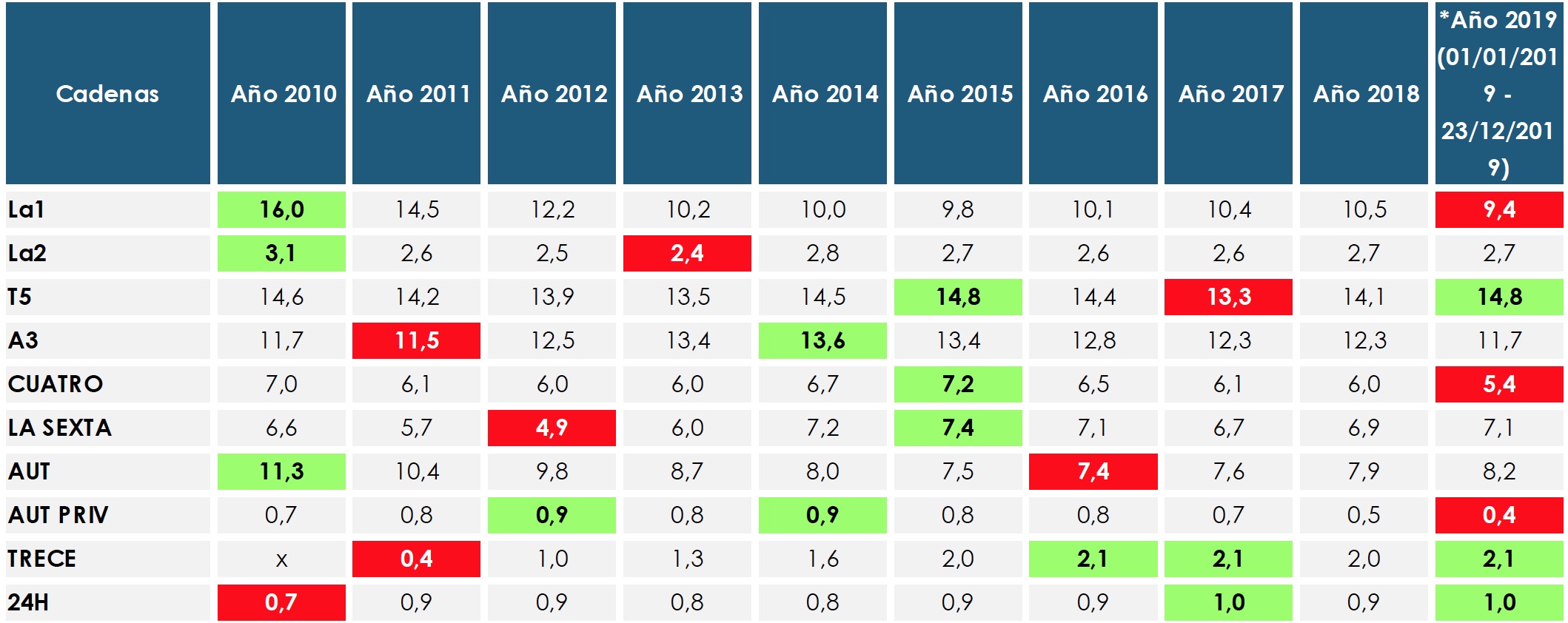
The The most watched channel in 2019 was Telecinco (14.8%), leadership that it occupies for the eighth consecutive year. In addition, it achieves an improvement of +0.7 compared to last year. They are followed by Antena 3 (11.7%), La 1 (9.4%), regional (8.2%), paid themes (8%), LaSexta (7.1%), Cuatro (5.4%), FDF (2.8%), La2 (2.7%) and Nova (2.2%).
This year has seen the highest record for Energy (2.4%), Atreseries (1.4%) and Gol (1.1%), while La 1 (with 9.4%) and private regional companies (0.4%) have registered an inflection. It should be noted that the sum of the large networks (La 1, Antena 3 and Telecinco) has stood at 35.9%.
En cuanto al ránking de emisiones, la más vista de este 2019 que concluye fue la correspondiente al partido de la Copa del Rey entre Barcelona y Real Madrid emitido por La 1 el 6 de febrero que alcanzó 7.315.000 espectadores y el 35,9%. La primera emisión no deportiva del ránking ocupa la posición número 6 y fue las votaciones de Eurovisión (18 de mayo en La 1) que reunieron a 6.168.000 espectadores con el 44,6% de cuota.
Did you like this article?
Subscribe to our NEWSLETTER and you won't miss anything.
Related articles
 Conecta Fiction 2024 starts, an event that once again turns Toledo into the axis of the television industry
 Keys to the III collective agreement for technicians in the audiovisual industry: schedules, remuneration, AI...
 EITB and Elkargi shed light on taxation and success strategies in the Basque audiovisual industry
 Television production is consolidated in Spain in 2023 marked by the fall of the US market.
 Anglatecnic shares the keys to its Fingercloud accessibility system with the European broadcast industry
 Has 'La casa de papel' marked a point of no return in the Spanish industry?
 Flashtalking points out the keys to maximizing video advertising in the convergence of cable and digital television
 San Sebastián announces the 2019 Industry Awards
 These are the ten trends that have marked 2018 on television
 Teresa Fernández-Valdés, recognized as one of the 20 most influential women in the television industry worldwide
 What impact will big data have on the television industry?
 Netia celebrates twenty years in the television industry
 The television industry is not capitalizing on the second screen
 The video game: a fundamental piece in the television industry