





The Parliament of Catalonia updates its entire production and production infrastructure
For the new infrastructure for the production, transport and distribution of HD signals, TSA, the winner of the project, trusted Crosspoint to supply cameras, mixers, as well as different routing, processing, communications and integrated control solutions.
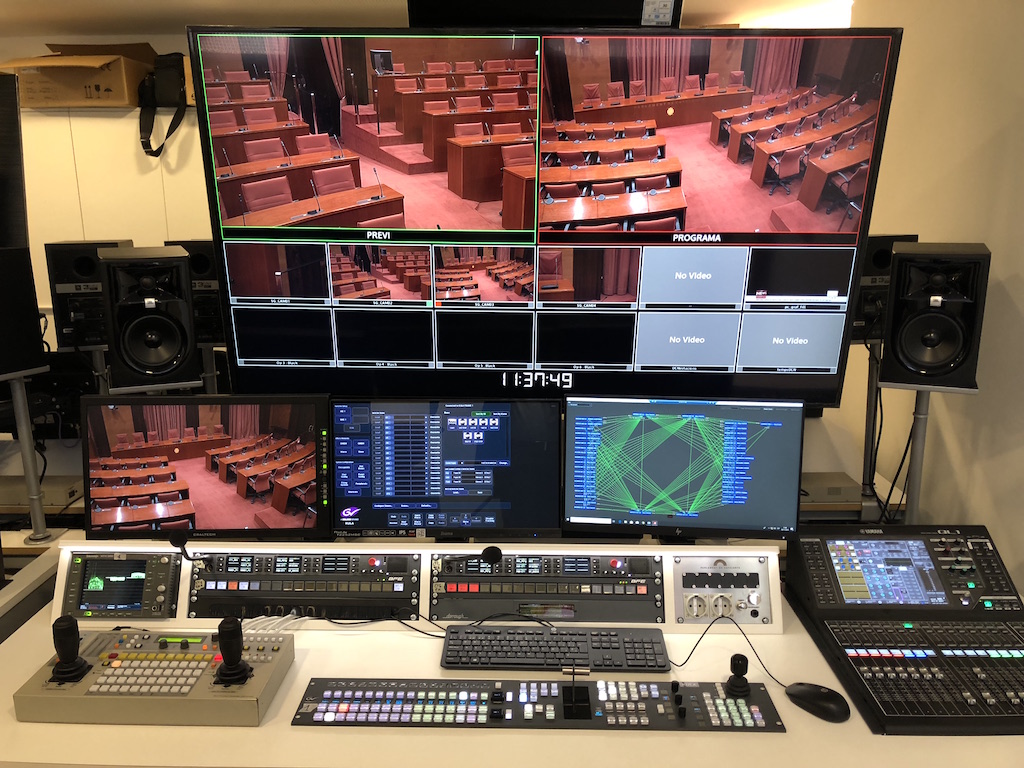
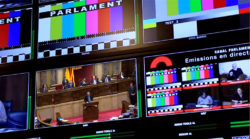
2019 has meant the comprehensive renovationl of the infrastructure production and realization of the Parliament of Catalonia. Most of the equipment used to date dated from 2002, whose obsolescence was beginning to have an impact on parliamentary activity with more projection, such as the production of plenary sessions and parliamentary commissions.
Thus, at the beginning of 2019, the Parliament awarded a public tender in order to update audiovisual equipment of the Session Hall and the rest of the rooms of the building in order to be able to see, listen, record and disseminate the interventions of the deputies, and, on the other hand, generate the unique signal audio and television of the sessions and events that take place in the Chamber.
Thanks to this new production, transportation and distribution infrastructure It is possible to follow all sessions and public events in HD which are carried out at the Catalan parliamentary headquarters and are available to all media and citizens in general through the Chamber's online media.
The Parliament of Catalonia awarded the project to Telefónica Audiovisual Services (TSA) who, by the hand of Crosspoint, integrated equipment from leading manufacturers Riedel Communications (transport, processing, routing, monitoring and communications), Grass Valley (chambers, mixers and modulars), BFE (comprehensive control system), AJA (storage and converters). Additionally, Crosspoint has included customized developments, start-up services, training and support to the project.
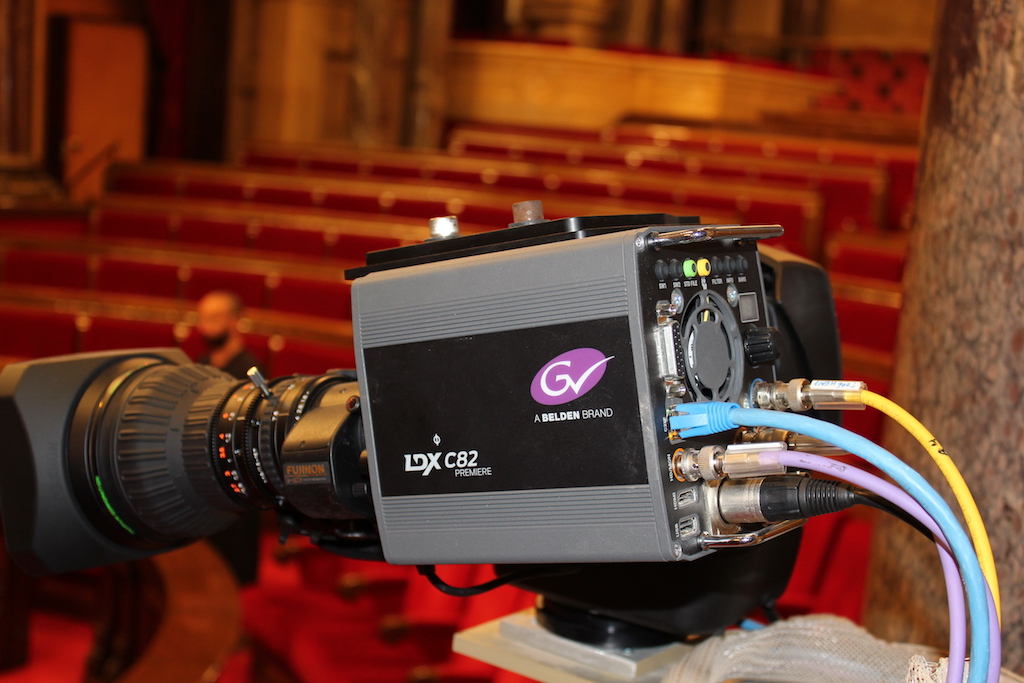 The facilities have been equipped with a complete system of robotic HD cameras with remote control for the plenary hall. 8 systems stand out here LDX C82 from Grass Valley. These compact cameras have 3 2/3″ Xensium-FT CMOS sensors and include wide color gamut (WCG) and, optionally, 1080p capture or HDR operation.
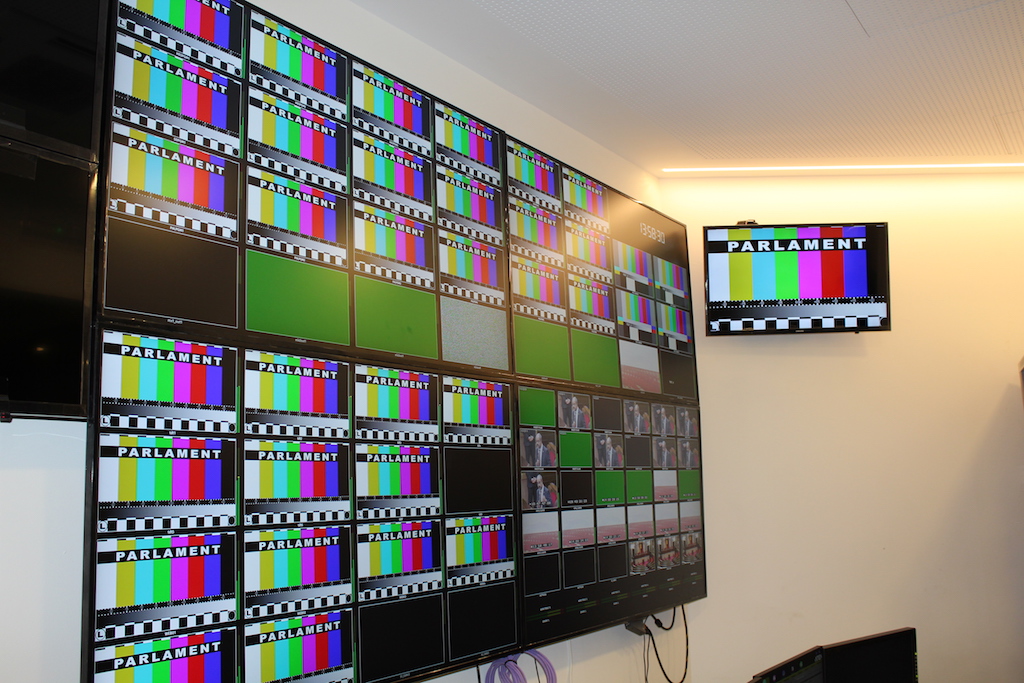
In addition, the audiovisual equipment of the performance controls of each of the rooms, mainly composed of audio and video mixers, technical, audio and video monitoring, multi-screen and intercom system that allows communication between all the technical rooms of the Parliament.
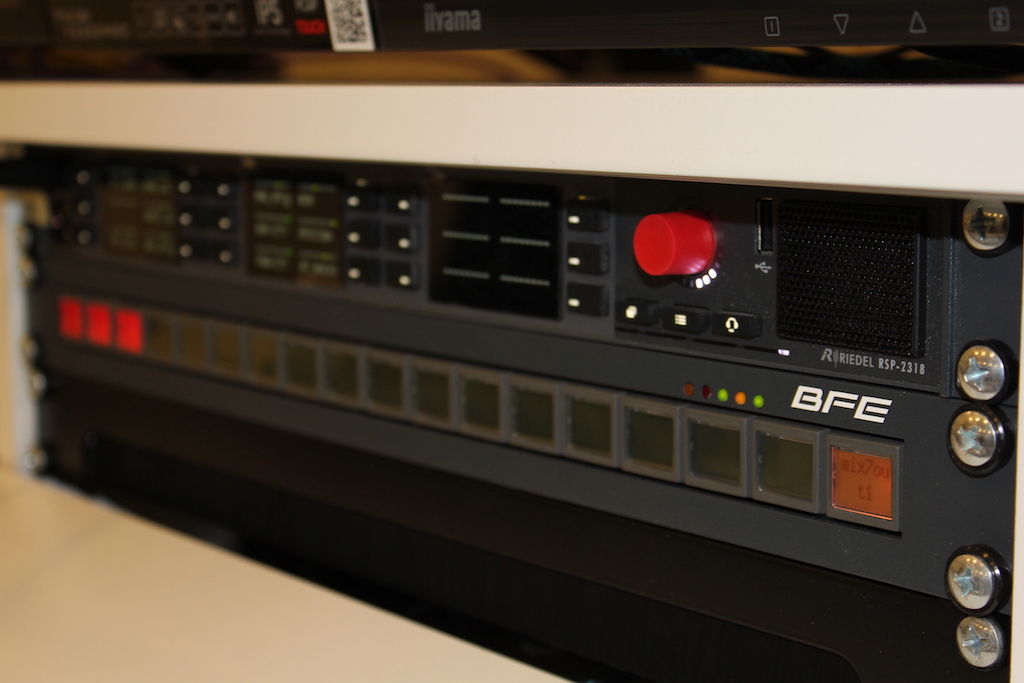
In the case of routing and processing, the option chosen by the Parliament was the systems Mediornet, Micron and Metron from Riedel. Also from the German manufacturer are the Artist digital intercom and the new Bolero wireless intercom system, integrated into this project.
In 2008, the Parliament began a partial renovation process, since then having HD cameras, although production was not carried out in high definition since the crisis paralyzed the renewal of networks and production controls. We would have to wait until 2017 for the Catalan Chamber to once again resume a comprehensive migration to HD.
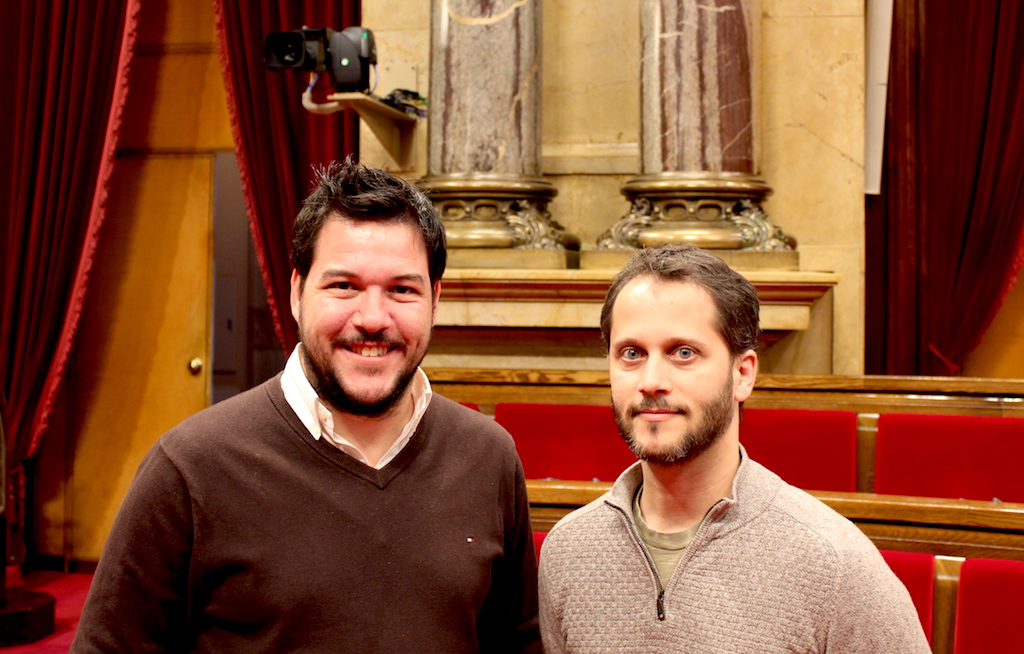 However, as recognized Daniel Rodriguez, broadcast engineer leading the renovation project together with Rafael Ramón, "this migration could no longer be done in a phased manner because we were ten years behind the original project and the need to provide HD to all media was imperative. We proposed a total migration from SD to HD in terms of production controls, signal transport infrastructure and distribution."
On the other hand, as the Parliament has been providing its rooms with the necessary technical equipment for television production, the media have stopped having direct access to these rooms except to record the typical “silent” moments just a few minutes before the start of the session. It is the Parliament that is responsible for producing the institutional signal, recording it, distributing it to all media and archiving it. At a time when the vast majority of channels had already migrated to HD, the Parliament could not continue offering an SD quality image.
The project had contemplated two differentiated transport networks that are integrated with each other, one for audio that allows the integration of the video system with the audio system and another for the transport of video signals through a proprietary system, which offers a decentralized solution to transport and distribute signals over fiber generated. The set is complemented by a management layer and orchestrator system which allows monitoring, control and switching of devices, as well as the integrated audio and video network. This is where it comes in KSC Coreh, by BFE.
Rodríguez destaca que la peculiaridad de un edificio histórico de mediados del siglo XVIII enclavado en pleno parque de la Ciudadela, en Barcelona, precisaba de una serie de requerimientos a la hora de cablear que la fibra soluciona en gran medida. Además, “teníamos claro que somos un Parlamento, no una televisión, por lo que debemos buscar en todo momento hacer un uso de la tecnología lo más eficiente y racional posible. Es por eso que el formato de video escogido para el proyecto ha sido 1080i, pero para nosotros era fundamental que a nivel de infraestructura de transporte pudiéramos asumir en un futuro señales 1080p e, incluso, 4K. En el momento de plantear el proyecto se pensó, por tanto, en términos de ancho de banda más que en líneas punto a punto.”
Regarding the possibility of working in 4K, Rafael Ramon, co-responsible for the project, recognizes that “going to 4K would have been a very exponential leap that meant more bandwidth in infrastructure, replacement of cameras…”. However, with the current network scheme, the Parliament would have the capacity to transport Ultra High Definition signals.
Although, within Riedel, some steps were taken in 2012 with the release of Compact Pro transport solutions, the costs for an application as large as the Parliament's infrastructure skyrocketed.
 Maribel Roman, general director for Southern Europe at Riedel Communications, emphasizes that the German company “developed Micron precisely to be able to respond to this type of projects with this amount of signals, with distributed matrices capable of responding to a high density of signals.”
“At the design level, instead of having a central node, with all the switching and control electronics, we opted for a decentralized scheme of nodes that give us great flexibility and the scalability typical of these modular systems,” says Rodríguez.
Rafael Ramón adds that "deploying such a large matrix with the limited space we have in the server room was not viable. We had nodes with satellite racks distributed throughout the Parliament, configuring a cloud with signals transported by fiber that acts as a matrix." Starting from this concept, Riedel's Micron “allowed us to gain efficiency and regroup all the controls with the space saved,” he points out. “Specifically in this facility we have more than 50 chests.”
The main project aimed to transport all these signals without the budget going through the roof. They even considered using large mixers to route signals at the same time as they were used for mixing. However, "we preferred smaller mixers than a large mixer with many cards. This scheme gave us greater security in case of error than an endless number of boards and components in a large mixer. In this case, Kula has fit like a glove."
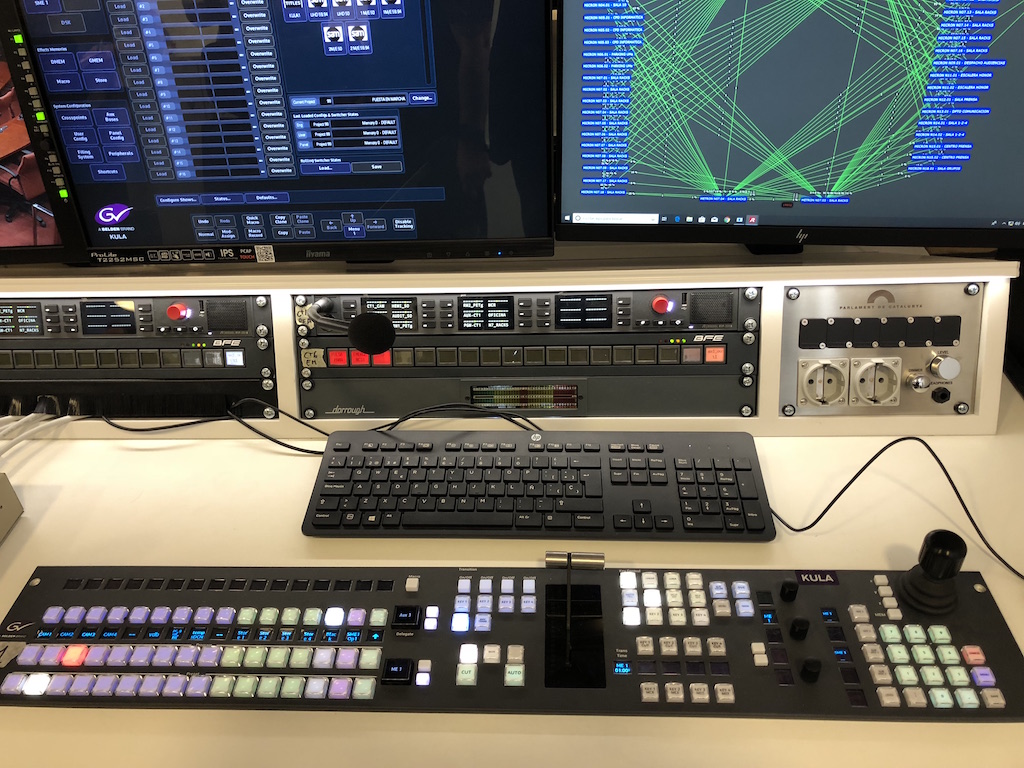 Finally An independent network and seven Grass Valley Kula mixers were chosen installed in the different implementation controls. This all-in-one mixer offers digital video and audio mixing and includes clipstore integration for graphics creation and multi-screen output. With a mainframe of just 2RU, Kula has 40 video and 80 audio inputs/outputs, which provides great configuration flexibility.
Ramón affirms that "we are very happy with both the new cameras and the mixers that allow us to maintain a clean feed for the media, while allowing us in the future to enrich the signal with windows, graphics, subtitling for the deaf... for web transmission."
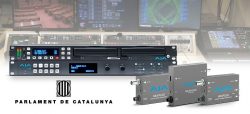
Additionally, Crosspoint has supplied several AJA solutions such as Ki Pro recorders/players, frame synchronizers y FS2 format converters and several miniconversores.
The project, although it cannot be classified as a native installation in IP SMPTE 2110, has Micron systems that accept IP signals and can manage up to 80 Gigs of bandwidth. Furthermore, as the Parliament's engineers recognize, 2110 when the drafting phase of the project began was not yet so standardized or competitive from a cost point of view.
Daniel Rodríguez subraya que la tecnología empleada por Riedel es “muy fácil de utilizar. Como casi todos los sistemas propietarios parten de un esquema plug & play. En cambio, el 2110 nos consta que es más complejo y en este concurso valoramos la facilidad de gestión y que no requiriera la incorporación de personal especializado y profesionales de sistemas”.
Scalability
One of the requirements of the Parliament's technological renewal was the punctual scalability in situations of high information demand. Although the day-to-day work of the Chamber is covered by barely a hundred journalists, in specific cases more than 1,500 journalists from all over the world have been accredited.
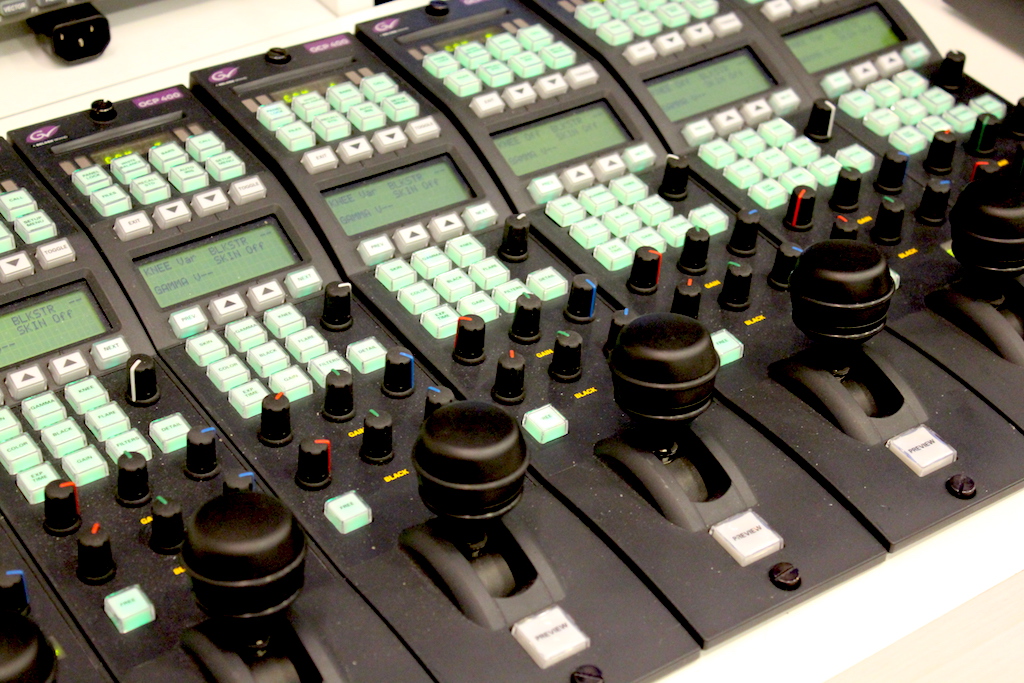 En caso como estos, el Parlament venía recurriendo al alquiler puntual de sistemas. Ahora la nueva infraestructura permite conectas cofres de Riedel plug&play a la fibra y comenzar a trabajar en cuestión de minutos proporcionando las imágenes para parlamentarios y medios al instante.
Rodríguez analyzes that "when the design was made, it was intended to be a very versatile installation, which is why we opted for a decentralized matrix with all signals accessible from anywhere. This allows us to adapt the configuration of the installation to both ordinary and extraordinary needs. In fact, when we quadruple demand, we do so without the need to add external resources."
Victor Garcia, commercial director of Crosspoint, states that "both from Crosspoint and from the TSA integrator, we have provided very robust, reliable, flexible and highly tested solutions in the field. Something fundamental in this type of installations in which, even if they are not 24×7, when they issue, nothing can fail."
 This allowed deploy all the new infrastructure in just five weeksIt's just in time for the Diada celebration at the beginning of September. Rafael Ramón recognizes that “great teamwork has been done between the professionals of the Parliament's audiovisual and infrastructure department together with Crosspoint and the rest of the suppliers to get everything up and running.”
Precisely, September 11th marked the premiere of the new Bolero wireless intercom. Ramón places emphasis on the ease of use: "it was practically unpacking the Bolero flasks and starting to operate them, creating groups in a very intuitive way even before the training. Later, with the training we discovered many more functions. Introducing a wireless intercom has solved life for this type of complex events, dispensing with the always uncomfortable use of mobile phones."
At this time, the Parliament has mobile antennas that offer coverage in the areas where it is required depending on the needs of the activity. And beyond a simple intercom, the Bolero matrix is used on a daily basis to coordinate equipment or even to monitor audio from different points.
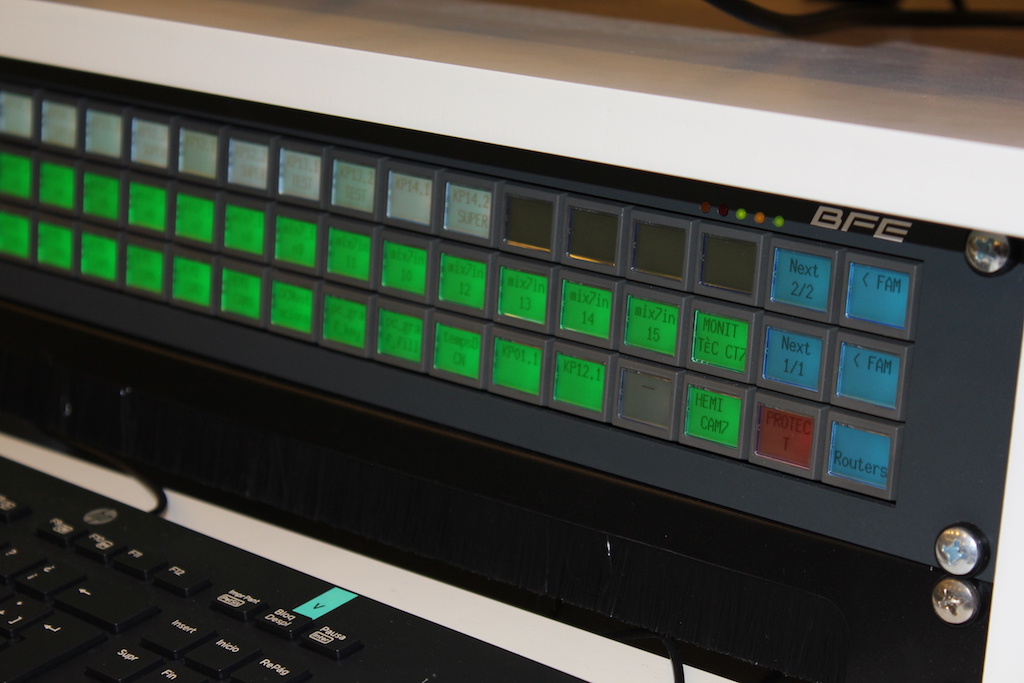
Finally, it should be noted that The Parlament installation is totally transparent for the operator, with a top layer of BFE's KSC Core control (orchestrator) system, also deployed by Crosspoint. Thus it is possible to switch, diagnose and monitor the entire infrastructure, in which various material modular Grass Valley IQ for distribution and processing, avoiding errors before they occur. In this way, operation at the operator level is simplified, reserving the applications specific to each system, MediorWorks, RollCall, Director... for use at the engineering and installation management level.
Did you like this article?
Subscribe to our NEWSLETTER and you won't miss anything.
Related articles
 Radio Botswana upgrades its entire infrastructure to IP with Type R from Calrec
 Qvest upgrades Channel 9's broadcast infrastructure and production environments
 IBC 24 channel updates its broadcast infrastructure with AMPP (Grass Valley)
 Sapporo Television upgrades its network infrastructure with Riedel's MediorNet and MicroN
 Unitecnic updates the basic infrastructure of Mediapro Argentina to IP with Lawo
 Canal+ turns to Cerebrum from EVS to update its entire IP media infrastructure
 The Parliament of Catalonia enhances its live HD broadcasts with AJA solutions
 This is how the Parliament of Catalonia has carried out its largest renovation of audiovisual equipment
 New Jordanian all-news channel Al Mamlaka controls its entire infrastructure with Lawo VSM
 Avid upgrades Finnish MTV3's news production infrastructure
 The television of the French National Assembly controls its entire infrastructure with Cerebrum
 Digiturk updates its infrastructure with Grass Valley solutions
 Unitecnic will renew the chambers of the Parliament of Catalonia
 All the programming of Televisió de Catalunya, in 16:9 format