





The VVC would improve the compression efficiency in UHD satellite emissions by 50% compared to the HEVC
Ateme junto a VideoLabs e IETR llevan a cabo la primera transmisión de extremo a extremo de radiodifusión por satélite UHD utilizando el nuevo estándar Versatile Video Coding (VVC).
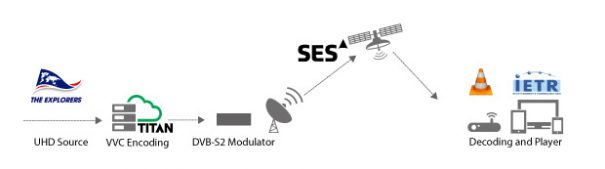
Atem has collaborated with SES, VideoLabs e IETR para la primera emisión de extremo a extremo por satélite en Ultra High Definition utilizando el nuevo estándar Versatile Video Coding (VVC).
La experiencia se ha llevado a cabo empleando la posición orbital 28,2° Este de SES llevando un flujo de video UHD (4K) usando el estándar VVC.
In this test, the signal has been encoded with VVC and encapsulated in MPEG-TS using the video processing platform Titan Live by Ateme. The streams have been modulated using DVB-S2 and are broadcast through an Astra 2E transponder, covering all of Europe. On the reception side, the signal, demodulated by a DVB to IP gateway, was sent over IP to the VLC player that displayed the video using the real-time OpenVVC decoder developed by the IETR.
The test has demonstrated some benefits of VVC such as greater efficiency in terms of bandwidth optimization with the consequent reduction in the cost of UHD transmission with VVC and compression efficiency.
Furthermore, the DVB-S2 broadcast with VVC increases audience reach and coverage by providing a high-quality viewing experience using VLC media player.
VVC is the latest video coding technology, developed by the Joint Video Experts Team (JVET), formed by experts from the ISO/IEC MPEG and the ITU-T VCEG. The VVC improves compression efficiency by 50% of the High Efficiency Video Coding (HEVC) standard and targets all video formats (VR-360°, 3D, 4K, 8K, HDR). Its versatility allows the standard to cover a wide range of applications, from broadcasting to OTT delivery.
Thomas Wrede, vice president of new technologies and standards at SES, notes that “since our first digital transmissions in 1995, every 10 years the industry has released a new, more efficient video coding scheme and continuing our tradition of video innovation, we are proud to collaborate with our industry partners on the first satellite transmission using the VVC codec.”
For its part, Mickaël Raulet, vice president of innovation at Ateme, adds that "we are proud to have contributed to this groundbreaking trial. This trial, conducted as part of the EFIGI collaborative project, is a great example of how the combined efforts of dedicated professionals can result in driving innovation in the broadcasting industry and demonstrates that VVC is ready to enter the market in July."
Did you like this article?
Subscribe to our NEWSLETTER and you won't miss anything.
Related articles
 RAI leads the transition of the Italian television system with the imminent start of broadcasts in DVB-T2 and HEVC
 The Goya Awards gala increases its audience by 7.3 points compared to 2021
 WorldCast improves APTmpX, its compression algorithm for radio broadcasts
 RTVE migrates its satellite broadcasts for Africa to the DVB-S2 standard
 Televisa selects Ericsson technology to broadcast HD with HEVC compression
 Ateme: the story of 25 years of innovation in video coding and compression
 Sapec and the UPV demonstrate at the SMPTE annual conference the efficiency of HEVC for UHD compression in HFR
 First DTT broadcasts using the future Ultra High Definition format with High Frame Rate with scalable HEVC over DVB-T2 networks
 The EBU welcomes the recommendations of the European Commission regarding spectrum below 700 MHz.
 Tmediat and Ateme show the benefits of the HEVC video compression format in a workshop held in Madrid
 SES Astra carries out the first Ultra HD broadcast in HEVC via satellite
 TVE includes HbbTV in its satellite broadcasts for Europe
 TVE renews its satellite broadcasts for Africa and Asia-Oceania for the next two years
 Ateme 10-bit compression technology on Sky Italia