





The satellite is capable of providing UHD services to 100% of the population
At the 4K HDR Summit, Jorge Rodríguez, Marketing Manager at Hispasat, anticipate what the future of television will be and its relationship with Ultra High Definition.
Jorge Rodriguez, Marketing Manager a Hispasat, in the 4K HDR Summit has anticipated what the future of television will be and its relationship with Ultra High Definition.
The Spanish satellite operator was a pioneer by launching in 2013 Hispasat 4K, a demo channel aimed at promoting Ultra High Definition. Currently distributes 4 UHDTV channels through its satellite fleet.
Two years later, he would take a new step with the creation of the 4K Festival especially aimed at pieces shot in 4K. That same year, it carried out the first 4K HDR experiences.
In 2016, it distributed the first satellite signal in the world using technology Dolby Vision.
In 2019, it demonstrated at the main international sector fairs the possibilities offered by new value-added services such as Push VoD for 4K content.
Rodríguez highlighted at the beginning of his speech that currently around 60% of UHDTV channels in the world are transmitted via satellite. It is estimated that at the end of last year there were 197 Ultra High Definition channels worldwide, and this figure is expected to rise to more than 600 in 2025 and above 1,100 in 2029.
In addition, he highlighted that more than 200 million 4K televisions were manufactured last year alone.
Universal coverage
Rodíguez wanted to emphasize that it is estimated that throughout the world 3.6 billion people still lack an Internet connection. In Europe, some 19.5 million households do not have broadband and around 30 million inhabitants in Europe and Central Asia do not have any device connected to broadband.
In the case of Latin America, this figure rises to 200 million people without connectivity at home and some 40 million lack mobile broadband.
In the case of Spain, the COVID-19 pandemic has highlighted the broadband deficiencies in rural areas. At this moment, more than 1 million Spanish homes do not have at least 30 Mbps connection speed and about 3 million do not have 100 Mbps.
Satellite technology is key to democratizing Internet access and universalize television service. Furthermore, its coverage is universal for any point under its footprint, which ensures access to Internet and television services to 100% of the population and territory.
Rodríguez commented that the deployment is very fast and simple, with the possibility of increasing services without the need for additional equipment.
On the other hand, satellite television services can be complemented by advanced video technologies, without the need for residential Internet access.
“The satellite is capable of providing UHD services to 100% of the population with a high level of quality,” he assured.
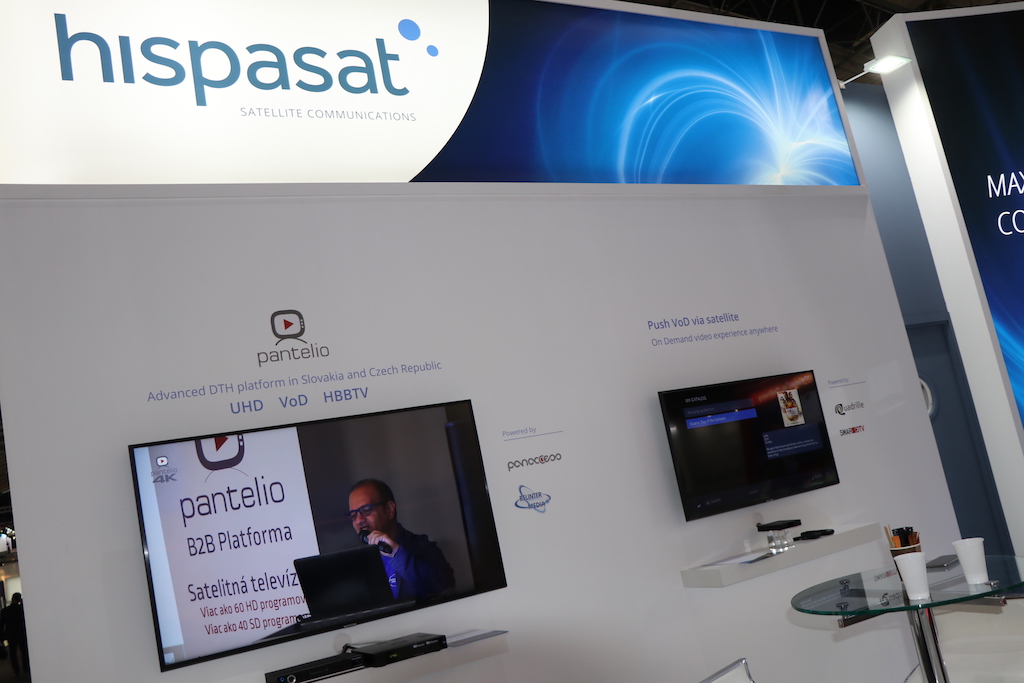
New services
Among the new possibilities that satellite provides, in addition to the distribution of broadcast signals on a massive scale, the Push VoD and the multicast ABR, with efficient transmission of IP content to second screens (in a multi-screen environment).
In the case of Push VoD, it is a new Hispasat service that allows end users to be offered an attractive selection of on-demand multimedia content for those who do not have access to broadband. It is a technology compatible with 4K/UHD content, with DVB and interoperable with DTH platforms and other mobile environments.
Jorge Rodríguez has also highlighted that the Push VoD has a modular design, integrable in a set top box with the existing CAS. In addition to providing television services, Push VoD could have wide applications in hospital environments, e-learning, maritime transport or as a WiFi Hotspot.
Regarding Multicast ABR, end users can access live content, even in 4KUHD, on any device. It is based on an HTTP distribution, transparent to encoders, DRM, players and receiving devices. And most importantly… with zero latency.
Did you like this article?
Subscribe to our NEWSLETTER and you won't miss anything.
Related articles
 Hispasat Wave, the new generation of wholesale managed services via satellite
 Ultrafast broadband will reach 95% of the Spanish population thanks to ÚNIC
 Telefónica's 5G already reaches 80% of the Spanish population
Telefónica's 5G already covers 76% of the Spanish population
Telefónica's 5G already reaches 80% of the Spanish population
Telefónica's 5G already covers 76% of the Spanish population
 Telefónica turns on its 5G that will cover 75% of the Spanish population before the end of the year
 Ericsson predicts that, in just 5 years, 5G will reach 20% of the world's population
 Hispasat begins to provide telecommunications services from 74º Oeste
 The satellite stomps on government communication and defense services
 53% of the population accesses the Internet while watching television
 Microsoft will end support for SQL Server in April 2016
 49% of the population is now fully adapted to the digital dividend
 The satellite takes positions against non-linear television with VoD or PVR services
 Open Digital TV already reaches coverage of 82 percent of the population in Argentina
 Digital television already reaches 46% of the Brazilian population