





Sennheiser microphones capture audio from the MOSAiC expedition to the Arctic ice cap
Professor Friederike Marie Krüger records a documentary of the MOSAiC Expedition, a milestone in climate research, using Sennheiser microphones.
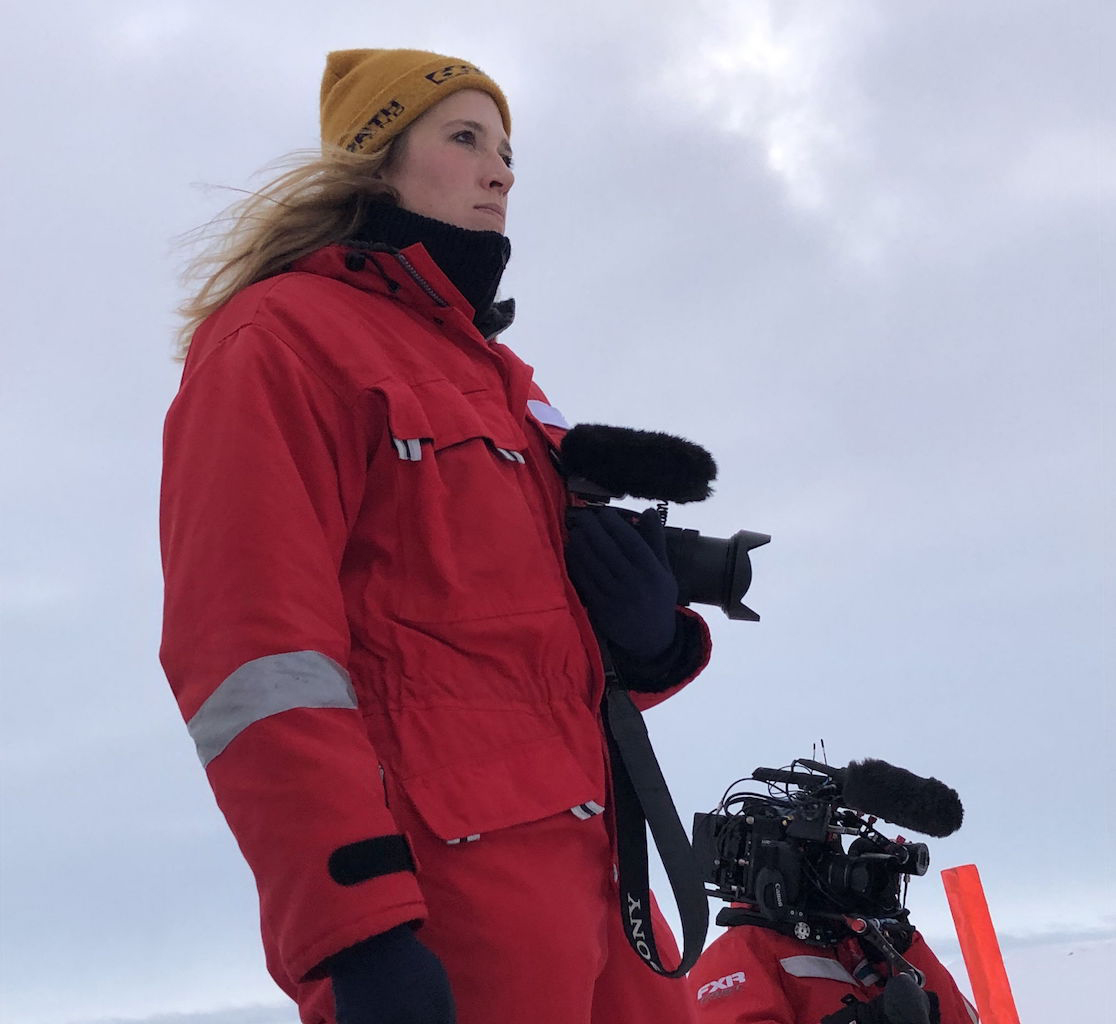
The expedition MOSAiC (Multidisciplinary Drifting Observatory for the Study of Arctic Climate), the largest Arctic research voyage of all time and a milestone in climate research, set sail from Tromsø in Norway on 20 September 2019 and came to an end with the return of the expedition's lead ship, the icebreaker Polarstern, to its home port of Bremerhaven, Germany on 12 October 2020.
During the expedition, the Polarstern had docked in Arctic sea ice and floated across the Arctic Ocean on a gigantic ice floe. As the ship drifted through the ice, it came into contact with a network of measuring stations covering many kilometers. One of the goals of the expedition was to gain a better understanding of the Arctic's influence on global climate in order to make more reliable predictions.
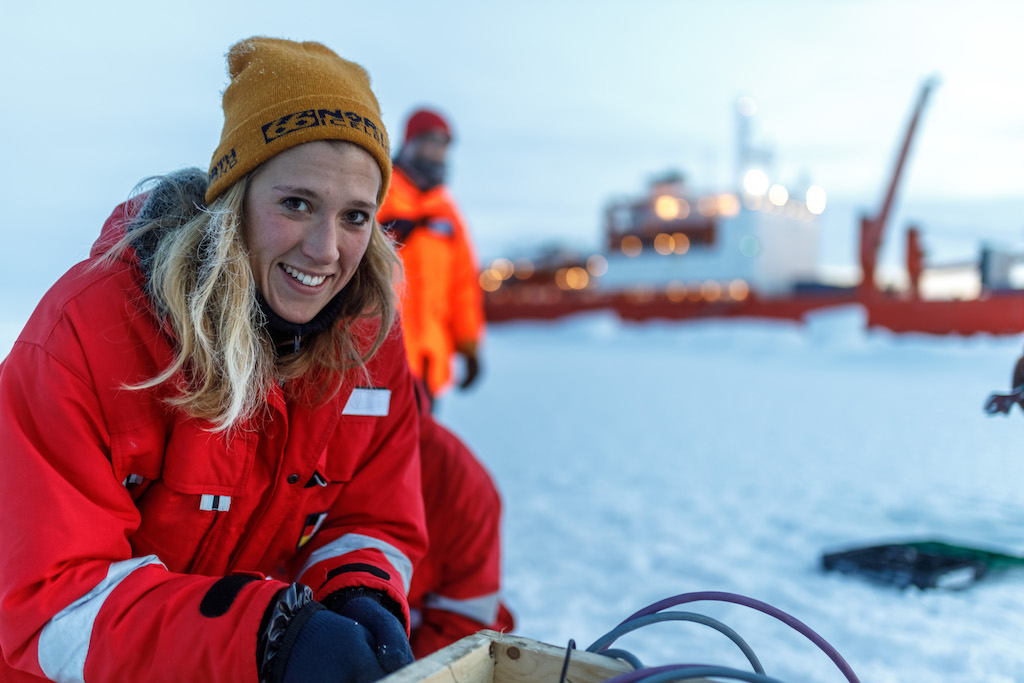
One of those who participated in the expedition was Friederike Marie Krüger, a German teacher who had the golden opportunity to exchange the classroom with a research ship for six weeks to create teaching materials. In addition to creating a short documentary of the expedition, which he recorded with microphones Sennheiser, its teaching materials are available on the expedition's educational subsite.
Friederike Marie Krüger normally works as a geography teacher: “I wrote my thesis at university on the global melting of glaciers,” said the former geography student. "While I was a student and in the years after, I traveled to Iceland many times. I quickly became fascinated by the Nordic regions. But it was completely by chance that I came across an advertisement for the MOSAiC expedition: they were explicitly looking for teachers to accompany the project. This is actually quite common practice on research expeditions, as the goal is to open up additional perspectives to a wider audience."
To record her impressions of the Arctic, Friederike Marie Krüger borrowed a compact camera with a CMOS sensor and a built-in zoom lens. She also took two Sennheiser microphones with her.
A bordo Akademik Federov
Friederike Marie Krüger departed aboard the Russian research vessel Akademik Federov, which accompanied the Polarstern during the first phase of the expedition and carried supplies of marine diesel and additional measurement equipment. Once the Polarstern docked on a suitable ice floe, a direct ship-to-ship transfer of people and materials took place. After that, the two icebreakers deliberately kept a clear distance to avoid damage to the ice floe that had been chosen for drifting and to avoid any negative influence on the measurements.
The fifth-year students at Krüger's school, IGS Bothfeld, were eager to learn about their geography teacher's exciting adventure, and she kept in touch with them as best she could. On one occasion a phone call was even possible via the ship's satellite phone. Additionally, he was able to send text messages at specific times using a messaging app. “Of course, the students always asked me if I was going to see some polar bears,” recalls Friederike Marie Krüger with a smile. "But they also asked me about more personal things, such as whether I was homesick and the special problems of living on a ship. They also wanted to know what it made sense, from an environmental perspective, to plow through the pristine wilderness of the Arctic with several icebreakers with powerful diesel engines."
Krüger quickly learned to master video and audio equipment with which she was previously unfamiliar: “I told myself that it can't be that difficult to record my personal impressions in sound and images,” is how the teacher described her self-taught learning, which in the end turned out to be positive. “The video recordings in 4K and Full HD resolution turned out really well, and the same went for the sound,” said Krüger. "At first, I never thought about bringing external microphones and only intended to use the compact camera. But fortunately, just five days before I left, two Sennheiser microphones arrived."
Most of Krüger's recordings were made outdoors and show the spectacular landscape and scientists at work. As extremely low temperatures are known to have a negative effect on battery capacity, Friederike Marie Krüger had wisely equipped additional sets of batteries, which were kept as warm as possible while filming outside, and also took care to hold the compact camera close to her body. “The still freezing cold caused the camera's autofocus function to stop working after a short space of time and I had to go inside the warm cabin for a while before I could continue filming,” said Krüger.
Outside temperatures ranged between -20 and -25 degrees Celsius, and on board it was not possible to mount the camera on a stand due to the movement of the ship. “The cold was quite unpleasant,” admits the teacher. “At such low temperatures, filming is fine for a few minutes, but then your fingers start to hurt.”
MKE 440 and MKH 416
For her sound recordings on the expedition, Friederike Marie Krüger used two tested Sennheiser microphones. For indoor recordings aboard the ship, he mainly used a WIFE 440 Mounted on the camera's hot shoe mount. In this compact stereo microphone, two capsules in a V-shaped configuration acoustically cover an area corresponding to the recording angle of a 35 mm camera lens, ensuring homogeneous coverage of the entire area with particularly high speech intelligibility in image focus.
With capsules that are elastically suspended inside, it goes without saying that the MKE 440 is protected against structure-borne noise. A thin but extremely strong stainless steel wire mesh protects the microphone capsules from mechanical damage and also reduces wind noise, without affecting the high-frequency sound image, which is often a problem with foam windscreens. The steel mesh also serves as an effective shield against electromagnetic interference. When outside, Friederike wore a windbreaker MZH 440 for the microphone.
For outdoor recordings, Friederike Marie Krüger mainly used a Sennheiser MKH 416, which was protected from wind noise by a basket windbreak MZW 60-1 equipped with a MZH 60-1 hair cover. The short shotgun microphone was mounted on a suspension MZS 20-1 with a handle that made it easy to control. “I quickly learned how important it is in an interview situation to point the shotgun microphone directly at the interview partner…” he adds.
The MKH 416 was connected via an XLR cable to a Sennheiser MZA 14 P 48 U battery power supply unit. The microphone signal was recorded with automatic level control via the 3.5 mm stereo mini jack input of the compact camera. The recordings were stored on SD cards inside the camera until Friederike Marie Krüger was able to save them to her laptop and external hard drives when she returned aboard the ship.
The sound of ice
Friederike Marie Krüger describes in vivid words the haunting sound of ice compression as the ice floe is crushed by waves, tides and wind before being pressed with incredible force against the ship's hull. "I'd compare it to the creaking of a steel door in an empty warehouse, but ten times louder! And right next to your bed!" In fact, this natural phenomenon was already described more than 125 years ago by the Norwegian explorer Fridtjof Nansen, whose work remains an inspiration for Arctic expeditions even today.
“The Sennheiser microphones did a fantastic job despite the harsh Arctic conditions and I never had any problems with any of the models,” says Friederike Marie Krüger with great satisfaction. "The sound recordings were really successful: the MKE 440 definitely proved its worth during indoor recordings on board, while the MKH 416 showed its strengths as a shotgun microphone during outdoor recordings. The basket windbreak and protective cover meant that wind noise was never a problem."
Looking back, she is certainly glad she took the microphones with her: “At first, I must admit that I never gave much thought to things like sound quality or that I simply intended to use the mini microphone built into the camera,” the teacher said. "It was only when I got on board the ship that I realized how important good microphones are if you want to record interviews with intelligible sound and, in general, if you want to record sound in high quality. The Sennheiser equipment was a great help to me on the expedition."
Did you like this article?
Subscribe to our NEWSLETTER and you won't miss anything.
Related articles
 Sennheiser microphones capture every detail in the heart of the Kenyan wilderness
 Audio-Technica adds two new professional USB microphones to its portfolio
 Sennheiser tests wireless multichannel audio WMAS system
 Audio-Technica presents BP28 and BP28L large-diaphragm condenser microphones at NAB
 Sennheiser MK 4 enables professional-sounding audio recordings at home
 Sennheiser's 6000 series digital wireless microphones take center stage at the Eurovision Song Contest
 Allen & Heath ofrece más presets para los micros de las series MB, ATM y Pro de Audio-Technica
 DPA microphones capture the sound of the final season of ‘Sábado Gigante’ on Univisión
 Sennheiser and Apogee launch digital lavalier microphones for iPhone and iPad
 Sennheiser presents its “HD Audio” and “Immersive Audio” solutions
 New Sennheiser EarSet microphones for broadcast applications
 Africa Expedition, capturing its mysteries with Sound Devices, Sony and Sennheiser
 Pure sound with the Sennheiser filter for MKH 8000 microphones
 Sennheiser's chrome microphones shine on American Idol