





TV3 awards Crosspoint with its KSC Core system the control of the equipment of its new high definition control
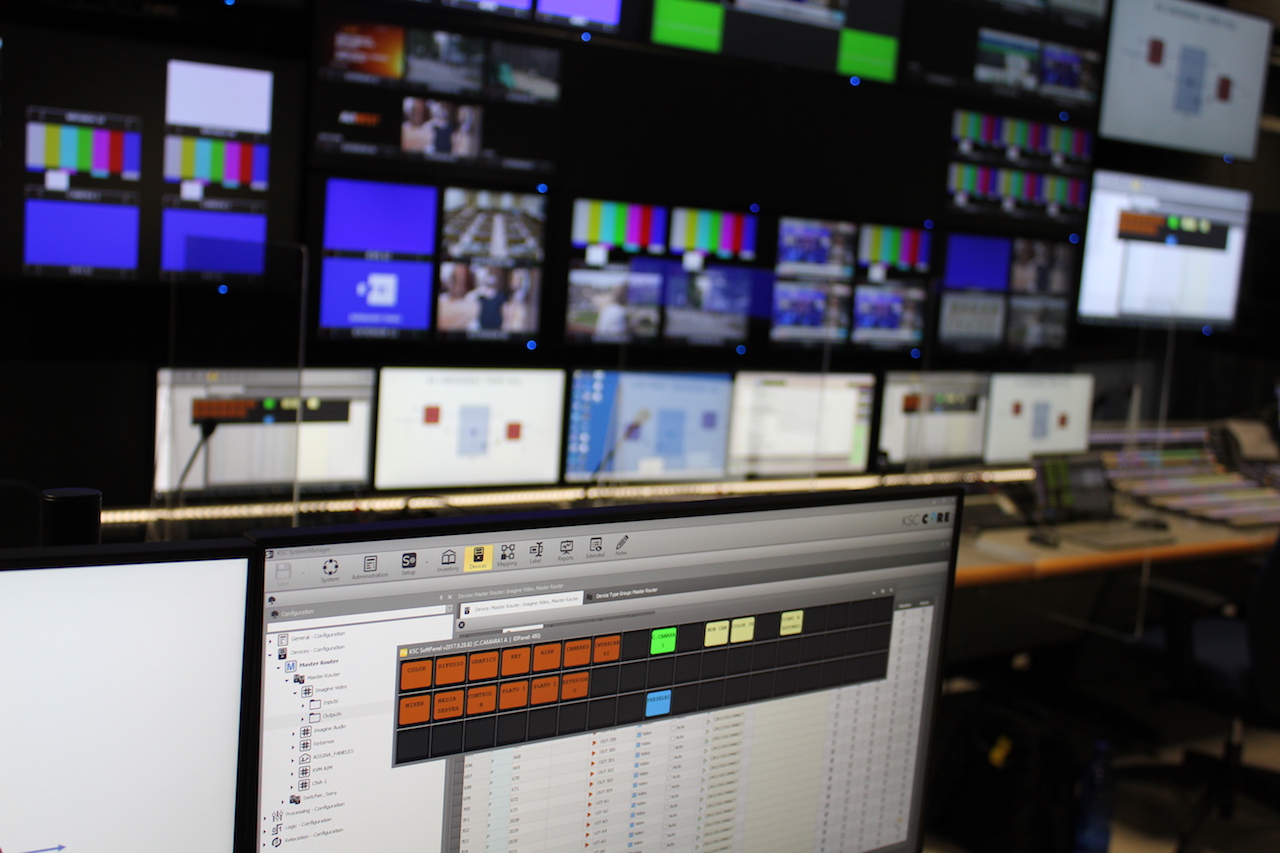
Looking ahead to the new season that starts after the summer holidays, the Catalan Corporation of Audiovisual Media has put its renewed Control A into production in high definition, and has done so with the help of Crosspoint, and the KSC Core broadcast control system, from the German company BFE.
Crosspoint with on system KSC Core was the winner of the public tender in which, among other things, different characteristics of both the system offered and the company responsible for its implementation were assessed. The KSC Core system is of great flexibility and quality, with proven reliability, and with a large inventory of device drivers from the German company BFE. Along with this system, Crosspoint's great ability to integrate systems, especially control systems, the company's natural habitat, as well as Crosspoint's extensive experience in consulting and project delivery capabilities in a timely manner, is added.
Although BFE has systems implemented in other industries such as education, events, defense or administration, it is in broadcasting where the German brand stands out, with the planning and integration of audiovisual systems and technical means in central controls of studios, broadcast rooms and mobile units. BFE's independence and good communication with the manufacturers of a project is one of its fundamental characteristics, since it manages to integrate devices from different brands, giving a result of maximum flexibility combined with high efficiency.
Unified control
To control the equipment of the new high-definition Control A of the TV3 CPA, Crosspoint developed a design through KSC Core, BFE's flagship control and monitoring system. A highly adaptable solution that allows fast and flexible control of all areas related to live streaming: planning, contribution, production, broadcast and distribution. Additionally, this solution has the ability to integrate seamlessly into existing network structures and improve reliability with hardware and software redundancy concepts.
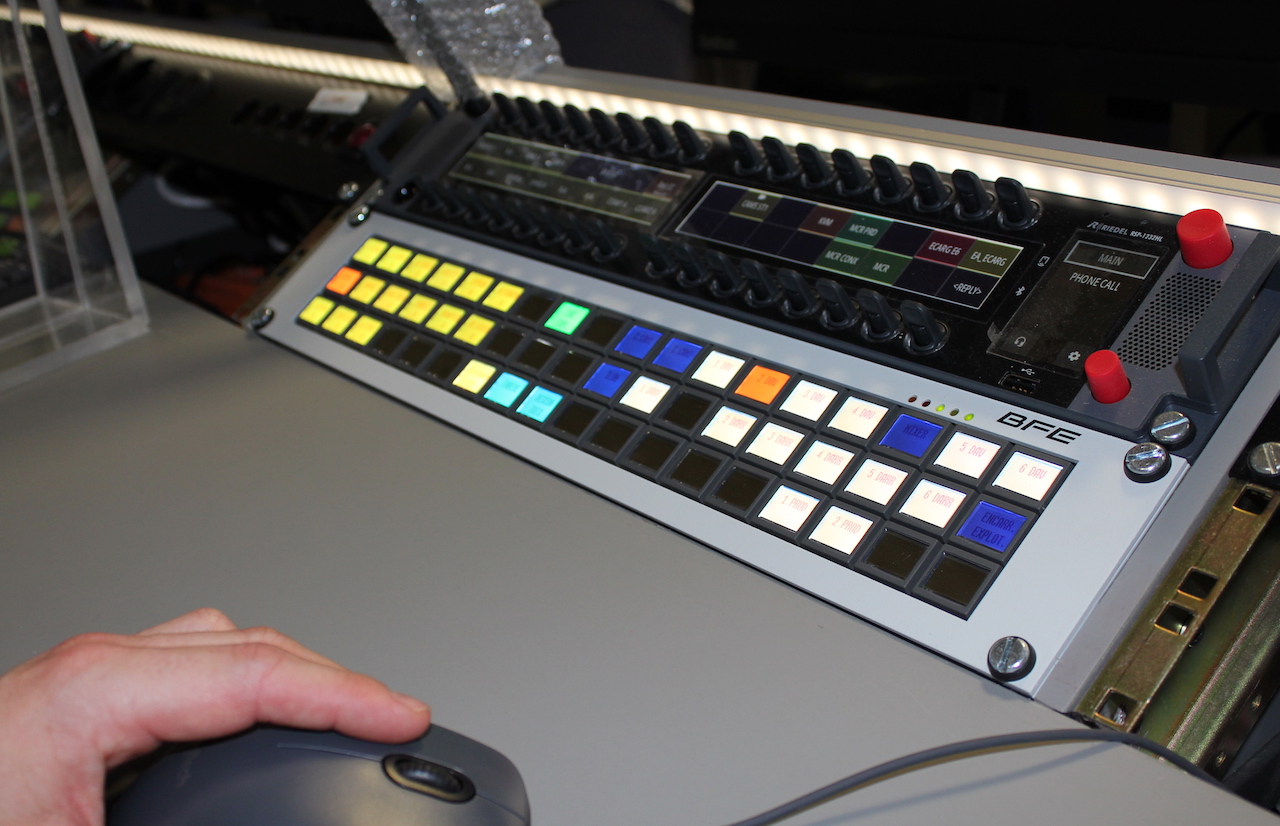
Regarding system control by the user, KSC Core has hardware elements (panels) and software applications (GUI), installable on conventional workstations, which are fully customizable. In a single panel, switching can be carried out indistinctly in the video matrix, in the audio matrix, in the intercom, KVM or in all of them at the same time. In addition, tallies can be managed in complex environments with several production controls that exchange the use of sets or transfer signal mnemonics from a unified database, without the user having to modify the name of the equipment.
The system also allows you to configure the control quickly according to the needs of each program or connect a second control as an emergency backup through quick and easy switching.
System architecture
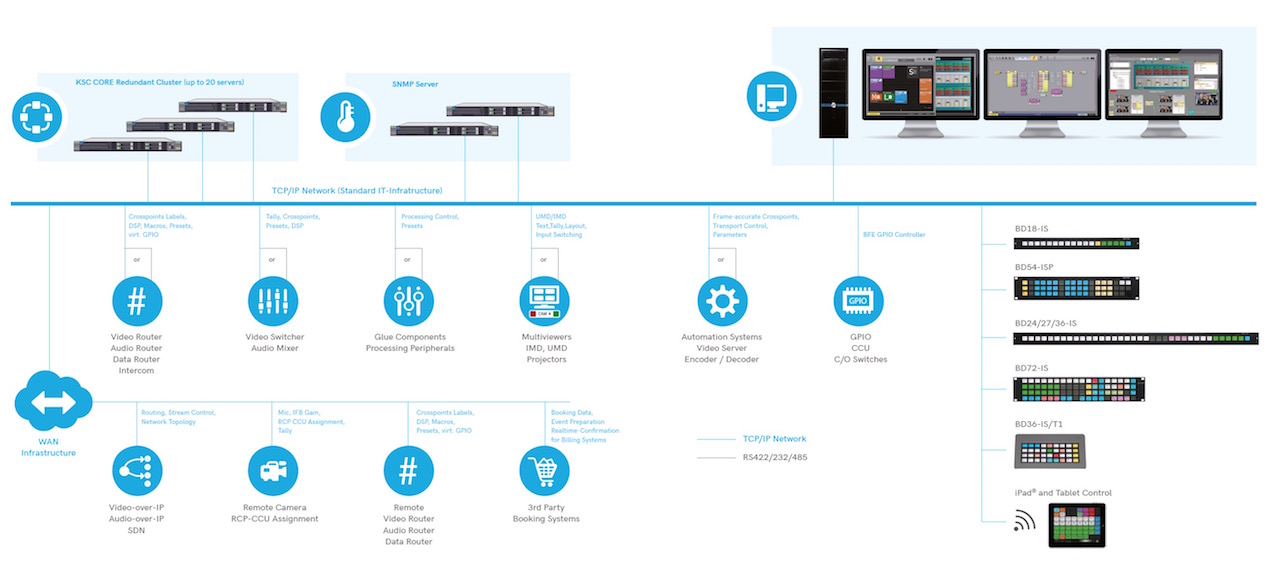
As shown in this diagram, the system has a variety of control panels, from 18 buttons on 1RU up to 72 buttons in 3RU. They are all configurable and you can dynamically assign multiple functions. They can work with pages to group switches by signal families and even combine them with video and audio controls or studio switching. KSC Core also allows the creation of software panels, which can be replicas of hardware panels on PCs or tablets, or with the GFX application, a fully customizable graphic application that can include buttons, faders, VU meters, backgrounds, third-party control URLs and even thumbnails of video streaming.
As a pioneer in IP-based transmission control, in 2011, BFE developed KSC Silknet, developed especially to meet the demands of the broadcast industry for new flows based on IP architectures and all types of topologies. KSC Silknet is now one of the most versatile SDN solutions on the market, and can be seamlessly integrated with the KSC Core broadcast controller. The core components of this product are the bandwidth management, topology, network service, pathfinder (path optimizer), and discovery (automatic device registration) modules.
Returning to the KSC Core deployment carried out for TV3's new A control, a redundant system has been proposed, with 23 BD54-IS/Z2 54-key LCD panels, and multifunctional operations, in 2RU, 3 virtual panels and different interfaces for devices controlled by IP, serial communication and GPI-I/O, such as video matrices and mixers, camera units, audio consoles, intercom or KVM systems.
Cross-cutting collaboration
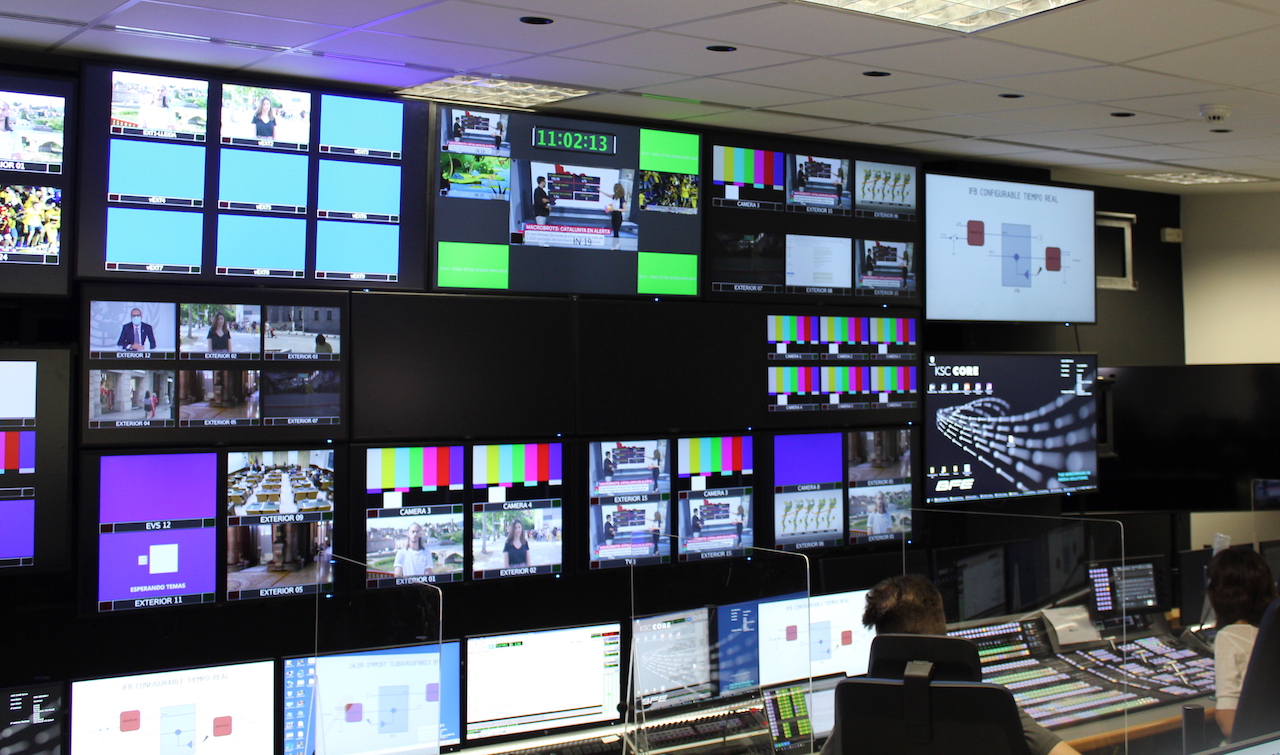
The renovation project of Control A has been a transversal collaboration project between different Areas of the CCMA, with a design in line with the increasingly common trend of converting all technical elements into shareable resources, adaptable according to production needs.
In this sense, they have been defined 22 positions identical work schedules with the KSC Core control system in such a way that, for example, a position today can serve the assistant in carrying out a program and tomorrow it can be assigned to the director of another totally different program, in an agile manner, depending on the needs and routines of each program.
Given the potential offered by the system, it is assumed that it will perform at the highest level when the rest of the controls are transformed to HD and that in the future any set can be assigned to any production control, regardless of its physical location, and with flexible allocation of resources between all of them. In short, we are heading more towards a scenario in which we are not talking about differentiated centers but rather about various sets and a set of production controls.
Jesus Ruiz, technical director of Crosspoint who has led the project together with engineers Luis Manuel del Álamo and Ricardo Cuenca, comments that "being awarded this CCMA project has been quite a challenge. From a single management system, and its user interfaces, we must configure multiple broadcast systems with multiple protocols. The management system, with adequate redundancy, allows operators to manage resources from twenty-three physical panels and three virtual ones, which have been configured to cover the operational and security needs. monitored.”
"It gives us great peace of mind to have suppliers, human resources and knowledge to carry out this integration and solve together the difficulties that inevitably arise in projects of this complexity. The magnificent communication with those responsible for TV3 has allowed us to adapt the technological solutions to the requested requirements," he adds.
Ramon Sangra, director of the TV Exploitation Area, comments that "the orchestration system has been the key piece to meet some of the basic objectives of the project such as: ability to configure jobs with the most convenient professional profile based on the needs and routines of each program, flexibility in the allocation of technical resources based on the needs of each program, and agility in the configuration and preparation of live events or already recorded programs."
"We are very satisfied with the result obtained, not only for the KSC Core, which is a very flexible system with many possibilities, and which will perform at its maximum when more controls can be interconnected, but also for the Crosspoint team. They have been involved from minute zero, and together with the needs and feedback provided by our engineers, they have designed a system tailored to us, implementing and delivering the project within the expected deadlines," he concludes.
This KSC Core control system integration project has been carried out after Crosspoint's previous supply of the Artist system (which also included AES-67 IP interfaces), Riedel Communications, aimed at the renewal of intercom in the CPA of TV3.
Did you like this article?
Subscribe to our NEWSLETTER and you won't miss anything.
Related articles
 New milestone for ultra high definition: 1 billion UHD televisions sold worldwide
 RTVE launches four new high-definition HD-SDI mobile units
 RTVE awards Telefónica the supply of HD and microphone equipment for its centers in the Canary Islands
 RTVE awards Albalá equipment for switching and distribution
 KSC Core expands to Spain with Crosspoint
 Aragón TV awards TSA the supply and installation of technical equipment, maintenance and operation services
 RTVE begins regular broadcasts of Star HD, its new high definition channel for America
 Crosspoint supplies a Riedel Artist intercom system to ETB for its UM1 Mobile Unit
 New high definition modulator from Promax
 Formula 1 returns to TV3 in high definition
 TVE awards Sony the renewal of high definition equipment
 All football in high definition on TV3 HD
 Calle 13, new high definition channel on Digital+
 Microsoft's new Zune HD will support 720p high definition video