





Matt Ryan combines Zeiss Supreme Primes lenses with Alexa 35 camera

Cinematographer Matt Ryan has combined the camera ARRI Alexa 35 with lenses Zeiss Supreme Primes to produce the ‘Fake Love’ music video for rapper and singer Tink.
Fake Love is a song about women who expose the fraudulent behavior of their male partners. Directed by Michelle Parker, features sequences of women berating men who have failed them in their relationships, along with a march of many women protesting against “false love.” The play culminates with a scene in which Tink and two other women set fire to an ex-boyfriend's car.
The entire project was shot during one night at the Anderson Warehouse in downtown Los Angeles. "It's an incredible space. You can't point the camera in the wrong direction," Ryan says. "It lends itself to a lot of possibilities with lighting, contrast and atmosphere. When approaching this shoot, we wanted to play with silhouettes, keeping Tink lit with a glamorous, poppy key light. We also wanted to use Steadicam to navigate the venue's tight hallways. To achieve all of this, I needed a camera package that was compact, yet high-speed to capture the cavernous warehouse spaces, using our production's limited lighting package."
Ryan knew right away that he wanted the Alexa 35 with Zeiss Supreme Primes. "We shoot with a T2 most of the time and that camera can go really deep into the shadows. When you have a camera sensor with that much dynamic range, you also need a lens that can resolve that image as well. The ARRI Alexa 35 has an incredible amount of latitude and staring potential. It's a great pairing because this camera can see so high in the highlights and so low in the shadows, which is a perfect fit for these lenses that can handle those same characteristics."
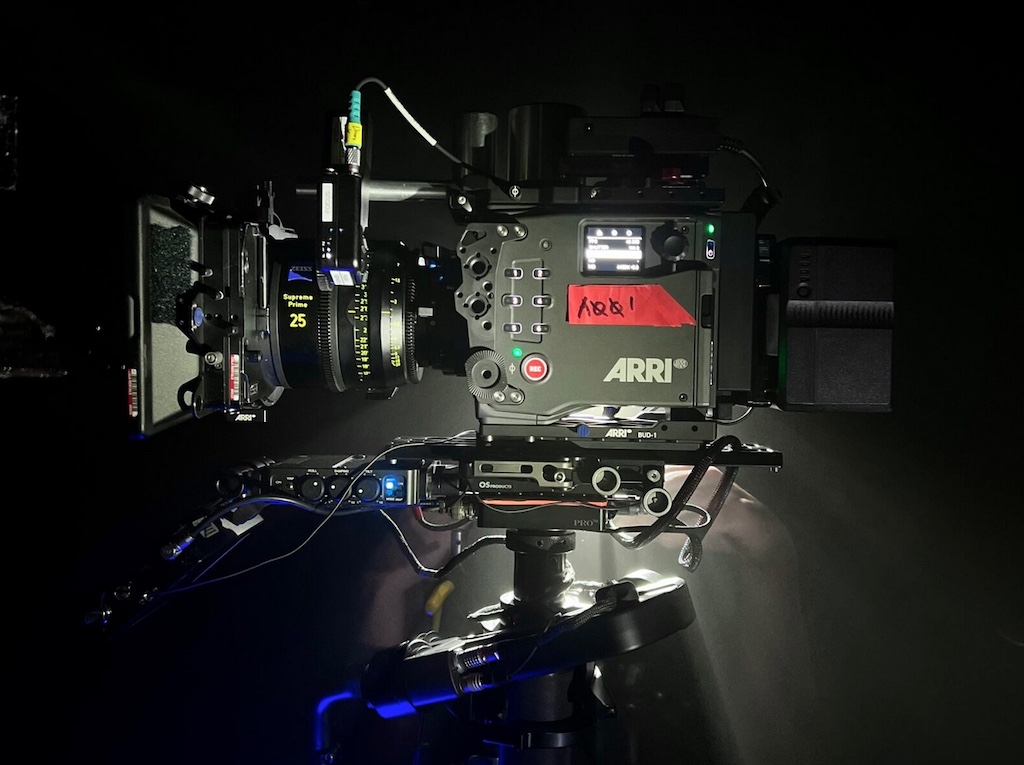 When it comes to lenses, prioritize the optics that best allow you to tell the story, especially when the story requires spontaneity and push the team to the limit. He details: "The first thing I look at is whether the set of lenses fits aesthetically: does the 21 look like the 85 or the 50? Then, what does it look like in a close-up? Can I focus on most of the face, nose, eyes and ears, and then have a graceful blur? What does the bokeh look like if I have out-of-focus specular reflections right next to a close-up? Will it cover a person's face? For me, the Supreme Primes lenses are the solution. I can get the clarity I'm looking for.” Armed with high-speed lenses and the high dynamic range of his camera, Ryan was prepared.
"In music videos, sometimes you have to improvise. There are always a lot of variables, unlike commercials where most of the time everything is known," says Ryan. The most iconic shots can come from a chance accident on set. He describes one of those moments: “The Steadicam was attached, with the camera pointed outside the set towards a frosted window with a fire motivated in a drum barrel that acted as a lighting gag with a fog machine.” A crew member was silhouetted in the accidental frame and Matt was impressed by the unexpected cinematic vision.
The director was equally impressed, and they added a shot to capture Tink's dramatic, colorful silhouette in front of the grimy window, an image that plays at the video's climax. "If I hadn't had that combination of lenses and camera, I probably wouldn't have gotten that shot. It was a happy accident."
"I consider the lens sensor as the canvas and the lens as the paintbrush. It all comes down to a feeling: can it help me fight this low light? When I have a versatile lens that has everything I need, with so much resolution, clarity and close focus... it's beautiful," concludes Ryan.
https://www.youtube.com/watch?v=vZBai3L6Nl4
Did you like this article?
Subscribe to our NEWSLETTER and you won't miss anything.
Related articles
 CinCraft: Zeiss virtual lens technology begins its beta phase
Zeiss designs new virtual lens technology
CinCraft: Zeiss virtual lens technology begins its beta phase
Zeiss designs new virtual lens technology
 Zeiss launches its new family of Otus ML lenses, aimed at mirrorless cameras
 ARRI designs the new Alexa 265, a compact cinema camera with a 65 mm sensor
 ZEISS CinCraft Scenario Camera Tracking System Adapts to Broadcast Environments
 ARRI presents the Alexa 35, a 4K Super 35 camera with an unprecedented sensor
 Sandra Valde-Hansen shoots ‘Plan B’ with Sony Venice and Zeiss Supreme lenses
Sandra Valde-Hansen shoots 'Plan B' with the Sony Venice and Zeiss Supreme optics
Sandra Valde-Hansen shoots ‘Plan B’ with Sony Venice and Zeiss Supreme lenses
Sandra Valde-Hansen shoots 'Plan B' with the Sony Venice and Zeiss Supreme optics
 Ovide adds the ARRI Alexa Mini LF camera and Cooke Anamorphic/i Full Frame lenses to its rental catalog
 ARRI launches Alexa LF, a 4K version of its popular camera
 ARRI Alexa and 4K lenses from Fujinon and Canon, recognized with the engineering Emmys
 I-Movix and Polecam develop a solution that combines Ultra Slow Motion with a light crane
 Zeiss enters the compact camera market with new Touit lenses
 Alexa, ARRI's new digital camera, dazzles NAB