





UHD Spain takes a position on the use of the radio spectrum

With the aim of proposing solutions to improve wireless connectivity in the production of television events, UHD Spain has prepared a document in which it expresses its position regarding the use of the radio spectrum.
5G technology with dedicated spectrum could be useful for recurring services on television sets, sports stadiums or concert halls, among others.
In the past, television cameras were connected by cables to a control center. Today wireless connections are used in the 2400 MHz band, but they also have technical limitations, especially with Ultra High Definition. According to Xavier Redón, vice president of UHD Spain and Product Manager of Cellnex Telecom, “the spectrum assigned for this type of communications is limited, which presents a challenge to transmit in UHD.”
In October 2023, the UHD Spain association carried out a IP-based production proof of concept of a live musical concert. They connected four 4K-HDR cameras to a private 5G network, allowing all four cameras to stream simultaneously and in Ultra High Definition. Redón has commented that this experience meant observing how this spectrum turned out to be highly effective in improving the quality of transmissions.
UHD Spain offers contact with dedicated spectrum for connectivity in audiovisual events. This would allow communication to be integrated into current production flows and use the same communication equipment as in the public 5G network. Furthermore, the association advises that this spectrum be operated by actors with the necessary technical training to ensure its maximum efficiency and quality.
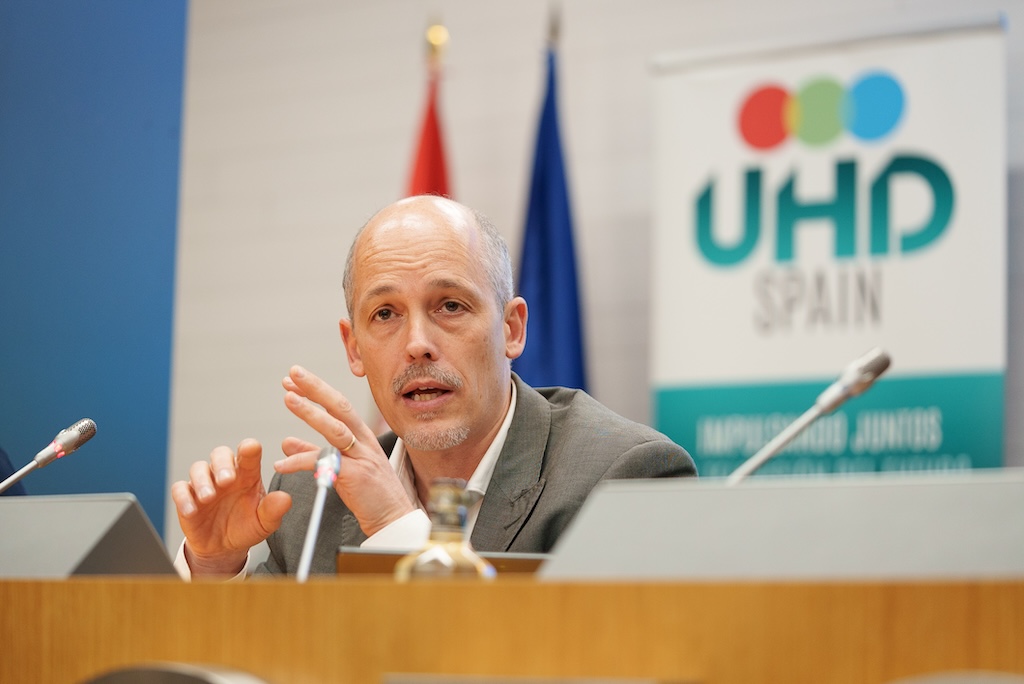 Xavier Redón emphasizes the importance of this measure stating that “at UHD Spain, we believe that it is crucial to consider the needs of the audiovisual sector when temporarily allocating spectrum for wireless contributions in UHD, thus facilitating the production of events in temporary and occasional locations.”
This technology will allow offshore production models, reducing costs and improving efficiency. To all these positive aspects we must add that it helps reduce the carbon footprint and facilitates work in rural and remote areas. For Redón, "the direct benefits for the public will include greater availability of live and Ultra High Definition content. This means an improved and more immersive experience for viewers."
Did you like this article?
Subscribe to our NEWSLETTER and you won't miss anything.
Related articles
 Spain Film Commission publishes the 'White Paper on virtual production in Spain'
 Spain Audiovisual Hub publishes the 2nd Report on the audiovisual sector
 IAB Spain sheds light on Connected Television with a complete White Paper
 IAB Spain sheds light on Connected TV formats with an Advanced Guide
 This is how the radio spectrum for mobile phones is in Latin America
 UHD Spain: Spain will have a permanent National Forum on 4K-UHD
 IAB Spain organizes a course on new advertising environments from online video to 'Addressable TV'
 BIT Experience puts radio spectrum management on the table
 European telcos stand up to Brussels over the use of the radio spectrum
The CNMC proposes a more intense control of the radio spectrum to avoid anti-competitive situations
BIT Experience will take the pulse of the thorny issue of radio spectrum management
European telcos stand up to Brussels over the use of the radio spectrum
The CNMC proposes a more intense control of the radio spectrum to avoid anti-competitive situations
BIT Experience will take the pulse of the thorny issue of radio spectrum management
 Experts in the radio spectrum will discuss the situation on networks and services in the UHF band
Uruguay rearranges its radio spectrum to prepare it for digital TV
Experts in the radio spectrum will discuss the situation on networks and services in the UHF band
Uruguay rearranges its radio spectrum to prepare it for digital TV
 Cisco positions itself in video over IP