





Compression: the variable added to definition and resolution that we must not forget in the transition to UHD

In this gallery, José Manuel Menéndez, professor of the Polytechnic University of Madrid and director of the RTVE Chair – UPM, reflects on the concepts of definition and resolution and unites them with that of “compression”, a concept that must be addressed with special care when defining the future of a DTT built on DVB-T2 and with UHD capabilities.
There is an open debate within the production sector of TV content about whether it makes sense broadcast on DTT signs UHD with resolution higher than 1080 HD lines or not. On whether we are able to appreciate the difference between both types of signals on the screens in our living room, taking into account the screen dimensions and the viewing distance from the sofa.
Let me add one very important variable to this debate: not only the resolution counts to have a feeling of greater definition (see my previous tribune [1]); It also counts, and a lot, level with which we compress the signal, since, if the compression is excessive, we lose definition. Let us remember that, with the digital signal, the definition is the fineness of detail with which an image is reproduced and, therefore, our subjective feeling of quality in contemplation of the scene.

Definition vs. resolution
I have always started my courses on TV signal talking about the human visual system. It is logical: every video signal that is produced is intended for a human to see (whether our pet also sees it is anecdotal). Therefore, we need to know how our eye sees to optimize what we present to it. And, in this sense, we have always started from the fact that our eye has an approximate visual acuity of one minute of arc (0o 1´ 0”). With this we have always proposed the minimum recommended distances to the screen so as not to discern the different pixels individually, and not have a feeling of pixelation.
All video signal that is produced is intended for a human see it (the fact that our pet also sees it is anecdotal). Therefore, we need to know how our eye sees to optimize what we present to you.
In my last check-ups with the optometrist to correct my myopia, I have been fortunate to achieve visual acuities of 1.2, while friends and family around me tell me that some surpass me, and others reach 0.8 or 0.9. And what does this mean? Well simple: that not all of us have the same visual capacity, among other reasons due to the difference in density of cones in the fovea (the area of the retina of the eye that allows us to see detail). This made me curious, and encouraged me to look at the data and do some math. It seems that [2] The fovea has an average of around 147,000 cones/mm2, although it is not strange to find people with 100,000 cones/mm2 and less, or with more than 324,000 cones/mm2. This could perhaps be one of the causes that would justify the difference in visual acuity between people. And then what about the minute of arc that we have been using all our lives for the recommended distances to the screen? Well, it comes from considering the statistical average of 147,000 cones/mm2. But if we consider the range of densities from 100,000 to 324,000 cones/mm2, visual acuities would go from 00 0´ 42.38” at 00 1´ 2.92”. That is, not all of us see the same. With this premise I have done some calculations with 1080 and 2160 line TV signals (HD and UHD) to see its effect on screens of different sizes (in inches [“] of their diagonal), and the resulting graph is the following:
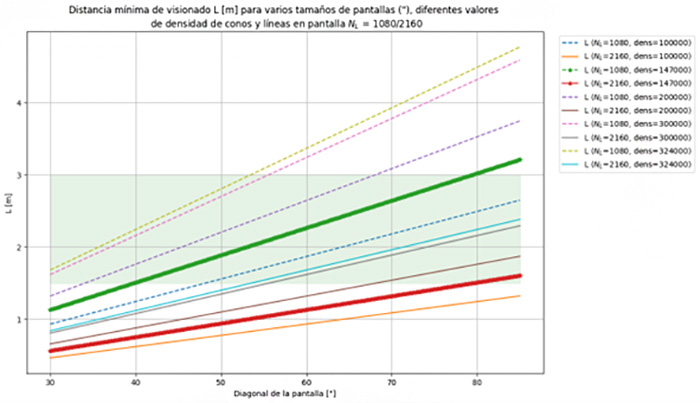
The graph shows results with dashed line for screens 1080 Full-HD resolution, and in continuous line for UHD 2160 lines. The values corresponding to the average of 147,000 cones/mm2 have been marked with a thicker line for both HD and UHD. The different lines correspond to different densities of cones in the fovea. The X axis is the screen sizes (in inches), and the Y axis is the recommended minimum distances to the screen so as not to discern each pixel. Therefore, for a certain screen size we need to be higher in distance to the TV to obtain maximum performance in its resolution.
I have tried to look for statistics on the usual TV viewing distance in the living room, but I confess that I have not found much. Samsung states [3] in an “e”study on viewing recommendations carried out by ITU-R for Samsung Electronics"(study that we would all appreciate if you shared to verify the source) that 87% of homes have more than 1.6 meters of distance from the TV. I have measured the distance that I have, and estimated that of some friends and family (it is not a plan to go around the houses with a meter...), and I have marked on the graph a green stripe between 1,5 y 3 m which I think covers a vast majority of what I've seen.
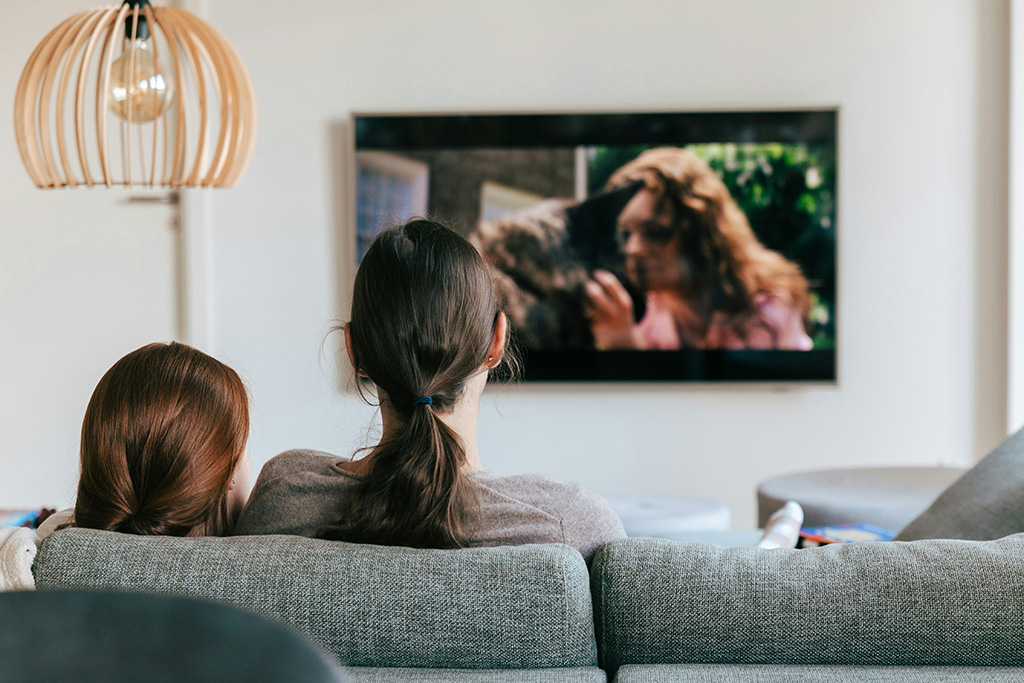
The living room, HD and UHD
From the graph it can be seen that with HD resolution screens, and with the viewing distances marked in the green stripe, there are situations that are not very suitable. However, with screens UHD if we are meeting the requirement, and making the most of the displayed resolution.
I think it is important that we all continue working for improve the signal emitted on DTT both in colorimetry y dynamic range as in resolution.
In my case, the distance restriction in the living room is met (which I am grateful for so I don't have to join the rest of the family to reconfigure the living room), and I confess that I am one of the lucky ones who are beginning to see series, movies and sports in UHD with HDR, and I DO notice the difference in definition (level of detail in the image) when going from HD a UHD, and I DO notice the very substantial improvement in colorimetry and luminosity in UHD compared to HD. In football, in particular, where colors tend to be very saturated, in UHD look natural while sometimes in HD they look very strange and “pasty”.
Therefore, I think it is important that we all continue working for improve the signal emitted on DTT both in colorimetry y dynamic range as in resolution. There is no doubt that it is advisable to adapt the screen size to the dimensions of our room and viewing distance, but I highly recommend that you choose to search settings where to get the maximum benefit to UHD, not only in colorimetry and brightness, but also in resolution.
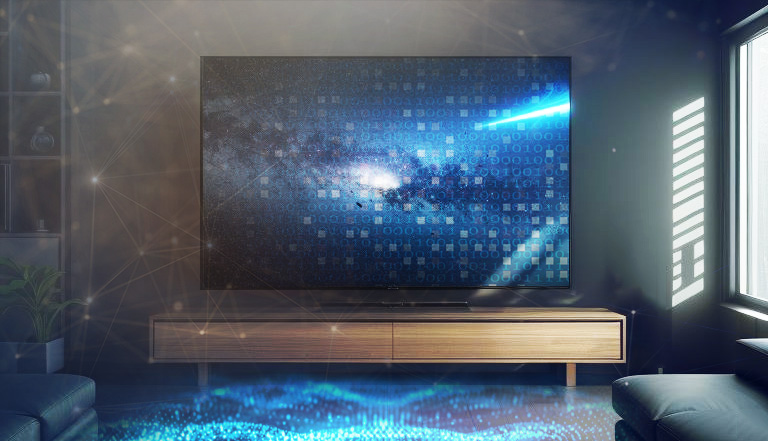
Definition vs. compression level
In 2010, in Spain we implemented the analog blackout on DTT, which implies that portions of 8 MHz that were used to broadcast each channel of analog TV Now they have become “multiplex” (MUX) that carry 19.91 Mbit/sec, in which they are currently broadcast 4 TV channels with resolution HD.
a channel HD with 1080i25 format (that is, 1080 visible lines, broadcast in interlaced format at 25 frames/sec) as those that are being broadcast to us on DTT usually require, without any type of compression, 1.485 Gbit/sec on the SDI interface used in production. If we remove the synchronization information, the video signal (not counting the audio) remains at just over 830 Mbit/sec (to give a reference figure). Since four (4) channels are being output on each MUX, each in the range of 3 to 5 Mbit/sec, this implies that compression between 300:1 and 500:1 is being applied, i.e. very high. To perform this compression, we use algorithms proposed in international standards, (AVC, HEVC, VVC, etc.) that eliminate redundancy (what is repeated in the signal) space (in the same image) and temporal (between images) with motion estimation and compensation techniques and complex mathematical transformations, as well as other operations.
How much the more it compresses, worse will be the approach that we achieve original sign.
With this it is achieved represent video information with fewer bits. Compression can be achieved without loss, that is, recovering the original signal with all its definition from the compressed signal, but at the cost of achieving very low compression, around 3:1 at most. For higher compressions it is necessary to opt for lossy compression, that is, it is not possible to recover the original signal, but rather an approximation of it. The more it is compressed, the worse the approximation we achieve to the original signal..
The following figure shows a frame of a video signal (courtesy of the EBU), in its original version at the top, and with a higher degree of compression at the bottom. As can be seen, the more the signal is compressed, the worse definition is observed: the colors become paste, sharpness is lost, they even appear pixelated, and the fineness of detail with which the elements of the scene are outlined deteriorates. In short, you lose definition.


Migration to DVB-T2 and UHD
I have recently been invited, as director of the RTVE Chair at the UPM, to a meeting in Ametic to talk about the possible development of a new technical plan for the TDT (PT TDT) that considers the migration, in some way and with the relevant stages, of the current DVB-T modulation technique to its most efficient evolution, DVB-T2, and the transition from broadcasting HD signals to signals UHD. The migration to DVB-T2 is a step, in my opinion, very necessary if we want to justify that Spain is using efficient techniques (spectrally and energetically speaking) to broadcast DTT, and the evolution to UHD is something that is already taking place, both in our country and in other countries, so we need a regulatory framework that defines the mechanisms to carry out this transition.
Pass from 4 canales HD encoded in AVC to others 4 UHD channels encoded in HEVC could require (with many nuances) 2 times the capacity of the current MUX to maintain visual quality current HD channels.
A few years ago, within the framework of the activities of the RTVE Chair at the UPM, Cellnex (member of the Chair's Advisory Committee) did a study to determine the best configuration that could be had in Spain, with the current network infrastructure, to migrate to DVB-T2. This study was delivered to the Secretary of State in charge of managing the radio spectrum, and was presented publicly in 2018 at a 4K Summit event. It seems that the conclusions of the study are now being considered, which would imply increase the capacity of each MUX by 68%, going from 19.91 Mbit/sec to capacities greater than 33 Mbit/sec.
Making big round figures, currently we have 4 HD channels in each MUX. A UHD signal is 4 times larger than an HD signal. HD signal is usually encoded with AVC, and UHD signal with HEVC, which is supposed to be 2 times more efficient than AVC. With this, in large numbers, broadcasting a UHD channel would imply twice the bit rate of an HD one (all this with nuances, since it depends on the content of the signal, HEVC is not always twice as efficient as HD, a UHD channel does not always require 4 times the bit rate than another HD using the same encoder, etc.). Going back to the big round numbers, going from 4 HD channels encoded in AVC to another 4 UHD channels encoded in HEVC could require (with many nuances) 2 times the capacity of the current MUX to maintain the current visual quality of HD channels. and the migration to DVB-T2 would provide a increase of less than 70% of current capacity, it would not be duplicated.
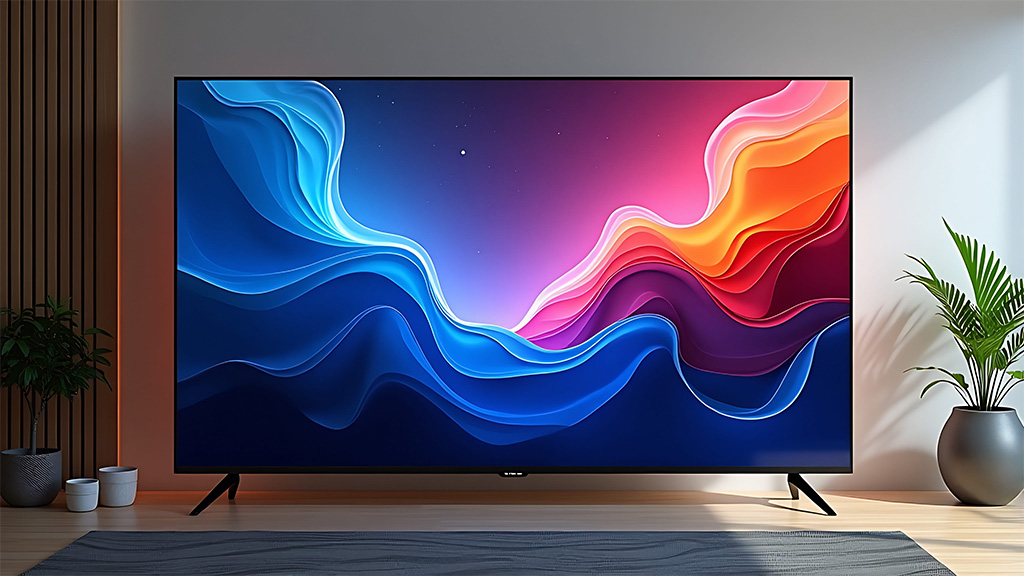
The risks of compression in the new stage of DTT
It is true that the efficiency of an encoder It usually improves with the passage of time. The manufacturer is managing, with work and time, to incorporate more functions than those defined in the standard and that work in real time, a restriction that is always present and limits what can be included in the first implementations or generations of the encoders. This, evidently, runs in favor of an increasingly efficient use of the MUX capacity, and what can be included in them. In addition, we also have statistical multiplexing, which tries to make the most of the capacity of the MUX by giving more capacity to channels that require it due to the content of the signal by cutting the other channels of the MUX whose content demands fewer bits, or to which less priority is given.
It worries me a lot, the message that is released publicly if they apply severe compression ratios about the UHD signals In the early stages of transition of a new PT TDT.
Nevertheless, it worries me, a lot, the message that is released publicly if they apply severe compression ratios about the UHD signals in the first stages of transition of a new PT TDT. Especially, because of the message that can be conveyed to the population that “there is really no improvement seen in relation to HD”, when the truth is that perhaps the signal is not being treated as it really should be.
Therefore, allow me to take this stand to request that, together, we manage to carry out a transition process, as long as necessary, in the new PT TDT scenario, which is respectful of the signal, and really shows all the possibilities that we can enjoy in our homes with the UHD signal. Let us always remember that the definition in the image it is not just a question of resolution.
[1] https://www.panoramaaudiovisual.com/2021/11/09/no-confundamos-resolucion-definicion-senal-uhd/
[2] A. Shroff. “An Eye on Numbers: A Ready Reckoner in Ophthalmology”. Postscript Media Pvt. ISBN 978-81-921123-1-2. 2011.
[3] https://news.samsung.com/es/el-tamano-importa-7-de-cada-10-espanoles-compraria-un-televisor-mas-grande
Jose Manuel Menendez
Professor of the Polytechnic University of Madrid y director of the RTVE Chair – UPM

Did you like this article?
Subscribe to our NEWSLETTER and you won't miss anything.
Related articles
 Christie will bring its Variable Dynamic Range (VDR) technology to CinemaCon 2025
 Let's not confuse resolution with definition in the UHD signal
 HDR: Are we still in a transition stage?
 Norway ends its analogue radio, should we follow in its wake?
 Dolby takes a new step to forget glasses in 3D
 For-A VFC-7000: HD recording with variable frame rate
 Cinemartin SFV: portable uncompressed HD, 2K and 3D recording
 Gekko will present Kedo, an LED luminaire with variable temperature, at NAB 2011
 Sensio acquires Algolith compression technology
 Uncompressed HD replays powered by AJA
Compression of signals in the Portuguese RTP, with Sapec
JVC Ultra High Resolution at IBC'09
Uncompressed HD replays powered by AJA
Compression of signals in the Portuguese RTP, with Sapec
JVC Ultra High Resolution at IBC'09
 Eugenio Monzón: “we must ensure that the film industry contributes 5% of the Community's GDP”
 Sony PDW-F800 with variable frame rate