





El Poder del Pop: the Spanish production company that champions the creation of videos with generative AI


Daniel Cuenca, responsible for The Power of Pop, a Madrid-based production company specialized in audiovisual creation with artificial intelligence, sheds light on the use of generative AI tools for the creation of images and videos, used in a wide range of applications such as video clips, advertising or corporate videos.
At a time when the creation of images with Generative AI begins to be democratized thanks to tools from technological giants such as Microsoft (AI image generator) o X (Grok), there are still certain limitations in the section of videos. The commercialization of these models, as well as their limitations in terms of resolution or customization, imply important barriers for the most curious citizen, but also for the professional who seeks to take advantage of the cost savings that these can bring.
Despite these restrictions, little by little we see audiovisual content created with these generative video tools with spectacular results. As an example, the Coca-Cola's latest Christmas ad, which takes the brand's festive imagery as a reference to create a new product built with AI tools. Another example is Rhythm of Life from Vodafone, a spot without a single real pixel, in the words of Amr El Badry, senior manager of brand identity and global communications at Vodafone, which was directed by filmmaker Sebastian Strasser of the production company Lipstick.
 As in any technological development, it is only a matter of time before the technological initiatives of the large industrial giants become progressively more and more accessible to all types of producers. In Spain, we find dozens of examples of production and post-production companies that use AI processes to accelerate their edits, improve audio, optimize cataloging or generate storyboards of his next projects. However, there are few cases as particular as The Power of Pop, a producer born in the post-pandemic effervescence that has championed the use of AI in multiple expressions: video generation, video rescaling, automated video editing, music generation, automatic translation, subtitling…
Daniel Cuenca, head of the production company, shares his journey of exploring and integrating the possibilities of generative AI in professional audiovisual creation, whether to create a universe of a video clip from scratch or to enable training videos in multiple corporate contexts.
A personal concern and an industrial opportunity
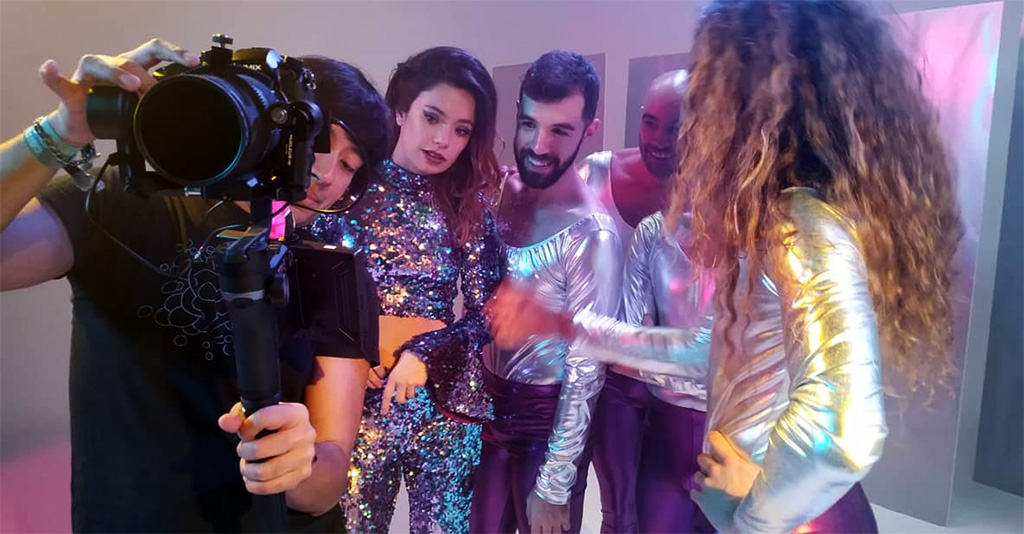
Cuenca, who had been working for five years as a graphic designer in a company dedicated to tourism, alternated his daily work in an office with the filming of video clips for bands from the Spanish independent scene. It was his true passion and it took up more and more hours: there was no afternoon that he did not have to do pre-production for a shoot or edit, while the weekends were reserved for filming.
“At first, AI models They were not suitable for professional use. They generated many aberrations, characters with strange anatomies…Now we have reached the point where you can't distinguish If a video is created with IA of no”.
The arrival of the pandemic caused him to close his main job, which was the perfect impetus to launch into the world of audiovisual production. It was then that he decided to found El Poder del Pop, a production company that, whether working with international clients such as Amazon Music or creating video clips for bands from such emblematic labels as Elephant o Subterfuge, carved a niche for itself in the industry by forming a portfolio of collaborators that Cuenca would call according to the needs of each project.
Currently, El Poder del Pop continues to create music videos of international reach for artists such as La Casa Azul, Edurne, Fitness Forever, Helen Love, Soleá Morente, Putochinomaricón or Capitán Sunrise, among many others, but the 80% of your business volume has turned to AI tools application in audiovisual processes. "I am always very aware of technological news, and two years ago I saw the direction that the industry was going to take. I focused on learning everything that had to do with image and video generation, and I began to learn self-taught by exploring all types of software. Little by little I started making videos with generative AI, and from there things went more and more," Cuenca explains.
First expressions of dizzying technology
The process of learning generative AI tools is never-ending. Such is the evolution at “dizzying speed” of these solutions, that users can find creation models that are updated “overnight" to offer new functions or better quality. In many cases, these improvements are what mark that a solution goes from being a mere proof of concept to a product applicable to professional environments: "At first, they weren't useful for professional use. They generated a lot of aberrations, characters with strange anatomies, totally incorrect anatomical movements and quite poor quality. Now we have reached the point where you can't distinguish if a video is created with AI or not."
The first major video project with generative AI that Cuenca developed was a format for a hackathon organized by the MIT (Massachusetts Institute of Technology): a competition in which you had to create a video based on a key concept in just 48 hours, developing scripts, stories, creating images and animating them. The result was awarded in the Best Music category, given that not only the images were created with these models, but also voice and music.
With regards to the musical creation, Cuenca comments that artists are usually open to working with generative AI tools. Such is the case of the artist Captain Sunrise, who decided to bet on El Poder del Pop to illustrate a song about the emergence of technology titled “Alexa, do you love me?”: "It was very good for us to add images created with AI. Furthermore, at the VFX level, we were able to use these tools to replace a character and change it for a robot, or add images recorded on video and transform them so that they had a video game aesthetic." Another example is the last video clip of Trötegalôpe: “They told us that, for the song they were making, the aesthetic they needed was that of a video created with AI.”
Generative AI creation tools applied to video
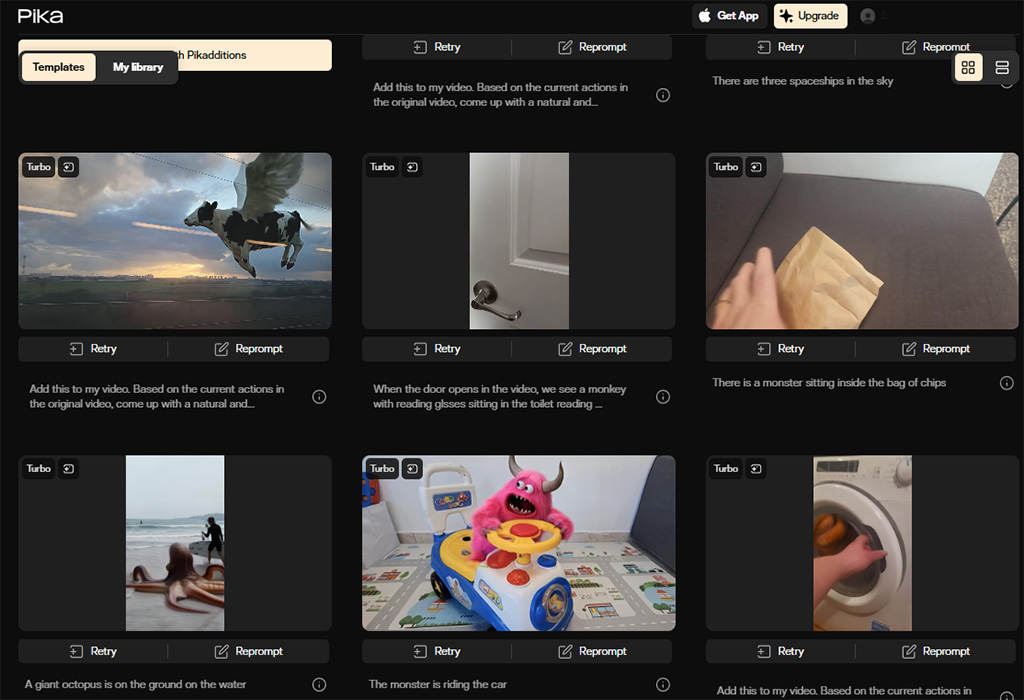
There is still no great all-in-one software or service that works as an AI-powered content creation hub. This forces users to use a combination of tools depending on the needs of each project. Cuenca usually starts from the creation of static images using Midjourney o Freepik, to later animate them with solutions such as Runway, a company that recently signed an agreement with Lionsgate to explore the use of AI in filmmaking.
Additionally, El Poder del Pop benefits from solutions such as Kling, which currently stands out for being one of the few solutions that offers content export in 1080p; Pika, which has incorporated the possibility of including physical elements (photographs, images, clothing or location) in the generation processes; Magnificent, an image scaling tool; ElevenLabs, which offer a wide variety of audio options, including synthetic voices, or AI is calling, a solution with which you can create realistic music from scratch from prompts. Most of these tools can be used by hiring subscription plans “quite affordable” that allow unlimited uses, avoiding models based on tokens offered in the most basic marketing models.
Once the audiovisual content is generated, Cuenca is responsible for assembling it using the software DaVinci Resolve: “Before I edited in Final Cut Pro or Premiere, I spent the churro I downloaded DaVinci to do the color and, once finished, I went back to some of the software if any adjustments needed to be made. "I realized that this was a quite cumbersome process and that it took a long time," he explains. Finally, he decided to opt for the solution of Blackmagic Design and now he uses it exclusively: "It is a program that I am quite comfortable with and that is constantly updated. The latest version includes many tools for machine learning and artificial intelligence that make our lives much easier.”
Limitations of creating video with generative AI
The opportunities offered by creating images with these generative AI tools are offset by the big limitations of a technology still in a development phase. Cuenca points out that, on many occasions, they force you to go “practically blind"trusting that the"trial and error” ended up giving the expected results: “There are times when you start creating videos or images and, suddenly, you have the best results on the first try. In others, you have to spend hours or even days trying to make content that resembles what you want.” This implies that, leaving aside the pre-production and editing process, the generation of images can extend between one or two weeks.
“There are times when you start creating videos or images and suddenly you have the best results in the first try. In others, you have to be hours o even days”.
Among the main frustrations that creators encounter, the “low level of manipulation” of these models, which could greatly speed up audiovisual creation: “Suddenly you have something that works very well for you, but you know that if you had a little more control over the camera it would be great. Which, in fact, there is: some of these tools have camera management options, but in past versions. So if you want to have the best quality and resolution, you can't have access to these movements.”
Efficiency and profitability in audiovisual creation
With an emerging industry, multi-million dollar investments and a legal landscape still being defined, the emergence of generative AI has a long way to go to reach its long-awaited consolidation. Another issue is the ethics of the use of these tools, an endless debate in which Cuenca positions itself in pro technological and business evolution: "I have never seen artificial intelligence as an enemy. It is not going to take away our jobs, but rather the job is going to be taken away from us by a person who knows how to use these tools. For me, it is the equivalent of if at some point you had refused to use the computer because the typewriter suited you very well. (...) A work done by a human will never surpass that which is done by a machine, but I do believe that it can give us many tools to bring our vision to reality in a more efficient and economical way."
“A work done by a human will never overcome which is made by a machine, but I do believe that it can give us many tools to bring our vision to reality more efficient and economical”.
To The Power of Pop, the opportunities have been more than evident. The company has changed its business model, without completely dispensing with filming video clips or short films, to focus on offering creation and post-production services using artificial intelligence in corporate environments. Whether they are pre-campaigns marketing, creation of advertisements for Google Ads campaigns or internal videos, generative AI represents a profitable alternative for a world focused, more than ever, on audiovisuals: "There are companies that cannot afford to do a shoot as such and that would benefit from a video that simply shows their product. Therefore, in recent years we have created content for companies that are in SEO positioning, focused on sectors as varied as blinds or even large energy companies that need internal videos. We have everything."
A report by Sergio Julián Gómez
Did you like this article?
Subscribe to our NEWSLETTER and you won't miss anything.
Related articles
 Create for YouTube Shorts: the alliance between Adobe and YouTube to promote the creation of short videos
 This will be the new RTVE of José Pablo López: creation of the production company RTVE Estudios, renovation of the center of the Canary Islands, new cultural channel...
 ThinkAnalytics' ThinkFAST Debuts at NAB 2024 to Bring Generative AI to Channel Creation
 Vertical shooting: creating professional videos for networks
 Mediapro studies the possibilities of AI for the creation of sports statistics and videos
 'The Lord of the Rings: The Rings of Power', finished in the cloud with DaVinci Resolve Studio
 Menorca Film Commission is born with sustainability as its flag
 La Claqueta PC, the first Spanish production company to join the UN Climate Neutral Now program
 Spanish Television makes the bravest Goya Awards gala shine
 'La casa de papel' makes history by becoming the first Spanish series to win an Emmy
 Spanish Television and the production company Programas y Tv begin recording 'iFamily'
 'Catch the flag' confirms with its Goya the good work of Spanish animation
 +TVE is born, the first second screen application to record live Spanish Television videos and share them on social networks
 The Spanish production company Continental Producciones sweeps the world with a “virtual fireplace”