





Sennheiser begins marketing its Spectera broadband wireless ecosystem
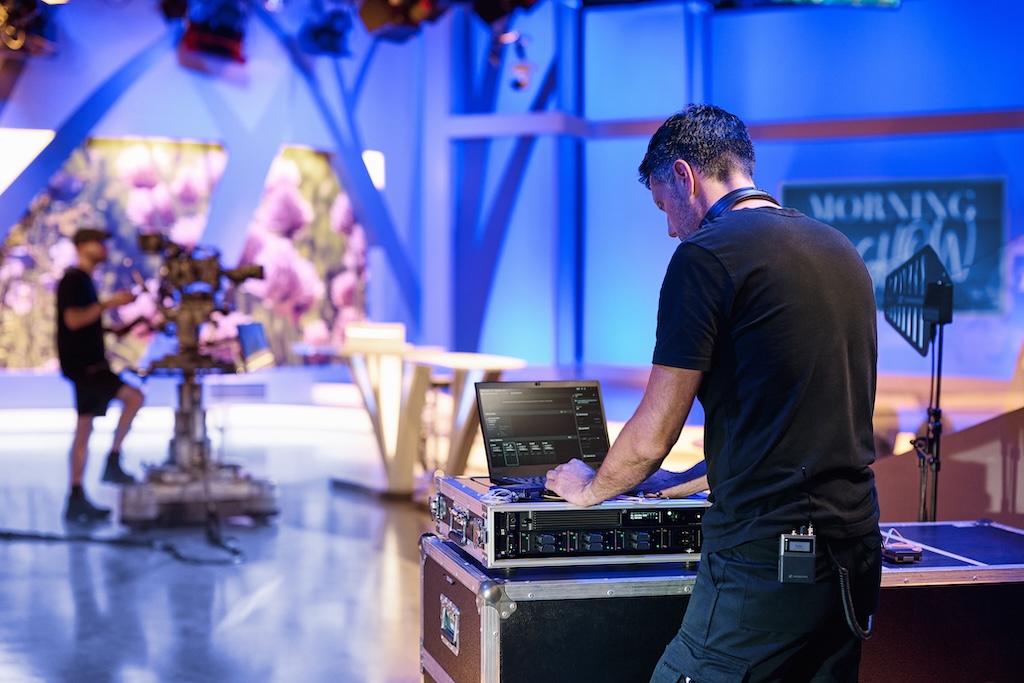
Bringing together the power of a multi-channel system in a single 1U rack unit, and being able to house wireless microphones, IEMs and control data on the same RF channel and in a single bodypack, the new bi-directional wireless solution from Sennheiser begins its commercialization.
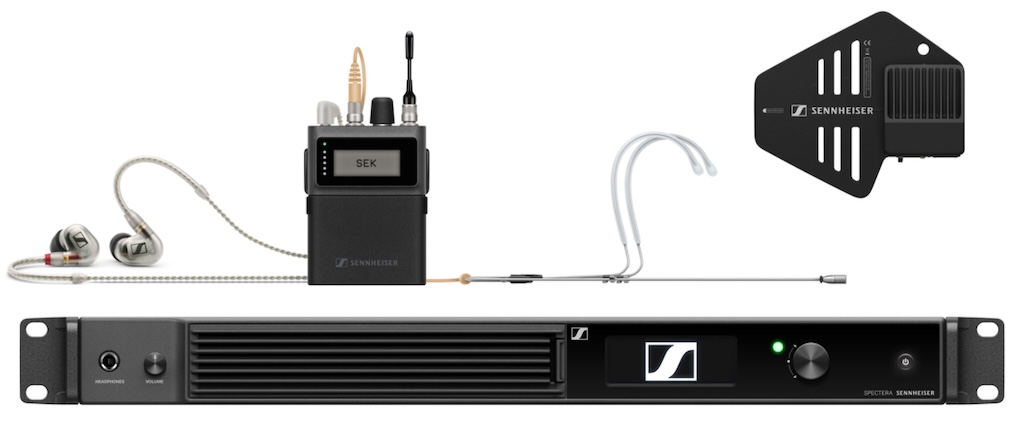
System hardware includes base station, he SEK bidirectional bodypack, in versions for the TV-UHF and 1.4 GHz bands, the DAD transceiver antennas (also in TV-UHF and 1.4 GHz versions), MADI cards and various accessories. On the other hand, the ecosystem includes the software LinkDesk and the Spectra WebUI web interface browser based.
Andreas Sennheiser, co-CEO of Sennheiser, highlights that "as a flexible and growing ecosystem, Spectera will continue to expand and adapt to the current and future needs of customers and users, and we are very excited to begin serial production and shipping. I would like to take this opportunity to sincerely thank all participants in the Pioneer Program for their contribution to the creation of Spectera, and to all our customers for taking this brave step into the future of wireless technology with us.
"At the same time, I must ask for patience and understanding from our customers, as it will take some time to fulfill the long list of pending orders. For our part, we have made a considerable investment in electronic production at our plant in Germany and have considerably increased our capacity, but due to the high demand, the fulfillment of orders will inevitably take time," he added.
A WMAS solution that simplifies live audio
From the small space that the ecosystem occupies in the warehouse, during transport and behind the scenes, to the automatic coordination of all mobile devices in it canal RF de 6 u 8 MHz assigned to it, Spectera solves many of the problems that owners and operators of narrowband multichannel wireless systems face today. Furthermore, the Setup time with Spectera is significantly reduced, as this broadband solution no longer requires the extensive frequency calculations and RF cabling of narrowband systems, or the complex power level calculations for multi-channel IEMs.
“We have received a lot of positive feedback from our Spectera pioneers, who say that it has been a completely new experience for them to be able to get the system up and running so quickly,” he says. Benedikt Euen, senior product manager at Sennheiser. “Before Spectera, everyone on a production had to wait for them, now they're the ones who have free time!”
Spectera allows operators to place both IEMs like microphones on the same television channel, without the need for separate bands with guard bands. Thanks to the permanent two-way communication offered by Spectera, engineers have full remote control of the wireless system for configuration and monitoring, including permanent spectrum sensing, also on the RF channel used by Spectera itself. Thanks to the low spectral density of the ecosystem, it is easier to reuse frequencies than with narrowband wireless technology, for example, between neighboring theaters.
Las productions gain flexibility in the use of frequency resources allocated to Spectera and can choose between several audio link modes to determine the ideal audio quality, latency, number of channels and operating range for each audio link. Microphones and IEMs can be easily added during a show, and because the RF components are part of the DAD transceiver antennas (and not the base station), the system requires no amplifiers, splitters or combiners.
Software LinkDesk y Spectera WebUI
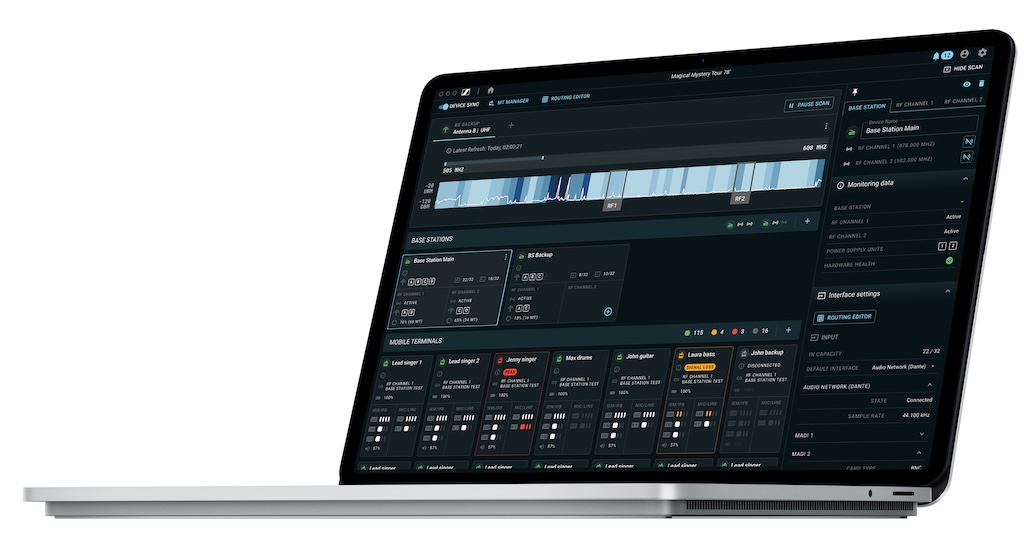
The new LinkDesk desktop app unlocks the base station with the correct region-specific license and converts a Mac or PC in a remote monitoring and control center centralized, with an intuitive and easy-to-use workflow for multiple Spectera base stations. The software offers the operator extensive configuration capabilities, routing and zoning functions, such as the ability to choose between different audio link modes with different levels of audio quality, latency, possible audio links and range.
Although LinkDesk is the recommended tool for any large Spectera configuration, an individual base station can also be monitored and controlled through the browser-based Spectera WebUI interface. Designed as an optimized web interface, Spectera WebUI allows access to the system from any device (phone, tablet or computer) for easy installation, configuration, monitoring and firmware updates.
In the future, Spectera will also be integrated into the SoundBase RF planning, independent of brands, which will allow the coordination of broadband and narrowband wireless technology in a single software. A mode planner is now available through SoundBase Tools.
On the other hand, it is worth noting that Spectera has obtained the regulatory approval Full coverage and product certification in all 27 EU countries, the United Kingdom, Switzerland, Norway, Greenland, Qatar, the United Arab Emirates, the United States, Canada, Australia (indoor use, outdoor pending), Singapore, Malaysia, Philippines, Indonesia, Hong Kong and New Zealand (510-606 MHz). Regulatory approval has been granted in South Africa, Egypt, Israel, Rwanda, Kenya, Nigeria, Mexico, Taiwan and Bhutan, and certification is pending. Certification is also pending in India, where there are no regulations in place.
Did you like this article?
Subscribe to our NEWSLETTER and you won't miss anything.
Related articles
 NEP Australia redefines its most demanding RF productions with Sennheiser Spectera
 Magnetrón supplies SRS with the first Spectera system (Sennheiser) in Spain
 Sennheiser reveals the most interesting new features of Spectera at IBC
 With the Pioneer Program, Sennheiser collects feedback from users of its Spectera system
 Getting to know Spectera, the Sennheiser revolution: “It provides a lot of control over your environment”
 Sennheiser ushers in a new era in wireless digital audio transmission with Spectera broadband bi-directional solution
 Sennheiser: new wireless audio system for cinema and TV at NAB 2023
 AJA begins the commercialization of its OpenGear OG-3G-AMA
 G4: the evolution of Sennheiser's popular wireless audio system
 For-A begins marketing its HVS-490 production mixer
 Newtek begins the commercialization of TalkShow
 AJA begins marketing Io 4K for the new Mac Pro
 Impact of OTT services on broadband
 Broadband stagnates in Spain