





María Coronado (SETT): “The audiovisual industry is mature, but its financial structure must be strengthened”


María Coronado, audiovisual director of the SETT (Spanish Society for Technological Transformation), explains in depth all the keys of this public business entity dependent on the Ministry for Digital Transformation and Public Function which provides the audiovisual and technology industry with great financing and investment opportunities in advanced and transformative technologies.
On July 16, 2024, the Council of Ministers of the Government of Spain approved, at the proposal of the Ministry for Digital Transformation and Public Service, the Royal Decree that approved the transformation of the commercial company SEMyS (State Society of Microelectronics and Semiconductors) into the SET (Spanish Society for Technological Transformation). This public business entity was born to manage and coordinate public investments in the areas of technological innovation with an item of 20,000 million euros from the Recovery, Transformation and Resilience Plan, integrating the powers of the Perte Chip (12,000 million), the Next Tech fund (4,000) and the Spain Plan, Audiovisual Hub of Europe (1,700).
The mechanism, which far from what one might think It is not a mere instrument for aid management, search redefine the relationship of the audiovisual industry with the traditional role of the State with regard to strategic investments. Through pillars such as regulation, the generation of environments conducive to investment or risk management, the State adopts a proactive co-investor role. In this way, as EPE itself emphasizes, digital transformation becomes a “historic” opportunity for the “transformation of the economic model of Spain”.
This approach to alternative financing models, more linked to the Anglo-Saxon universe than to the usual European economic and cultural policies, is accompanied by two great challenges: consolidate agreements before August 31, 2026, deadline for access to funds, and transform the very structure and economic strategy of the applicant companies, many of which will consider this proposal disruptive based on their current financial structure. In this interview, Maria Coronado, director of the audiovisual area of SET, sheds light on this initiative, announces its reception and reveals the main challenges posed by a transformative proposal, yes, but profoundly new at a conceptual level in the Spanish business ecosystem.

Three instruments to take advantage of European funds
What does SETT consist of and what type of benefits can it provide to the audiovisual industry?
The SETT, Spanish Society for Technological Transformation, is an EPE, a public business company, attached to the Ministry of Digital Transition that celebrated its first year at the end of July. That is to say: a young company new within the Public Administration that is established with the mandate of manage three large funds of the final consignment of the European recovery and resilience mechanism of the post-COVID era: Perte Chip, next tech y audiovisual.
SETT is established with the mandate to manage three large funds: Perte Chip, Next Tech y audiovisual
This last part has a provision of 1,712 million euros, although there is a small subdivision: 1.5 billion are for the audiovisual universe, so any business that has tangency with it is likely to be able to apply to them. We are no longer only talking about the traditional value chain, but also video games, eSports, immersive reality, artificial intelligence developments, streaming, OTT... The remaining 212 million have to do with a PERTE game of languages and are aimed at cultural industries that perhaps do not have that purely audiovisual factor, but must be related to any of the co-official languages: podcast, music or radio, among others.
What instruments does the SETT have to be able to bring the Spanish industry closer to these funds?
The sum of both figures is energized through three instruments which are, especially two of them, quite new in the audiovisual industry. It is important to highlight that in the three facilities the minimum SETT ticket is half a million euros.
One is directed to investment vehicles: funds, or any type of company, which must be regulated by the CNMV or by the ESMA, in the case of being outside of Spain, on an investment X that they want to raise. In these cases, the SETT can contribute up to a maximum of 49%, so 51% has to come via private investment. It is important to understand that whenever we talk about SETT, we are referring to publicly owned maximums. In the event that there are other public investors, they will add up to that 49%.
We do not lead the investment strategy, but we do equal it, given that these facilities They do not have the State aid component, but we operate in market conditions.
These investments are for a maximum term of 15 years and the investment strategy must be within this audiovisual framework. I always give the same example: we are not talking about an SME that suddenly sees an investment opportunity in an audiovisual company, but about a company with a clear audiovisual strategy. Furthermore, we do not lead the investment strategy, but we do match it, given that these facilities do not have the State aid component, but rather we operate under market conditions.
The other two instruments are aimed at companies. One is that of capital, and guidance on a capital increase round. In a newly incorporated company or a joint venture, the SETT can contribute up to 49%. We are also going to go to a maximum period of 15 years and we will accompany the private part. We will always require that there be, for example, in the case of a capital increase round in which investment partners are going to enter, at least one new partner, who is the one with whom we will match the agreed contribution and conditions.
If we manage to ensure that the capital instrument is used well and reaches the business fabric, you can go directly to financial lung of companies, giving them structure and helping them to be more strong.
For me, this is one of the most innovative instruments, because if we manage to use it well and reach the business community, it can go directly to the financial lungs of companies, giving them structure and helping them to be stronger, diversify, undertake new developments and, if there is an internationalization strategy, reach international markets.
The third instrument is debt. We are talking about loans for specific needs that a company may have to undertake anything. The SETT can contribute a maximum of 70%, although the remaining 30% must come via commercial banks, private institutions or funds. In this case, the SETT can go for a maximum period of 10 years and will match the offer made by the private entity. In this way, if the private entity gives a loan for 6 years, we will stay at that duration. The structure of guarantees and economic conditions will also be equalized, although this will depend on the financial analysis of the technicians.
In order to better understand the relationship of this project with the rest of the state initiatives linked to the audiovisual sector, could you clarify for us what relationship SETT has with the Spain Audiovisual Hub?
The funds managed by the SETT come from Spain Audiovisual Hub, an initiative that comes from the previous administration. I like to describe this initiative, maintaining the simile of the audiovisual language, as a second season.
The funds managed by the SETT come from Spain Audiovisual Hub. I like to describe this initiative, maintaining the simile of audiovisual language, as a second season.
The first season involved a non-refundable amount on a series of projects that were supported throughout our geography with different natures. Now, the 1,712 million of this second part are the funds that remained from that public-private collaboration.
In the end, we work in collaboration: the SETT, as I told you at the beginning, depends on the Ministry for Digital Transformation and the Public Service, and we work in coordination on this second part of a great project.
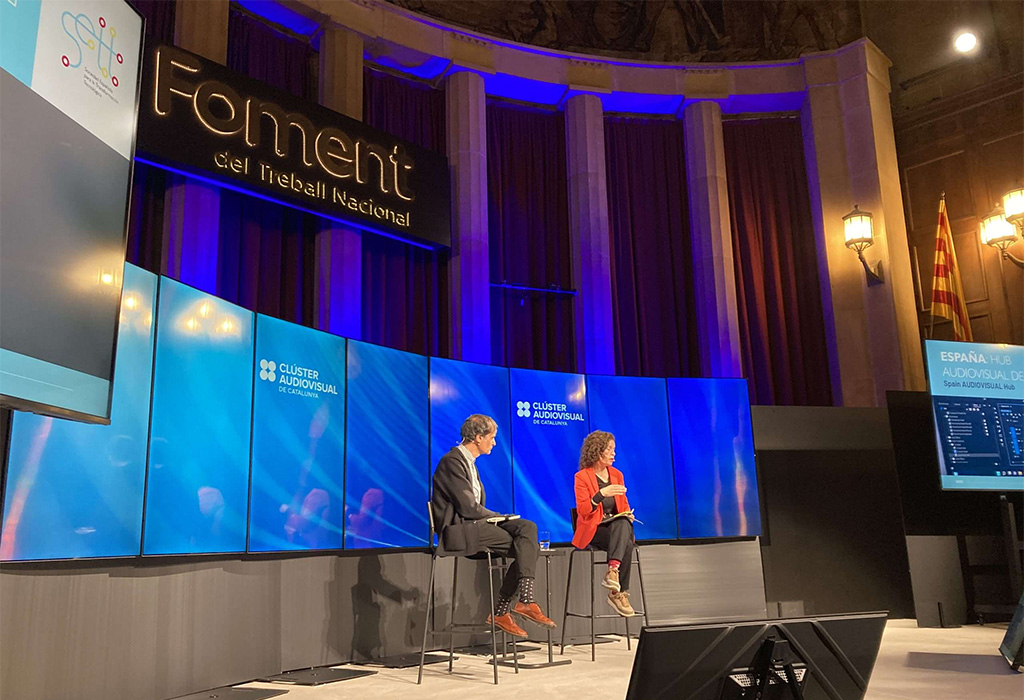
The audiovisual industry, facing a new model
Today, what difficulties have you encountered when bringing your message to the audiovisual industry? What are those critical elements that can prevent these companies from completing a project or a specific line of financing?
There are two very challenging aspects. The first is the issue of temporality. These funds have their deadline set in August 2026. Everything that has not been activated by that date is returned to Europe. Therefore, this presses us. If we had three or five years ahead of us, we could opt for a slightly slower strategy.
Sometimes I feel like we are like 10 years ago when it comes to raising private investors.
The other challenge, and I would say this is the biggest difficulty, lies in raise private capital. These opportunities represent a great opportunity to be able to reach 100% of the capital necessary for a project while obtaining only 51%. It makes the process easier, but the reality is that there is not much culture of private investment in the audiovisual industry, something that is more common in video games, animation or technology.
Sometimes I feel like we are like 10 years ago when it comes to raising private investors. It reminds me of when it was invested for a tax credit. A lot of pedagogy had to be done, explaining to the industry what tax incentives were... We are facing a great opportunity, but it is still novel.
Do you consider that Spain is behind other European counterparts in terms of attracting private capital that can promote audiovisual initiatives?
I don't think we're behind. It is true that this model is more anglo-saxon and that there is a lot of culture of investment and taking risk in one's own projects. But the reality is that, in Europe, as far as I know, these types of tools do not exist. In fact, Spain is the only country that requested a fund of these characteristics from the European Commission within the framework of the Recovery, Transformation and Resilience Plan.
Spain It is the only country that requested a background of these characteristics to the European Commission within the framework of Recovery, Transformation and Resilience Plan.
It is true that France has a typology of public funds that invest in the capital part, but at the European level it is quite new. Furthermore, for me, this initiative is fruit of a mature industry, but that must be reinforced in the financial structure; an opportunity for growth and capitalization to be able to negotiate, for example, the issue of IP, which as you know is a struggle that production companies have. In short: it is an opportunity that strengthens this industrial structure.
In the event that a company sets out to seek that percentage of private capital, can SETT help it identify the right doors to knock on?
Right now, we are not in a position to be able to put these companies in contact with a pool of potential investors. We have a department of scouting that works along these lines, but the reality is that deadlines in which we operate represent a determining factor. Currently, it is the companies that are moving to qualify for these funds, which are different alternatives for a mature industry that is beginning to enter other business and project financing models.

Technology and audiovisual R&D, in front of the SETT
Beyond promoting productions or projects defined by the participating companies, can the SETT be useful for companies focused on R&D around broadcast technology? AI, automations, extended reality, virtual production…
SETT can work with any technological development that has to do with audiovisual. Furthermore, in parallel, we have the facility next tech, an area in which any technological development that has to do, for example, with the healthcare industry would enter. But yes: any technological development in AI for issues such as dubbing, as well as other disruptive projects, for example, can be evaluated. In fact, for us it is an important area to focus on, given that in this way Spain can develop that entire segment of the industry.
How is the television and film industry responding to this opportunity, whose instruments are not, as you have commented, traditionally linked to our environment?
Today, we are having a lot interaction. It is necessary to take into account that our approach is industrial and is aimed at the entire value chain. In that sense, our strategy has been to carry out a tour throughout Spain through the clusters which has allowed us to have all types of associations ask us for meetings, webinars and even individual meetings with companies that have allowed us to get projects off the ground. Over the last few months we have planted a lot, and I hope that, for the good of the entire industry, we will see the return in operations that become formalized.
Over the last few months we have planted a lot, and I hope that, for the sake of the entire industry, we see the return in operations let them go formalizing.
Aside from these two markets, what are those emerging areas of audiovisual that are responding best to the SETT?
We are calling all doors so that the information reaches all layers of the industrial fabric. However, it is true that markets such as animation oh go video games, which usually have other financing and marketing models for their projects, may be facing a good opportunity.
The deadline for the granting of these funds is set in August 2026. Do you consider that this instrument to support audiovisual companies could be continued in our country once the deadline has passed?
I hope so. It must be taken into account that, although the funds must be committed to August 2026, then it is necessary to do a follow-up. Furthermore, the will is that, for 10 years, everything that we recover can be injected back into companies, which would mean circularity if the same framework of rules that we have now is maintained.
In my letter to the Three Wise Men, I hope that the SETT will be a starting point and have a long and fruitful life; It will depend on a series of decisions, but, of course, that is the will.
An interview by Sergio Julián Gómez
Did you like this article?
Subscribe to our NEWSLETTER and you won't miss anything.
Related articles
 SETT transfers the keys to the second phase of the Spain Audiovisual Hub plan in Conecta
 The SETT announces to the Galician Audiovisual Cluster its support mechanisms for the audiovisual sector
 Next-Gen Audiovisual Forum: innovation in the audiovisual industry debated at VDS Valencia 2024
 Movistar Plus+ modifies its structure to become leaders in the Spanish industry
 ATG Danmon builds UHD studio for financial management service
 EGEDA and Fundación Secuoya promote Iberseries Platino Industria, a professional event for the Ibero-American audiovisual industry
 María Rua Aguete (IHS Markit): “I am very optimistic regarding 4K but pessimistic regarding 8K”
 Mariano Barroso: "cinema should not defeat television. And television should not defeat cinema..."
 The Spanish video game industry grows in turnover but decreases in active studios
 RTVE reaches its spending target and reduces its financial debt by almost 50%
 The industry is making progress to prevent illegal consumption, but there is a lack of public education work
 Panorama Audiovisual once again leads in 2015 as a reference medium for professionals in the audiovisual industry
 The Panorama Audiovisual Congress defines the future of the audiovisual industry in Brazil
 Audiovisuals adopt the cloud but at a slower pace than expected