





The Goya Awards reinforce the regulation of Artificial Intelligence
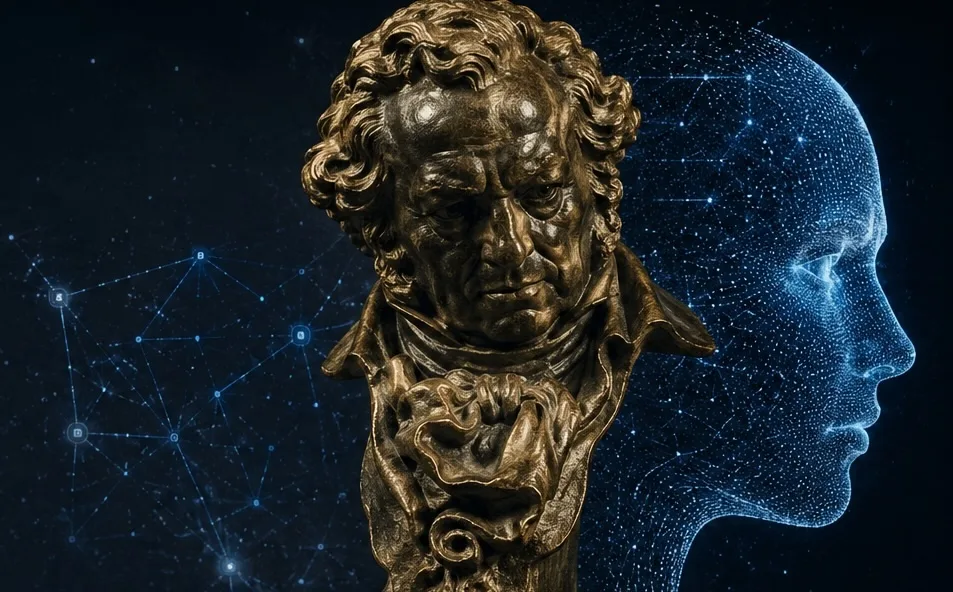
The Film Academy approves the Rules of the next edition of the Goya Awards, but this time the modifications focus on two key issues for the audiovisual industry: the regulation of the use of artificial intelligence in registered productions and the redefinition of the breakthrough performance categories.
The main novelty affects the use of tools of generative artificial intelligence in creative processes. The new Rules establish that only those works whose creative authorship corresponds to identifiable natural persons and derives from original intellectual work with relevant human intervention will be eligible for the Goya Awards.
The Academy clarifies that the use of AI systems will not invalidate human authorship as long as these tools do not replace fundamental creative decision-making or autonomously generate the final artistic content. Furthermore, creative control of the work must clearly and effectively rest with natural persons.
As an additional measure of transparency, all registered productions must present a responsible statement detailing the use of generative artificial intelligence tools during any phase of development or production. This documentation must specify the stages of the process in which the technology was used, the purpose of its use and the specific tools used.
The Bases consider certain uses of AI permissible linked to technical assistance tasks, automation of repetitive processes, technical optimization and post-production work, as well as the generation of internal work materials such as moodboards, tests or exploratory concepts.
However, the Academy adopts a especially restrictive position in the categories of Best Original Music and Best Original Song. In both cases, any use of artificial intelligence for the generation of musical compositions or lyrics is prohibited, even when it acts solely as a support tool. The new rules establish that Musical works whose authorship has been generated totally or partially through AI systems will not be eligible. nor those in which these tools have participated in the compositional process. Likewise, in the Best Original Song category, the lead vocal must correspond to a real performance recorded specifically for the film by a person or a choir of people.
Another relevant modification affects the categories of revelation interpretation. Starting with this edition, the candidates for Best New Actor and Best New Actress may not have participated in more than four commercially released feature films as supporting performers nor may they have developed a professional film career of more than ten years.
The Academy has also introduced changes at the Goya to Best European Film, limiting to one single application per country participation in this category.
On the other hand, it regulates the representation of collective candidates in those categories in which more than four professionals participate. In these cases, the production companies must designate a maximum of four representatives who will act on behalf of the group of people registered during the nomination process and, where appropriate, receipt of the award.
In the section of short films, it will be an essential requirement that the request for the nationality certificate has been made before the start of the festival that allows registration or during its celebration. In addition, all certificates must be dated before September 30, 2026.
The Academy has also confirmed the electoral calendar for the 41st edition of the Goya Awards. The first round of voting will be held between November 30 and December 10, 2026, while the second and final round will take place from January 13 to 22, 2027.
Did you like this article?
Subscribe to our NEWSLETTER and you won't miss anything.
Related articles
 Without people there is no intelligence (or artificial) in broadcasting
 Artificial intelligence in audiovisual production: opportunities and challenges
 Artificial Intelligence and the economy of creators star at NAB 2024
 Limecraft proposes the concept of Media Intelligence versus Artificial Intelligence
 Four unpublished narratives generated by Artificial Intelligence (AI)
 Europe in the face of disinformation: artificial intelligence and alliances
 VSN incorporates Artificial Intelligence into the RTVE Documentary Fund
 France 3 “interviews” the dead thanks to artificial intelligence
 2020, a year of Artificial Intelligence in RTVE Innovation
 Editshare introduces the latest in artificial intelligence at Flow2020
 Tedial bases cost optimization on artificial intelligence
 TVE's news programs implement artificial intelligence with Etiqmedia and Aicox
 Artificial intelligence democratizes content transmission
 Ready or not, Artificial Intelligence has arrived