





DAMA and SGAE claim the role of the right to remuneration in the sustainability of Spanish audiovisual production
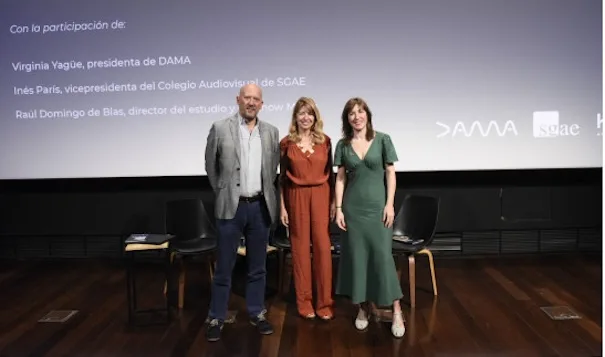
AGITATE y SGAE present in the Film Academy the study 'The economic importance of the right to remuneration in the Spanish audiovisual market', prepared by Know Media together with the Chair of Applied Economics of the University of Salamanca.
The report shows the consolidation of right to remuneration as an essential element for the creative sustainability of authors audiovisuals in Spain, reinforcing its economic stability and complementing salaries and pensions. The investigation analyzes a sector marked by the irregularity of work and the intermittency of income, in which the remuneration right is configured as a relevant source of stability. According to the study data, this system represents around 13% of the income of audiovisual creators and reaches approximately 60% of the group.
From a sample of 685 authors, the report estimates that this income represents on average more than 60,000 euros throughout one's professional life (up to 115,000 euros in future value), contributing significantly to the economic stability of the sector. The average annual income of the group stands at 38,964 euros. In this context, one in five creators obtains more than 20% of their annual income from the right to remuneration.
An engine for creation and cultural diversity
Beyond its economic dimension, the report highlights the role of the right to remuneration as a direct incentive for audiovisual creation. According to the analysis, its existence contributes to the generation of around 800 new works every year. This effect not only increases the volume of production, but also enriches the audiovisual ecosystem, favoring a greater diversity of content and a broader representation of audiences and realities.
The study highlights that the impact of the right to remuneration transcends its strictly economic dimension and contributes to the professional continuity within the audiovisual industry. The receipt of more than 5,000 euros per year for copyrights constitutes especially relevant support in periods of inactivity or work discontinuity, characteristic of creative activity, favoring the permanence of professionals in the sector.
This circumstance is particularly significant in the case of women, for whom this income can act as a factor of stability in times of interruption in their professional career. Likewise, the importance of the right to remuneration is projected beyond active life, playing an essential role in the retirement stage: four out of ten authors consider that this income is decisive in being able to aspire to decent retirement conditions.
A support network throughout your professional career
The right to remuneration also articulates a support network that goes beyond direct income. In recent years, the system has made it possible to channel more than 5,300 assistance grants, with more than 3 million euros allocated to direct support and nearly 6 million to training and promotion programs.
These initiatives range from attention to basic needs (such as health support or assistance in emergency situations) to training programs, creative residencies, mentoring, screenwriting awards, specialized workshops, meetings with the industry and aid for internationalization through attendance at markets and festivals. Its impact is especially relevant for new generations of creators. In fact, eight out of ten new authors consider that the disappearance of the right to remuneration would make it difficult for new professionals to join the sector, while the study estimates that, in a scenario of losing this right, the entry of new authors could be reduced by up to 67%. These data show that the right to remuneration not only protects already established creators, but is also an essential tool to guarantee generational renewal, creative diversity and the future sustainability of the Spanish audiovisual ecosystem.
The study also warns of the consequences that the disappearance of the right to remuneration would have. According to the data collected, 50% of authors would surely consider leaving the profession if this right disappeared, and up to 25% added also consider it highly probable that he made that decision.
The impact would be especially significant among younger profiles. 67% of new authors are very concerned about the loss of their conditions due to the loss of the right, and an equivalent percentage foresees a drastic drop in the entry of new talent.
Taken together, the report warns of the risk of loss of talent, diversity and creative capacity, as well as a possible contraction of audiovisual production in Spain.
The study concludes that the right to remuneration, administered by collective management entities, constitutes a structural element of Spanish audiovisual production. It not only guarantees recurring income and economic stability for creators, but also promotes the generation of new works, professional continuity throughout the entire author's career and the possibility of aspiring to a dignified retirement.
Did you like this article?
Subscribe to our NEWSLETTER and you won't miss anything.
Related articles
 Atresmedia, único medio español reconocido por S&P por sus progresos en sostenibilidad
 From paper to screen: the moral right of integrity as a limit to film adaptation
 The main Spanish platforms and television networks come together to define their role in the future of Spanish cinema
 The audiovisual sector facing the challenge of sustainability
 The CAC 2024 report analyzes the disruptive role of AI in audiovisuals
 DAMA points out the massive gender gap in audiovisual direction in its latest report
 European independent producers claim the role of movie theaters
 Academia TV and SGAE organize the meeting “Intellectual property in the new Spanish audiovisual ecosystem”
 DAMA and Netflix Spain launch 'Cambio de plana', a program to promote diversity in audiovisuals
 The SGAE Foundation recognizes the role of the 'Pioneers' with a film series
 The SGAE Foundation organizes the Spanish Film Festival in Mexico
 Drones, law and audiovisual
 The SGAE Foundation presents Spanish cinema in Argentina and Brazil
 The SGAE Yearbook takes the pulse of audiovisuals