





DTT in HD, payment services, interactivity and accessibility... the pending subjects
Industry representatives debated this Thursday in Oviedo within the framework of the Technical Conference on television, organized by ASIMELEC and FENITEL, about the future and the challenges that the medium will have to face after the analogue blackout. Experts have agreed that, given the growing number of HD televisions, broadcasters should be urged to broadcast in high definition and integrate quality paid content, since what exists now is clearly insufficient.
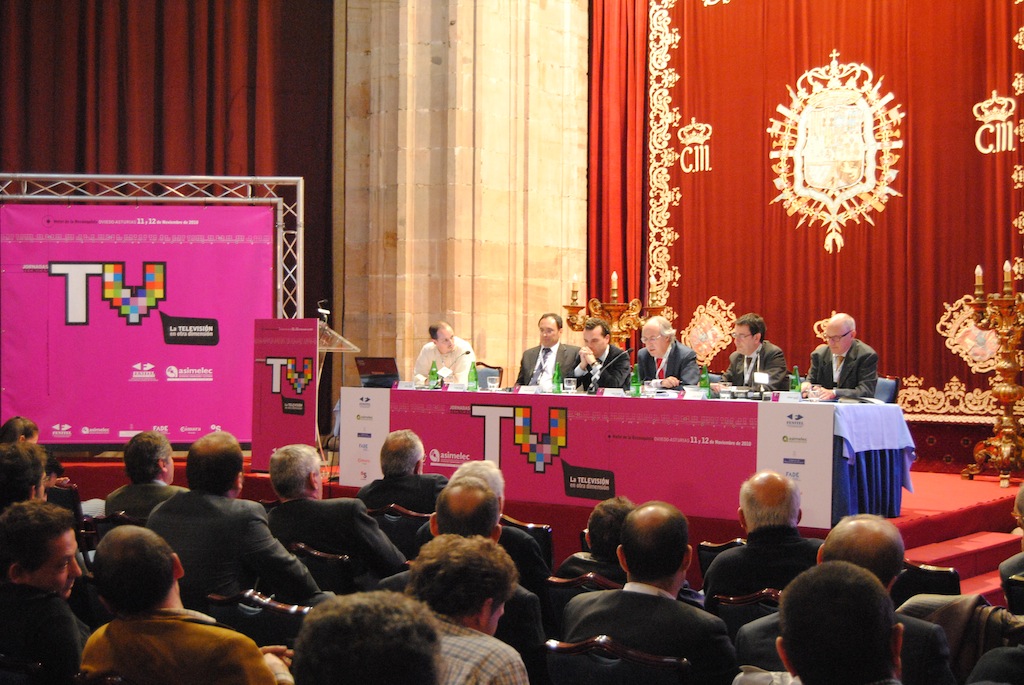
Industry representatives debated this Thursday in Oviedo within the framework of the Technical Conference on television, organized by ASIMELEC and FENITEL, about the future and the challenges that the medium will have to face after the analogue blackout. Experts have agreed that, given the growing number of HD televisions, broadcasters should be urged to broadcast in high definition and integrate quality paid content, since what exists now is clearly insufficient.
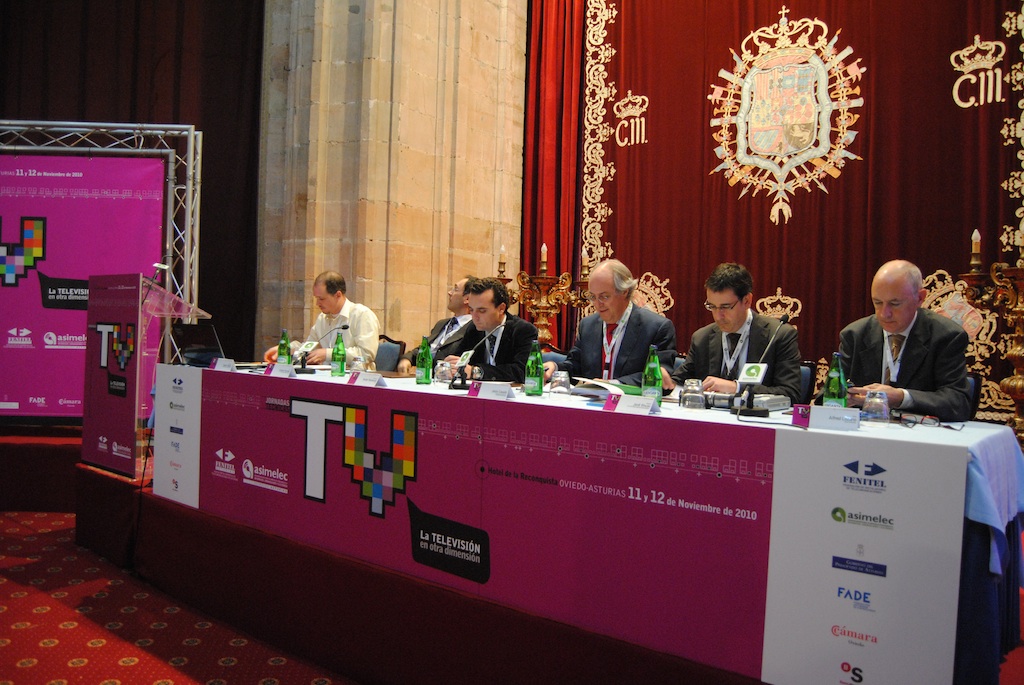
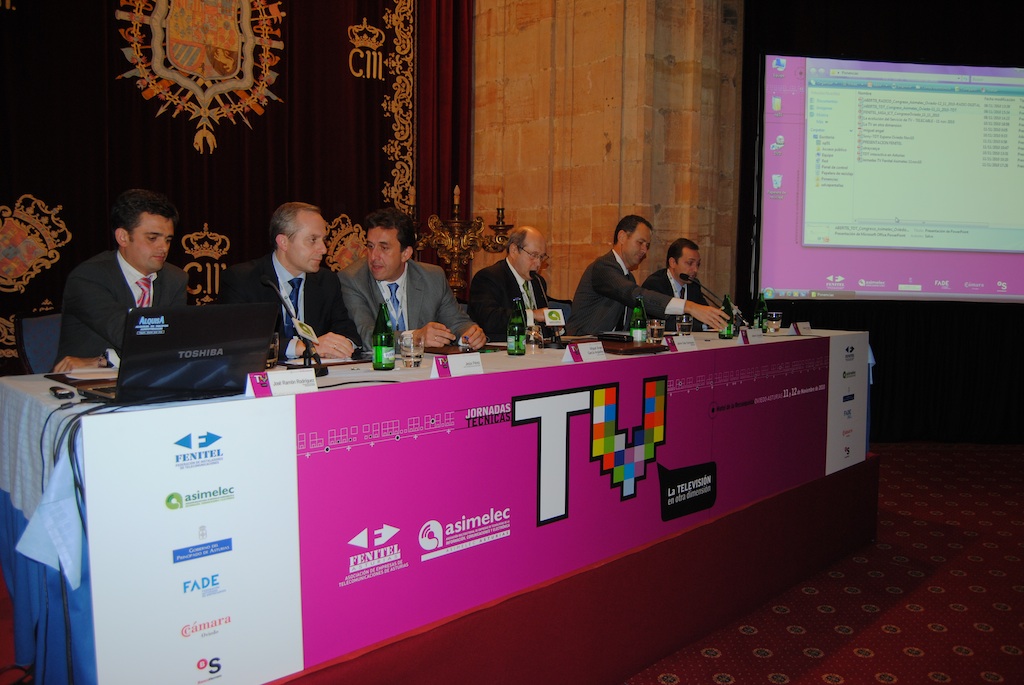
In a round table moderated by Jesús Casado, coordinator of the Digital TV and Radio Commission at ASIMELEC, Xavier Redón, marketing analyst and television and radio product manager at Abertis Telecom, exchanged impressions about the situation of the industry in Spain; Andrés Román, strategic planning manager for television in Europe at Sony; Sergio Talarewitz, CEO of Gigaset/Siemens; Jordi Rincón, senior product manager of display TV at Panasonic; and Alfred Lozano, marketing director at Sharp.
Xavier Redón began his speech by ensuring that the transition to DTT has been a success since the transition has been completed with a technology implemented in all homes thanks to the efforts of everyone with coverage similar to the pre-existing analogue and a degree of DTT penetration sufficient to ensure technological substitution and continuity of the service.
Redón recalled that currently, 96-98% of the coverage is offered by the radio station, while 2.5-0.8% corresponds to the extension of coverage carried out by the different administrations; and a very residual percentage receive a signal through satellite.
The Abertis manager recalled that the digital dividend that will be developed before 2015 will entail the abandonment of the 800 MHz band and the migration of broadcasts to channels lower than 61. Once the spectrum is reassigned, RTVE will manage two multiplexes, six private operators, between 1 and 3 regional operators, also reserving between 1 and 2 for local/island and 1 for mobile TV (planning still pending).
With respect to pay television, Redón has highlighted that a multi-operator card would be technically viable compared to the single-operator model that has been imposed for the moment.
For his part, Andrés Román has reviewed some of the pending issues in the sector: DTT in HD, payment services, interactivity and accessibility.
With respect to HD, Román has stated that there is content, own production by radio broadcasters and audiovisual material from content providers; the receivers are fully prepared; Bandwidth is sufficient… “but fine-tuning of parameters such as transition from SD-HD (advertising and legacy content), automatic remapping (when there is no HD content), and audio from stereo to AAC/AC3 must now be carried out.”
Román has asked broadcasters to signal as HD when it is really a broadcast of native high definition content, not upscaled.
3D standardization
As far as stereoscopy is concerned, the Sony manager has clarified that “each element of the transmission chain has to be as independent as possible, so that a 3D broadcast does not affect reception regardless of whether it is 2D or 3D and independent of the 3D format chosen (side-by-side, chess, top-bottom, sequential...)”.
In this sense, an aspect that should be taken care of, according to Andrés Román, is 3D compatibility. 3D signage is intended to allow the receiver to recognize and react correctly to 3D content; inform the user of simultaneous transmission between 2D and 3D content; and change the screen content between 2D and 3D from HDMI or broadcast sources... hence the importance of respecting a signaling protocol.
Along these lines, the technical signaling module in the DVB group works to try to minimize signal changes to achieve commercial requirements.
“While this standard is not finalized, the receivers must switch between 2D and 3D manually, since the television does not recognize the 3D broadcast,” said Román.
Regarding payment, Andrés Román has highlighted that the HD TDT offer has not yet been resolved, and has advocated for the implementation and generalization of the CI+ system, already available in the receivers of the main brands.
As for hybrid television, this model, as Sony understands, has strong support from broadcasters since, among other advantages, it would mean an HD replacement for teletext, as well as a combined approach for broadcast and broadband, and an adequate link between both worlds giving access to applications such as VoD, TV on demand, individual EPG...
Román commented that “hybrid television represents another opportunity in Spain, using the experience of the MHP, for the effective implementation of an open platform.”
HD receivers
Sergio Talarewitz has reflected on the situation of the set-top-box market. "The law that was approved on HD requires the introduction of an HD tuner from 21 inches, but broadcasters are not obliged to broadcast content in high definition. Now HD is already broadcast, actually a standard image scaling, and very few broadcast HD. Let's force broadcasters to broadcast 100% in HD, the industry has already been prepared for high definition for two years," commented the CEO of Gigaset.
Regarding payment, he has recognized that "the industry has made investments thinking about 1,300,000 users, and today an offer like Gol TV does not exceed 300,000 subscribers to paid services. This has done great damage to the industry. It is completely undeveloped, why are there 4 million users in Italy? We are not used to paying and there is an oversupply of channels. Broadcasters should integrate quality paid content, with much more content broad and for this there should be a platform as Dahlia TV once tried.”
Regarding the Internet on TV, Sergio Talarewitz described it as the “great future success,” and advocated for platforms that unify all this content. In this regard, "if the sustainable economy law is approved and 80% of web pages are closed, it may be that paid content has a future."
HD content
If technologically the consumer electronics industry and the users themselves already coexist with high definition every day, where is the content? Alfred Lozano has drawn attention to the fact that we have “remote controls with similar buttons that users have to pay for functions that are not fully operational.”
As a manufacturer, Jordi Rincón has influenced the point of view of the consumer, who in the end is the one who pays and decides whether an offer interests them or not. "We promised 40 channels, and yet the entire population does not receive them either because they do not exist or because there are reception problems. Some arrive in HD, but how many hours of HD does the user receive? It is important not to create frustration in the consumer," he stated.
Regarding 3D, he stressed that "we cannot forget that 3D is a technology that is beginning to become a reality, despite the fact that all manufacturers have a 3D range, but, today, the main source of content comes from Blu-ray... the industry is betting heavily on both the Internet and 3D. Now, we are starting new steps by betting on stereoscopic recording by the user."
To close this discussion table, Jesús Casado stated that “there would be no better formula to avoid audience fragmentation than to rely on solutions such as high-definition broadcasting and the launch of quality free-to-air or pay channels…”.
The first day of this meeting organized at ASIMELEC and FENITEL in Oviedo concluded with a round table in which the situation of the ICT industry in Asturias was analyzed. Participating in this colloquium were Alberto González, general secretary of the Asturian Federation of Entrepreneurs (FADE); Alberto Fuente, secretary of FENITEL Asturias; Miguel Ángel García Argüelles, managing director of FENITEL, Jesús Pérez, director of strategy, products and services of Telecable; José Ramón Rodriguez, manager of the information systems area at Sadim; moderated by the president of FENITEL Asturias, Jaime Soto.
González opened this debate by pointing out that ICT assets are those that have experienced the greatest growth in real terms over the last 20 years, "although in Asturias there is still much to do." In the Principality there are currently 640 ICT companies registered, representing a sector that has grown by 30% in the last three years.
Did you like this article?
Subscribe to our NEWSLETTER and you won't miss anything.
Related articles
 HD on CMM TV: challenges overcome… and pending
 TestTree (Enensys) products will help Evoca monitor pay TV services
 Pay television, electricity and fixed broadband, the services least valued by Spanish households
 Public administrations, pending 5G
 The new DTT plan, one of the first pending issues on Álvaro Nadal's table
 RTPA expands its accessibility services for people with disabilities
 Ericsson MediaFirst Platform brings together the best of traditional pay TV and OTT services
 Sony's smart television wins in interactivity
 Red Bee Media to provide accessibility services to BBC
Deluxe Spain offers accessibility services for Discovery Max
Red Bee Media to provide accessibility services to BBC
Deluxe Spain offers accessibility services for Discovery Max
 Panasonic takes large-format screen interactivity to another level at ISE 2011
 Never.no proposes cloud-based interactivity
 Globo TV is committed to interactivity and mobile television
 More formats, accessibility and speed with Avid