





Satellite and connected TV
La televisión conectada y los servicios híbridos HBB asociados están en proceso de desarrollo. Probablemente el cambio será lento, pero con una profundidad e impacto en sectores relevantes como el satélite. Inés Sanz, directora Ingeniería de Clientes en Hispasat, reflexiona sobre este nuevo escenario.
Asistimos con gran interés a una transformación importante en nuestros hábitos de consumo de contenidos audiovisuales fruto de los avances tecnológicos en la electrónica de consumo. La forma clásica de utilizar la TV exclusivamente para ver canales de TV y de conectarnos a Internet a través de PC, está cambiando, y cada vez es más frecuente conectarnos a Internet a través del móvil, la tableta o la TV, así como disfrutar de contenidos de vídeo y canales de TV a través de Internet directamente en la pantalla del televisor. Esto es lo que denominamos la TV conectada, en inglés “Over the Top TV” (OTT). En este escenario se combinan los mundos Broadcast (TV clásica lineal) y Broadband (Internet), dando lugar al concepto de servicios híbridos HBB (Hibrid Broadcast Broadband).
En relación con estos cambios debemos tener en cuenta otros factores : la migración a los formatos HD y 3D, la evolución hacia consumos lineales y no lineales, así como la multiplicación de las pantallas, elementos añadidos con una fuerte demanda de ancho de banda. Por ello, los nuevos sistemas híbridos Broadcast – Broadband (HBB) van a requerir de la alta capacidad de los canales Broadcast junto con acceso a Internet de alta velocidad, con el requisito adicional de permitir el acceso a los contenidos en cualquier lugar y en cualquier momento.
Como operadores de satélites, en Hispasat consideramos el reto que supone esta nueva demanda como una oportunidad, ya que las características específicas de nuestros satélites los convierten en aliados estratégicos en la era HBB, para cubrir las limitaciones de las redes terrestres actuales (DSL, Cable, etc.). El satélite es la plataforma ideal para ofrecer contenidos de alta calidad (HD, 3D, etc) , así como acceso a internet de alta velocidad para todos los ciudadanos y desde cualquier lugar.
Las redes terrestres actuales (DSL, Cable, etc.) tienen limitaciones muy significativas para ofrecer contenidos de alta calidad en el hogar, y la modernización de las infraestructuras terrestres requiere grandes inversiones que sólo estarán disponibles en núcleos urbanos, dejando fuera a una parte de la población. Los operadores de infraestructura de telecomunicaciones nos encontramos ante el reto de atender una demanda de ancho de banda masiva, por lo que el uso eficiente e inteligente de los recursos será un aspecto clave para el éxito de nuestras empresas.
Desde Hispasat hemos experimentado un extraordinario crecimiento relacionado con la incorporación de la Alta Definición en las plataformas DTH que operan en nuestros satélites, las cuales han pasado de transmitir uno o dos canales de HD en 2008 a alcanzar el 50% de su oferta total, en la actualidad. La tendencia a nivel mundial es que la TV en HD será la televisión estándar del futuro, para la que el satélite, con gran disponibilidad de ancho de banda, se conforma como aliado estratégico fundamental.
Asimismo, a la oferta de HD, se están incorporando con buenas previsiones a medio plazo servicios de 3D y, a más largo plazo, la UHDTV que de nuevo demandan gran ancho de banda disponible.
Es por ello que, desde la perspectiva de Hispasat, el futuro pasa por el desarrollo de redes y soluciones híbridas que permitan ofrecer los servicios que los usuarios están demandando mediante la explotación conjunta, eficiente y flexible de las redes Broadband y Broadcast.
 Los retos de la TV del futuro
El incremento de demanda de ancho de banda será un problema a corto plazo si la industria y los operadores de red no buscan soluciones sostenibles y eficientes que permitan hacer un uso más inteligente de los recursos. En este sentido, la saturación de las redes terrestres convencionales es inminente, por lo que el satélite seguirá posicionado como plataforma de referencia para la difusión de contenidos de alta capacidad y alta calidad. Asimismo, la universalización de los servicios de televisión en aquellas zonas con problemas en el despliegue terrestre seguirá siendo uno de los retos para los proveedores del servicio que tendrán en el satélite un aliado importante para suplir esas carencias. Uno de los ejemplos de la Universalización de servicios de TV, es el caso de la TDT-SAT en España gracias a la cual el 100% de la población tiene acceso a los canales de la TDT a través de nuestros satélites Hispasat 1D y 1E.
En Hispasat, estamos trabajando para superar el reto de la evolución hacia la era HBB, cuyo análisis abordamos a través de cuatro ejes principales: los contenidos, la evolución tecnológica, la estandarización y el modelo de negocio. Los contenidos de calidad conforman la base de la experiencia audiovisual, y constituyen sin duda el deseo de los usuarios y el fondo de la industria, por lo que una mayor disponibilidad y calidad de los contenidos será clave para el buen desarrollo del sector. Asimismo, la evolución tecnológica y el desarrollo de sistemas que permitan mejorar la cantidad, calidad y flexibilidad de los contenidos serán también muy importantes para conseguir una experiencia de usuario cada vez más satisfactoria. En este sentido nuestros satélites incorporan la tecnología más avanzada, ofreciendo los niveles de cobertura y potencia más elevados sobre el 100% del territorio español.
Cabe mencionar la incorporación del satélite Hispasat-1E a nuestra flota de satélites a finales del año pasado, gracias al cual hemos incrementado nuestra capacidad satelital en más de 50 transpondedores en banda Ku y 500 MHz en banda Ka, lo que supone una capacidad equivalente superior a los 5 Gbps. Asimismo estamos trabajando en diferentes proyectos de innovación tecnológica para desarrollar nuevas tecnologías en el campo de las aplicaciones audiovisuales entre los que destacan JEDI (segunda generación de TV 3D), SATURNO (satélite y giga conectividad en el hogar digital), ENGINES (DVB-SH), PHIDIAS (HBB), etc..
En lo que se refiere a la estandarización, desde Hispasat estamos trabajando en los foros nacionales e internacionales más relevantes, entre ellos el DVB, donde formamos parte del comité de dirección. Es cierto que en el campo de la televisión híbrida han surgido muchos estándares y sistemas propietarios que pueden generar una segmentación del mercado nada positiva para el sector. En HISPASAT creemos que el desarrollo de un estándar común, como el hbbtv, será imprescindible para el éxito de la televisión conectada del futuro. Asimismo, la estandarización está relacionada directamente con el modelo de negocio. La incorporación de nuevos actores al mercado y las diferentes alianzas que han surgido respecto a la televisión híbrida plantean un horizonte incierto para el sistema. En este sentido, la colaboración entre distintos partners de la cadena de valor (fabricantes, proveedores de contenidos, operadores) será la clave del éxito en este dominio. En este sentido, el grupo Hispasat participa en los grupos de trabajo del DVB con el objetivo de desarrollar soluciones con el soporte de un estándar común.
 El satélite en los Servicios Híbridos
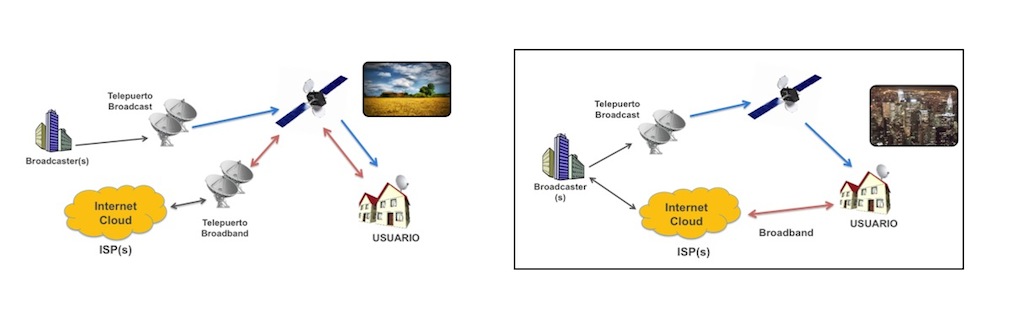
¿Cómo será el nuevo ecosistema de televisión y servicios híbridos? Desde Hispasat apostamos por un modelo donde broadcast y broadband se complementen para explotar los beneficios y sinergias de cada uno.
Así, en un escenario de televisión híbrida el satélite será imprescindible para la radiodifusión de contenidos (lineales y no lineales) de alta calidad (HD, 3D, etc.) gracias al gran ancho de banda disponible. Estos servicios podrían ser complementados con contenidos no lineales de calidad estándar a través de infraestructuras terrestres, bien con contenidos adicionales, bien con funcionalidades añadidas.
A modo de ejemplo podríamos considerar dos escenarios tipo de servicios: en el primero se consideran los usuarios que viven en áreas urbanas o suburbanas, con acceso a Internet de alta velocidad a través de redes terrestres. En este caso, el satélite jugaría el papel de potente plataforma radiodifusora, transmitiendo los contenidos de mayor ancho de banda (HD, 3D, etc) y sincronizado con las aplicaciones sobre Internet (contenidos, señalización e información complementaria).
En el segundo escenario, el usuario se encuentra en un área suburbana o rural, con limitación en el acceso a redes terrestres y sin posibilidad de acceso a Internet de alta velocidad, a través de redes terrestres. En este escenario, el satélite jugaría un doble papel: el de difusor de contenidos de alta calidad y el de proveedor de acceso a internet en alta velocidad.
Con estos dos escenarios y aprovechando las posibilidades que ofrece la gran cobertura del satélite, sería posible dar servicio de televisión híbrida con contenidos de alta calidad al 100% de la población, suponiendo además una descongestión importante de las infraestructuras terrestres.
Conclusions
La televisión conectada y los servicios híbridos HBB asociados están en proceso de desarrollo. Probablemente el cambio será lento, pero con una profundidad e impacto muy relevantes en cuanto al incremento exponencial en el ancho de banda demandado y a las limitaciones en las capacidades de las infraestructuras de telecomunicaciones.
Queda mucho trabajo por hacer y desde Hispsat estamos convencidos de que las ventajas del satélite le permitirán jugar un papel fundamental como medio “Broadcast” para la radiodifusión de contenidos de alta calidad (HD, 3D etc), así como complemento de las redes “Broadband” para permitir el acceso a internet de alta velocidad al 100% de la población y desde cualquier lugar.
Inés Sanz
Directora Ingeniería de Clientes en Hispasat

Did you like this article?
Subscribe to our NEWSLETTER and you won't miss anything.
Related articles
 The satellite is capable of providing UHD services to 100% of the population
 Live via satellite from El Escorial… with Hispasat
 The satellite, a key element in the 5G ecosystem
 Hispasat advances the future of satellite television at IBC
 Hispasat demonstrates the possibilities of 4K HDR and IP transmission via satellite
 Broadcasting and satellite: a couple for the future
 SSL will build the new Hispasat 1F satellite
 Hispasat launches its tenth satellite into space
 The Phidias Project Consortium launches two channels for connected television
 Abertis brings connected television even closer
 New future environments around connected TV
 Broadcast, satellite and transmission systems with Aicox
 Successful launch of the Hispasat 1E satellite
 Satellite: engine of technological innovation