





Multichannel audio on television, under debate
La generalización del audio multicanal en televisión está planteando nuevos retos desde el punto de vista tecnológico y creativo que numerosos expertos han analizado en Madrid en un seminario organizado por el Instituto de RTVE en el que se han puesto sobre la mesa numerosas experiencias en audio envolvente.
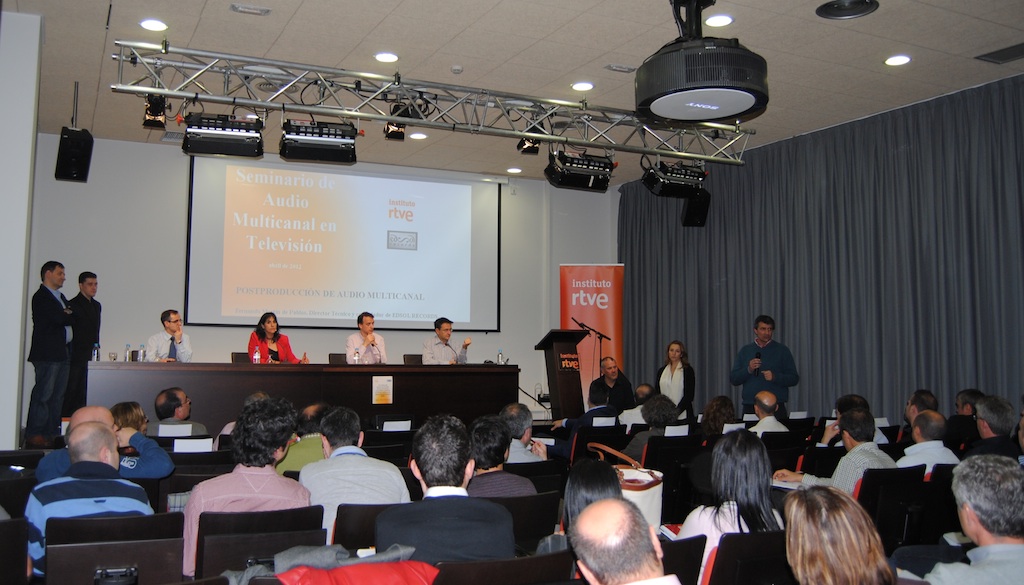
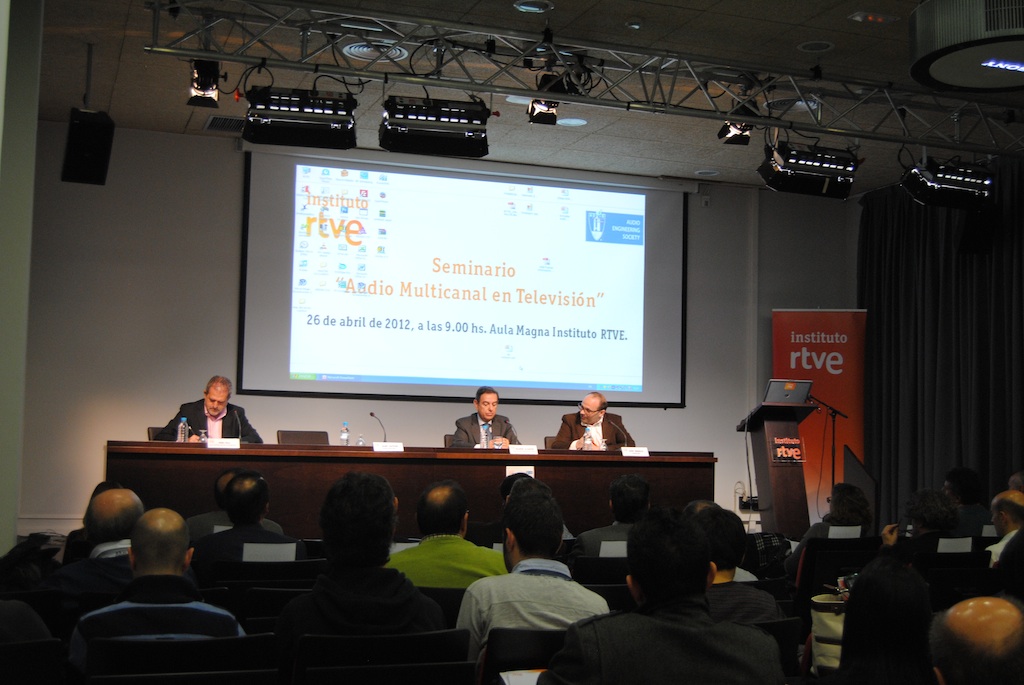 La generalización del audio multicanal en televisión está planteando nuevos retos desde el punto de vista tecnológico y creativo. Para analizar la implementación, producción y transmisión de audio multicanal en entornos broadcast, el Instituto de RTVE ha organizado este 26 de abril en Madrid un seminario en el que han participado destacados profesionales que han aportado una visión general de la situación poniendo sobre la mesa numerosos ejemplos de implementación.
Ricardo Alvariño, subdirector General de Infraestructuras y Normativa Técnica del Ministerio de Industria, ha abierto el turno de palabra inaugurando este seminario asegurando que “el audio queda en ocasiones, lamentablemente, en segundo lugar, tras el vídeo, olvidando su importancia. Ahora, con la televisión digital tenemos nuevas posibilidades para distribuir audio 5.1 con notables ventajas”. Alvariño ha hecho hincapié en la importancia de la coordinación entre los productores de programas y señal y los fabricantes de receptores para una correcta recepción del audio multicanal.
Por su parte, Suso Ramallo, presidente de AES España, ha resaltado la importancia del multicanal. “Esperamos que, tras la irrupción de la alta definición, la HD llegue también al audio y, sin duda, en un futuro cercano podríamos hablar de codificación espacial por objetos abriendo unas nuevas, hasta ahora desconocidas, a la creatividad”.
Pere Vila, director de Planificación e Innovación Tecnológica de RTVE, ha hecho una llamada aprovechar esta jornada para debatir y compartir experiencias en ingeniería, red, producción… tanto por parte de productores, operadores y broadcasters.
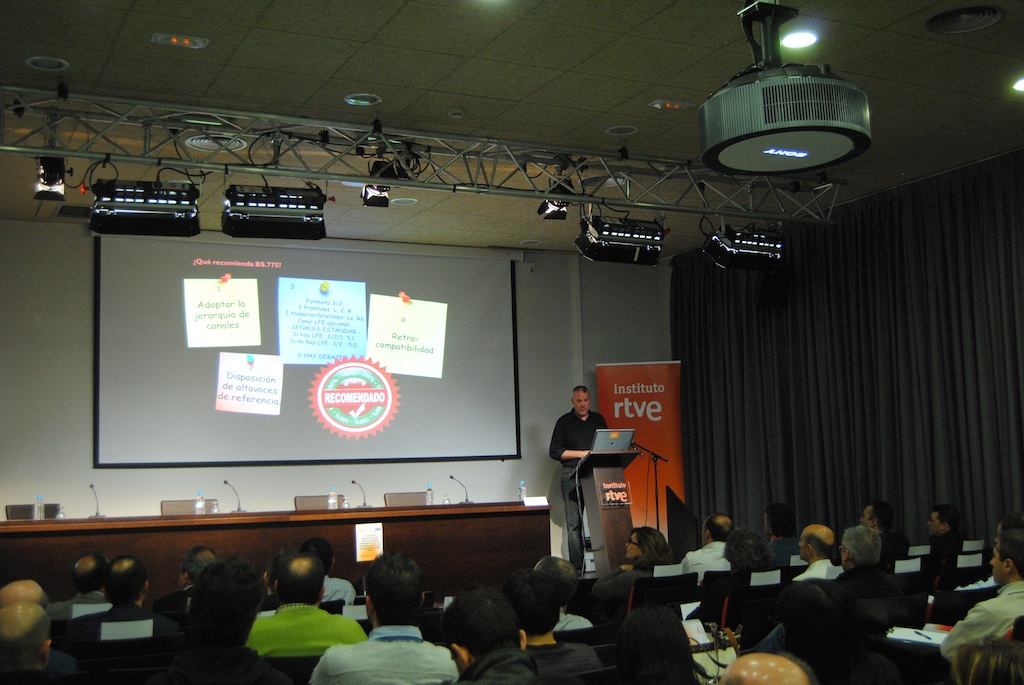 La primera ponencia ha corrido a cargo de Juan Carlos Díez, responsable de los estudios de grabación de El Corte Inglés, quien ha centrado su intervención en el análisis de los trabajos y recomendaciones de UER y otras entidades relevante sobre el audio multicanal y su aplicación en el ámbito de la producción y difusión de televisión y radio.
Díez ha hecho un curioso paralelismo entre la teoría de la evolución de Darwing y la evolución del audio desde el mono (audio monofónico) a una espacie robusta con un desarrollo espacial, el Neanderthal (el estereofónico) y ahora, el Homo Sapiens, caracterizado por sus habilidades, sociabilidad y curiosidad. El sistema de sonido estereofónico multicanal, basado en la UIT-R BS.775 (con última revisión en 2006), representaría este último estadio evolutivo marcado por la sociabilidad y respeto a la norma.
¿Qué recomienda la BS.775? Adoptar la jerarquía de canales, establecer una disposición de altavoces de referencia y la utilización de cinco señales (izquierda, derecha, central, surround izdo. y dcho, y una sexta señal que sería la LFE-Extensión de Baja Frecuencia), conservación de la retrocompatibilidad con los sistemas de audio existentes hasta ahora. Todo este marco, según Juan Carlos Díez, debería ser una referencia universal y recomendable.
Díez ha hecho un repaso a la importancia de la calibración de las salas para contar con un lugar de escucha de referencia y a la correcta asignación de los canales de grabación siguiendo la recomendación UER R.91 de 1999 facilitando así el intercambio entre productores y radiodifusores.
Con respecto a la transmisión de lo grabado, el caballo de batalla de la transmisión es el escaso ancho de banda disponible. “Frente a una codificación matricial, con imposibilidad de emitir en simulcast, ahora, los actuales sistemas de codificación perceptual consiguen comprimir información de 12 a 14 veves, aunque perdiendo información en el proceso, pero sin que el oyente sea capaz de percibirlo”, ha asegurado Díez, repasando, además, los diferentes formatos de codificación perceptual tanto códecs abiertos (MPEG-1 Layer II, MPEG-2 BC Layer II, HE-AAV, HE-AAC v2…) como propietarios como los Dolby o DTS.
Sin embargo, ha asegurado que Dolby E es el único capaz de cumplir los requisitos de usuario para sistemas de codificación de audio en radiodifusión (UIT-R BS1548-2).
¿Cuántas emisoras en TDT están capacitadas para emitir en multicanal? De los 31 canales de cobertura nacional en España, sólo 8 utilizan MPEG-2 preparados para emitir multicanal. En radio, el DAB no permitiría multicanal, salvo que se utilizara DAB+ (HE-AACv2).
En Europa, desde 2005, se emiten frecuentemente programas en multicanal con emisoras prioneras como ORF, BBC, ZDF o SVT. Tanto películas como series y eventos deportivos, suelen ser las emisiones más extendidas en audio multicanal.
Sin embargo, según Díez, en España en este aspecto estamos a la cola de Europa. TV3 fue pionera emitiendo los viernes una película en 5.1, así como la Champions y la Fórmula 1. TVE comenzó recientemente en su canal en alta definición alguna experiencia en Dolby Digital Plus, mientras que Radio Nacional emite semanalmente un concierto en este formato. En las plataformas de pago, sí está generalizada la emisión de audio multicanal.
Efectos sobre la ingeniería
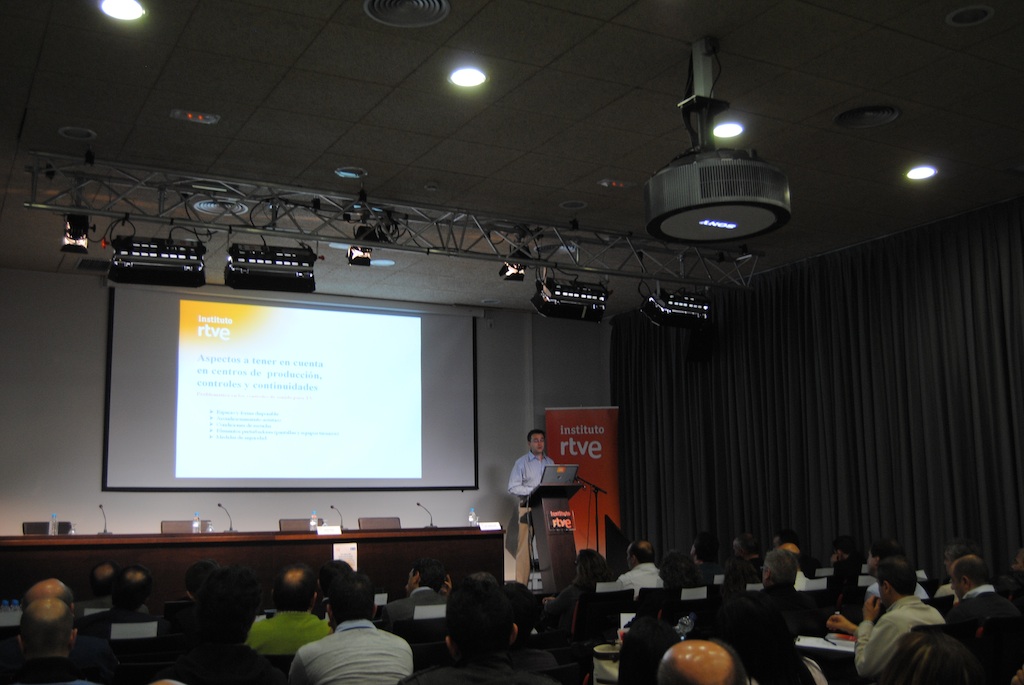
Luis Santillana, responsable de audiofrecuencia en RTVE, ha centrado su intervención en los efectos sobre la arquitectura global de las instalaciones y aquellos aspectos a tener en cuenta en centros de producción, controles y continuidades.
Santillana ha destacado una serie de recomendaciones a tener en cuenta en las condiciones de la sala donde se va a llevar a cabo la mezcla pese a que en ocasiones, como en unidades móviles con espacio restringido, “nos encontramos con habitáculos que nos apartan de las condiciones ideales de escucha”.
Además, hay otros elementos necesarios, ha asegurado, “para la sonorización y control de un programa de televisión, que dificultan el posicionamiento de los altavoces condicionado por las peceras de control o locutorios, monitores para previo-programa o cámaras auxiliares, equipos informáticos, racks técnicos… interfiriendo así la disposición perfecta para la escucha. La solución: el mejor compromiso entre el espacio, las necesidades técnicas y las recomendaciones, con el mayor ajuste posible entre ingeniería y la operación final”.
En TVE utilizan para la captación multicanal microfonía discreta para captación de sonido y sistemas de captación de sonido envolvente con cañones 5.0, micros tipo Zepelin 7.1 (configurados en 5.1), sistemas en tres dimensiones para post-procesado de audio (B-Format), grabadores-mezcladores portátiles de audio muticanal en disco duro…
En cuanto a estudio y unidad móvil, Santillana ha destacado la importancia contar con equipos de medida PPM, VU y loudness integrados en la mesa de sonido, así como los analizadores de coherencia surround que permiten hacer un análisis más profundo de las tramas.
En mesas digitales, las actuales mesas presentan una topología en red con control vertical de la señal 5.1 permitiendo, además, una gestión de múltiples monitorado multicanal.
En reproducción, TVE trabaja con altavoces con procesado por DSP, sistemas discretos para control de calidad y minimonitorados para visualización y control de audio multicanal, así como cascos con procesado binaural para escuchas 5.1.
Por último, Santillana ha abordado la experiencia con voice-over con la ayuda de un sistema automático de mezcla para audio multicanal, con compensación del canal centra entre la versión 5.1 y estéreo, uso de Lo/Ro para deportes y configuración de metados (como ayuda para corregir la descompensación del 5.1 con respecto al estéreo al reducir canales).
TVE cuenta con una unidad móvil específica para la captación y postproducción de programas con sonido envolvente 5.1. Las unidades móviles HD también están preparadas para 5.1, así como los Estudios 10 y 11 de Prado del Rey (Madrid), los estudios de Teledeporte y el 5 y 6 en Sant Cugat (Barcelona) y el A4 de Torrespaña… estos últimos han sido una acción reciente de cara a los Juegos Olímpicos. Los estudios de postproducción y doblaje y las salas de edición también están totalmente preparadas para trabajar en un entorno multicanal.
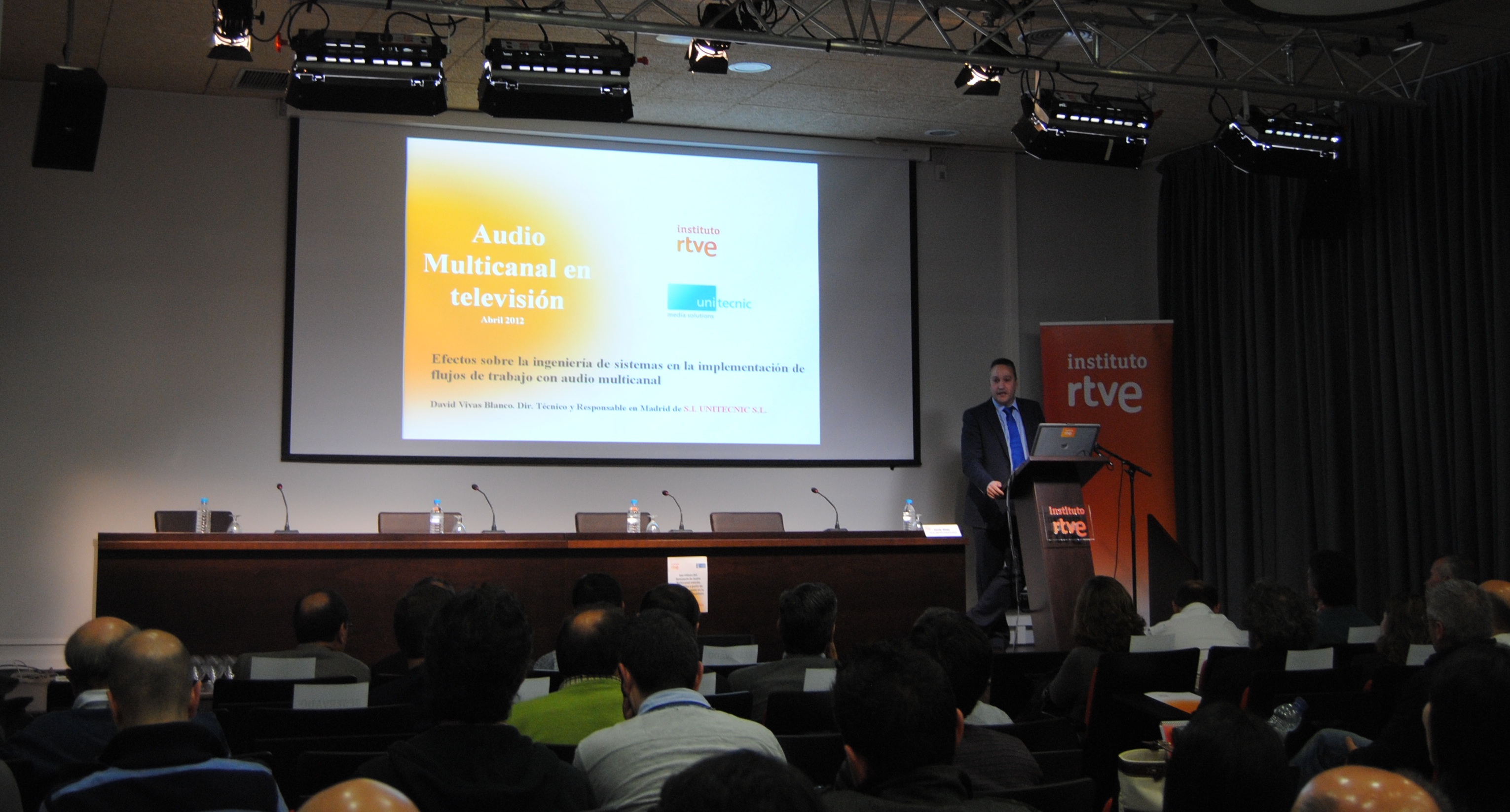 Por otro lado, David Vivas, director técnico de Unitecnic, ha expuesto los efectos sobre la ingeniería de sistemas en la implementación de flujos de trabajo con audio multicanal para una mejor experiencia por parte del espectador. Vivas ha hecho hincapié en los modos de trabajo, tipos de señales y ficheros que el multicanal implica.
“Los entornos de producción, postproducción, archivo y emisión deben ser preparados y equipados para producir, tratar, archivar y transmitir señal multicanal. Necesitaremos poder contar con un flujo de trabajo que permita operar con señales multicanal, siendo compatible con la recepción de esta señal en los hogares del consumidor final. Es importante asegurar la compatibilidad de las emisiones multicanal en la recepción, controlando cómo se va a realizar y llevaer a cabo el paso de seis canales de recepción a una reproducción en dos o un canal con ayuda de los metadatos”, ha asegurado.
“Idealmente deberíamos movernos en el ámbito de señales en el que nos manejamos habitualmente. El uso de SDI con audio embebido y AES para señales de audio, garantiza un entorno familiar. Los ficheros deben soportar el uso de contenido de audio multicanal e idealmente, como formato de gran implantación, pero sin descartar otros. Así, deberíamos poder utilizar MXF”, sostiene Vivas.
Según Vivas, no es estrictamente necesario utilizar microfonía multicanal, mientras que en mezcla, además de la mesa (que incluso puede ser una clásica en estéreo), ha destacado la necesidad de contar con un sistema de monitorado que permita escuchar nuestro programa tal y como se está produciendo así como ajustar la metadata dentro de la codificación Dolby E o en SDI como datos auxiliares si contamos con embebedores que soporten esta característica. Por lo que a medidores se refiere, es importante que estén acorde con R128 ya que será necesario medir loudness no sólo nivel eléctrico.
En entornos de postproducción, Vivas ha destacado que “es importante que los sistema de postproducción puedan trabajar en entornos de almacenamiento compartido para optimizar flujos de trabajo para acceder a los materiales desde diferentes puntos”.
En control central y continuidad, “en estas salas, por su tamaño y forma, como por el número de señales que controlan es complicarlo adecuarlas óptimamente para monitorizar 5.1. Por ello, es aconsejable contar con una pequeña saña dentro del mismo control para instalar un set de escucha 5.1 para utilizarla esporádicamente”, ha afirmado Vivas.
Utilizando Dolby E como formato de contribución y distribución los sistemas de conmutación, servidores, y equipamiento modular debe ser compatible con este tipo de señal.
David Vivas ha reseñado que Dolby Digital Plus es un formato de codificación de audio para transmisión broadcast, no sólo multicanal, soportando desde mono hasta 7.1 con una optimización del bit rate de codificación muy elevada.

Adecuando el ancho de banda
Miguel Ángel Bona, director de planificación de radiocomunicaciones en RTVE, ha repasado algunas consideraciones y parámetros generales y ha compartido la experiencia concreta de RTVE en esta materia.
Bona ha destacado la labor pionera que está llevando a cabo Radio Clásica HQ cuando en diciembre de 2011 puso en marcha la primera emisión de audio multicanal en radio en España. Desde entonces, cada viernes emite un concierto en 5.1 (dentro del segundo multiplex de TDT de RTVE, con codificación Dolby Digital AC3+).
Radio Clásica HQ, para asegurar la compatibilidad con todos los receptores, emite dos streams de audio simultáneamente: un flujo estéreo codificado en MPEG1-Layer II y un segundo codificado con AC3+ con opción estéreo o 5.1. En ambos casos, a 320 Kb/s, 16 bits, 48 KHz.
“AC3+ nos permite incluir un número variable de canales de audio, con una reducción considerable en la velocidad de datos respecto a AC3 con una velocidad entre 32 Kb/s a 6 Mb/s, con soporte de metadata”, ha asegurado Bona.
Otra experiencia a destacar en multicanal por parte del broadcaster público español es TVE HD, condicionado en este caso a que el bit rate de los múltiplex españoles es de apenas 19,9 Mb/s. TVE HD emitió por primera vez con sonido envolvente el pasado 25 de enero con motivo de un partido entre España y Eslovenia en el Europeo de balonmano. En este caso se emplea el mismo sistema que en Radio Clásica HQ.
Los nuevos codificadores de la cabecera de TDT en Torrespaña permiten la entraga en formato AES/EBU (PCM) o Dolby E (hasta 8 pistas de audio por par AES/EBU). El codificador permite conmutar de manera transparente de un formato a otro, incluso entre pistas, en ausencia de Dolby E.
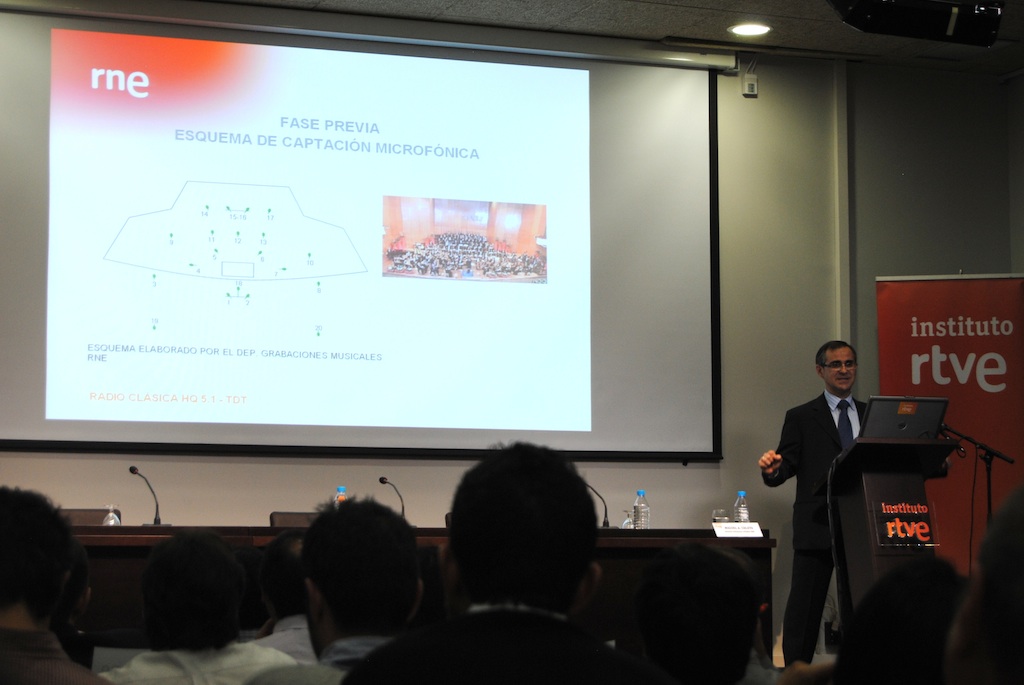
La experiencia de Radio Clásica HQ
Miguel Ángel Coleto, director de emisiones y medios RNE, ha hecho un repaso a la experiencia de Radio Clásica en la emisión de sonido envolvente.
Coleto ha reseñado que en una fase previa se llevaron a cabo una serie de pruebas en conciertos y un intenso intercambio de opiniones con ingenieros de ORF, NDR o RTBF…, antes de la primera emisión oficial que tuvo lugar el 2 de diciembre de 2011. En esta experiencia, Radio Nacional de España ha optado por ser fieles al patrón principal de la mezcla estéreo con ampliación a 5.1 a travées de una panoramización envolvente de señales, compensando el downmix con atenuaciones de los canales centra e izquierdo y derecho traseros con -3 dB y -6 dB, respectivamente.
En captación, RNE apuesta en sus conciertos 5.1 por un array de multimicrofonía combinado con un árbol Decca adaptado envolvente.
Coleto ha destacado también la necesidad de transportar, tratar y codificar estas señales a través de la red de contribución de RTVE contando para ello con nuevo equipamiento de codificación multicanal en la cabecera de Torrespaña. Al no contar con un sistema tradicional de radio capaz de soportar estas emisiones, Radio Clásica difunde su programación a través de TDT asegurando la compatibilidad en la emisión de Radio Clásica HQ entre la señal MPEG1 Layer III y Dolby Digital Plus con una transmisión continua de las dos codificaciones.
Para llevar a cabo esta emisión, RTVE se ha visto en la necesidad de adaptar la cabecera del segundo múltiplex, así como la cadena de transporte, control central y continuidad de Radio Clásica. Coleto ha hecho hincapié en la simulación de emisión y recepción de ambos servicios (estéreo y Dolby E) en diferentes tipos de receptores TDT y televisores para garantizar la compatibilidad de recepción en todos los escenarios posibles.
A partir de ahora, RNE se enfrenta a nuevos retos como la emisión en directo multicanal ampliando la producción de eventos con sonido envolvente a otros espacios escénicos y festivales. Además, se ampliará la adaptación de estudios y medios de producción y postproducción.
Coleto ha asegurado que el reto está ahora en investigar y promover a través del desarrollo de la radio digital un medio propio de difusión con audio multicanal, así como provocar en los oyentes un estímulo perceptivo capaz de reconocer el avance que significa el sonido envolvente con productos de una mayor calidad.
Metadatos
Gabriel Solsona, responsable de la Unidad de Sonido de TVE, ha analizado los pros y contras de la producción .0 y .1. El 5.1 otorga mayor creatividad, facilidad de transcripción y dificultad de gestión de 6 canales. Por su parte, el .0, ofrece un despliegue más básico, sin ningún compromiso en broadcast, así como una mayor facilidad de control de 5 canales homogéneos.
Solsona ha destacado la importancia de los metadatos en un entorno multicanal a la hora de reconocer material procedente de archivo o facilitar el workflow en producción y emisión. Los metadatos nos aportan el nivel de normalización de sonoridad que porta una señal, qué formato multicanal tiene, de dónde procede esa señal…
Dolby E ha solucionado gran parte de la gestión de estos metadatos conforme a la norma SMPTE 2020, ha destacado Solsona.
Para afrontar las mezclas simultáneas (estéreo y envolvente) cabe la posibilidad de hacerlo de forma atendida, semiatendida y desatendida. Ambas mezclas pueden llevarse a cabo de forma paralela o mediante un downmix de 5.1 a estéreo, o, por último, generar una única mezcla que gracias a los metadatos permitan que cuando un consumidor sólo pueda acceder a estéreo, el downmix se genere en destino bien atendida gracias a la metadata. Ésta sería la tendencia en el futuro, según Solsona.
 Canal + HD
Juan Piñar, ingeniero de Proyectos de Prisa TV, ha expuesto en esta jornada la experiencia de un operador privado como Canal+ que emplea en la emisión de su canal Canal+ HD audio multicanal en Dolby Digital con dos programas de audio en multicanal (versión española y original).
Cabe destacar que PRISA Tv ha apostado por un total respeto a los contenidos originales sin llevar a cabo un upmixing así como por la compatibilidad plena de contenidos en alta definición en la emisión en la versión en definición estándar (en estéreo) sin generar un downmix. Todo ello conlleva trabajar con un total de 16 canales de audio gracias a un empaquetado con Dolby transportándolos embebidos en el stream de vídeo SD.
PRISA Tv trabaja con equipamiento de decodificación y codificación, con equipo modular, audio embebido (I/O solamente de vídeo) y compensación de retardos internamente.
El trabajo con Dolby E ha significado, por otro lado, ampliar los controles de calidad para vigilar posibles errores CRC, la alineación de la trama de audio con el intervalo vertical de vídeo o el uso de los metadatos con parámetros de codificación correctos. PRISA ha optado por transportar los metadatos del contenido original al receptor del abonado con paquetes de datos diferentes para la versión española y la original.
En cuanto a archivo, Piñar ha hecho hincapié en la necesidad de decodificar las dos tramas Dolby E archivando cuatro pares de audio (V.E. Dolby E 5.1+2, V.O. Dolby E 5.1+2, V.E ST y V.O. ST).
En postproducción, PRISA Tv decodifica la trama Dolby E en la propia sala de vídeo mientras que en la sala de audio se trabaja con los audios del proyectos de vídeo ya decodificados.
Esta jornada sobre audio multicanal la ha cerrado Fernando Martín de Pablos, director y cofundador de EDSOL Records, quien ha hecho un repaso sobre el sonido envolvente en el ámbito de la postproducción podiendo numerosos ejemplos de las diferentes técnicas de Upmix y Downmix que utilizan en sus estudios para pasar de estéreo a multicanal y viceversa. Martín de Pablos ha compartido también con la sala otros ejemplos de sonoridad multicanal y estéreo.
Segunda Jornada sobre Audio Multicanal
Este seminario se complementará con una segunda jornada convocada por la Universidad Rey Juan Carlos I que tendrá lugar el miércoles 9 de mayo en el Campus de Fuenlabrada (Madrid) dirigida por Manuel Sánchez Gil.
En las ponencias de la mañana, se tratarán temas como la implementación tecnológica básica para la producción con 5.1 y la innovación conceptual en este sistema de sonido, entre otros. Por la tarde, el programa estará formado por doce talleres que abarcarán desde los costes de implementación para la producción de audio multicanal hasta el diseño de sonido 5.1 en cine, pasando por la producción musical en multicanal o la creatividad y producción de sonido en surround.
Did you like this article?
Subscribe to our NEWSLETTER and you won't miss anything.
Related articles
 Sennheiser will focus at IBC 2024 on immersive audio and WMAS, its wireless multichannel technology
 La IA en los informativos, analizada en un debate promovido por la Academia de Televisión
 El VB440 de Bridge Technologies estrena generación de audio multicanal en IBC 2023
 Sennheiser tests wireless multichannel audio WMAS system
 Marshall incorpora Dante a su monitor de audio digital multicanal AR-DM61-BT
 Televisión Española empleó ópticas Fujinon en el primer gran debate electoral
 El presente y futuro de los informativos en televisión, a debate
 The latest trends in multichannel audio and loudness, in Broadcast IT Experience
 TSL SAM1-3GM: monitoreo conciso en todas las fases del procesamiento de audio multicanal
 The immersive audio experience, up for debate at IBC 2012
 Monitorización de audio multicanal PAM2 de TSL en los Juegos Olímpicos
 Monitorado de audio multicanal de TSL en la BBC durante Londres 2012
 Multichannel audio seminar on television at the RTVE Institute
 La nueva televisión, a debate