





The i2CAT Foundation presents the results of the FIBRE project developed between the EU and Brazil
Faced with the challenge of greater use of the Internet for the distribution of audiovisual content that takes up large bandwidth, the emergence of cloud services and big data, this project attempts to lay the foundations for what the Internet will be in the future.
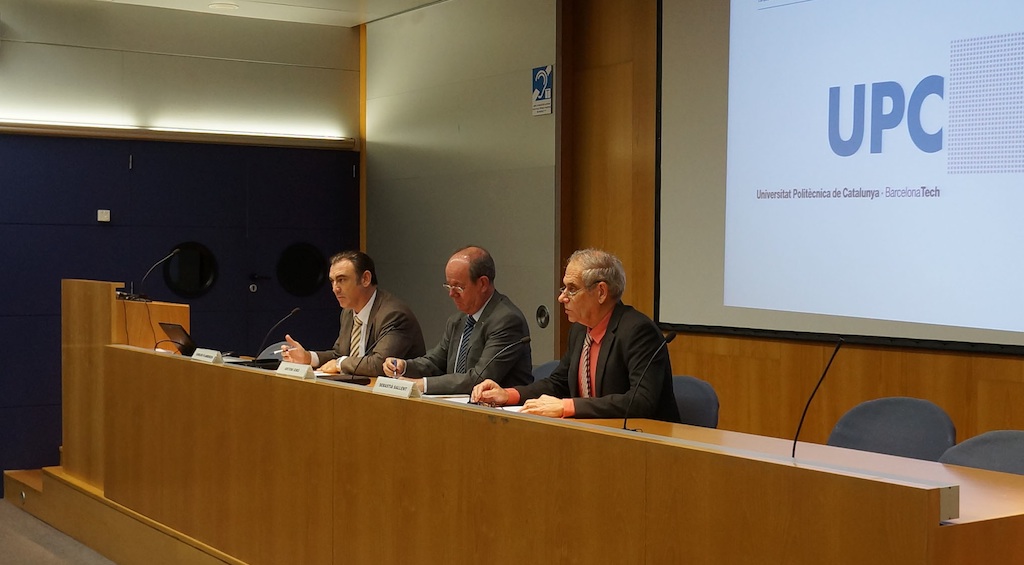
The i2CAT Foundation has presented the results of the joint project between the European Union and Brazil FIBRE, which aims to create a Future Internet experimentation infrastructure for research on network structures and distributed applications.
With a budget of almost 3 million euros, this project, led by the i2CAT Foundation, is financed by the Brazilian government and the European Commission (within the 7th Framework Programme) and has been conceived to design, implement and validate an infrastructure shared between both territories for the experimentation of the Internet of the Future at the disposal of European and Brazilian researchers.
Aimed at both industry and researchers, the master's classroom of the Polytechnic University of Catalonia hosted yesterday, Tuesday, November 5, a conference on the project, in which the main results achieved in the project were shown as well as demonstrations of the technology.
Among the achievements of the project, which will end in 2014, the construction of a large network of OpenFlow switches from Europe to Brazil stands out, essential for experimentation in the Internet of the Future, since research in this area needs large-scale flexible environments that support virtualization of resources and allow new control and routing algorithms.
Sebastià Sallent, director of the i2CAT Foundation, highlighted during the event that “the Internet of the Future will be SDN, a new paradigm for communications networks that will allow us to create new types of applications, technologies and business models, as well as scale existing devices and services and optimize them.”
The day was also attended by Javier Benítez, Senior Network Architect at Colt, who stressed the importance of “having large-scale testbeds, such as FIBRE, to be able to carry out proofs of concept and prototypes and collect the resulting data”, since the company has a laboratory but not a testbed (experimentation platform) on a global scale.
For his part, Víctor López, technology specialist at Telefónica R&D, added that "SDN is key to the management of Telefónica's networks, as it allows us to focus on the problem by deploying software controllers that solve specific needs on the large network that we have and control, with millions of users and a multitude of different equipment (hardware)." For this reason, they consider that the existence of testbeds like FIBRE facilitates the development of this technology that they see as so interesting.
SDN y OpenFlow
FIBRE is based on the SDN (Software Defined Networking) concept, which provides a software layer above the network hardware, thus enabling software developers to control the network. This provides much more control and flexibility, allowing administrators to modify the state and behavior of the network without having to physically access the devices.
Regarding the concept of OpenFlow, it is a communication protocol between network devices that allows SDN to be enabled over a given network, thus facilitating network control through software.
Behind this new infrastructure concept provided by FIBRE are top-level companies such as Google, Facebook, Cisco, Goldman Sachs, IBM, Microsoft, Intel, Hitachi, Fujitsu, Ericsson, HP, Telefónica, Deutsche Telekom, Yahoo or VMWare, among others.
Did you like this article?
Subscribe to our NEWSLETTER and you won't miss anything.
Related articles
 The SGAE Foundation presents 32 scripts at Conecta Fiction 2023
 'Santo', first Netflix original series filmed between Spain and Brazil
 The RTVE Chair at the University of Zaragoza presents the results of its first technological challenge to the scientific community
 ZDF trusted Robycam for aerial shots of the international soccer match between Germany and Brazil
 TV3, i2CAT and Cellnex present the conclusions of the TV-Ring project on connected television
 The European UHD4U project presents its results
 Josep Paradells, new director of the i2CAT Foundation
 'Estadio 1' on TVE enriches its graphics with Orad in a project developed by Aicox
 Datafactory presents HTML Center Brasil 2014
 The SGAE Foundation presents Spanish cinema in Argentina and Brazil
 i2CAT Foundation, Abertis Telecom and TVC participate in the TV-Ring project that will outline the hybrid television of the future
The i2CAT Foundation increases its turnover by 25%
i2CAT Foundation, Abertis Telecom and TVC participate in the TV-Ring project that will outline the hybrid television of the future
The i2CAT Foundation increases its turnover by 25%
 i2CAT Foundation promotes an experimental platform to validate results of R&D projects in ICT
 Mediapro projected the match between Barcelona and Ceuta in direct 3D