





NHK tests long-distance terrestrial distribution of 8K signals
NHK researchers have used Orthogonal Frequency Division Multiplexing (OFDM).
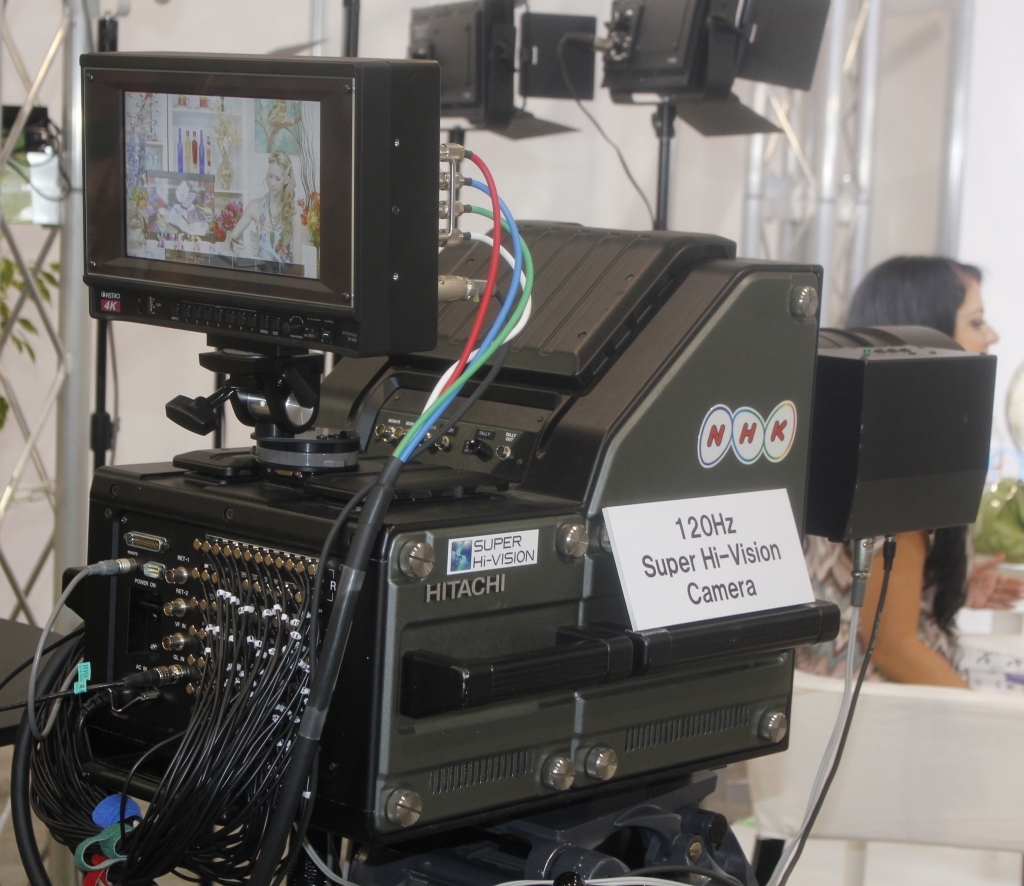
El broadcaster público japonés NHK ha llevado con éxito una serie de pruebas para la distribución de señales digitales terrestres de imágenes en formato Super Hi-Vision 8K. El envío a través de ondas de radio UHF permitó difundir imágenes en Ultra Alta Definición desde las oficinas de Nippon Hoso Kyokai (NHK) Science & Technology Research Laboratories Hitoyoshi, Prefectura de Kumamoto, en el sur de Japón, hasta una estación receptora a 27 kilómetros utilizando un solo canal UHF.
In May 2012, NHK already sent the world's first 8K signal to a point 4.2 kilometers away.
With a resolution of 7680x4320 pixels (equivalent to a 32 megapixel photo) this Ultra High Definition format is sixteen times greater than standard HD and four times greater than that of 4K televisions.
Uncompressed Super Hi-Vision signals allow them to be sent at 24 gigabits per second or even 48 gigabits per second at 120 frames per second. NHK researchers have used Orthogonal Frequency Division Multiplexing (OFDM), a digital data coding method used in Wi-Fi, as well as multiple input multiple output (MIMO), a technique in which multiple antennas are used at the transmission and reception points to improve performance.
The Japanese broadcaster began research into Super Hi-Vision in 1995, and in 2012, NHK produced six channels of live video at 8K resolution during the London Olympic Games for broadcast at various venues in the UK, US and Japan.
Following the 2012 Games, the International Telecommunication Union (ITU) approved 8K as a new high-resolution television format. NHK has since demonstrated lap projection of 8K content at different technology fairs and festivals such as Cannes and Tokyo.
On the other hand, NHK plans to broadcast some competitions during the Winter Olympics in Sochi in 8K and show the video at public screening locations in Japan, including Tokyo and Nagoya.
Looking to the future, NHK plans to broadcast some tests in Super Hi-Vision on satellite during the Rio de Janeiro Olympic Games in 2016, considering its adoption as an official format in 2020, when Tokyo hosts the Summer Olympic Games.
Did you like this article?
Subscribe to our NEWSLETTER and you won't miss anything.
Related articles
 Leader chooses IBC 2023 to present the new LT4670 SDI/IP test signal generator to the world
 Distance education in the Philippines uses Sapec's Laguna Media Processor to distribute its signals
 Net Insight expands The Switch's long-haul fiber network
 Netflix tests shuffle playback
 PyeongChang 2018 tests 8K and 5G production
 The German HD+ operator puts TVKey to the test
 WeLab tests the new Varicam LT
 Nokia tests new eMBMS technology
 Telson will design the new Renfe channel for high speed and long distance
 Canon puts its professional products to the test
 Sky tests 4K capture at Emirates Stadium
 Riedel RiLink, an innovative global fiber service for long-distance signal transport
 DVB-T2 Lite is put to the test to be seen first at IBC 2011
 Planet 51 is tested in Spain