





Sapec participa en la SMPTE Annual Technical Conference and Exhibition
La compañía española volvió a tener un especial protagonismo al presentar por segundo año consecutivo en colaboración con el Instituto iTEAM-UPV una solución tecnológica para la utilización eficiente del estándar HEVC en los servicios de contribución e intercambio de contenidos.
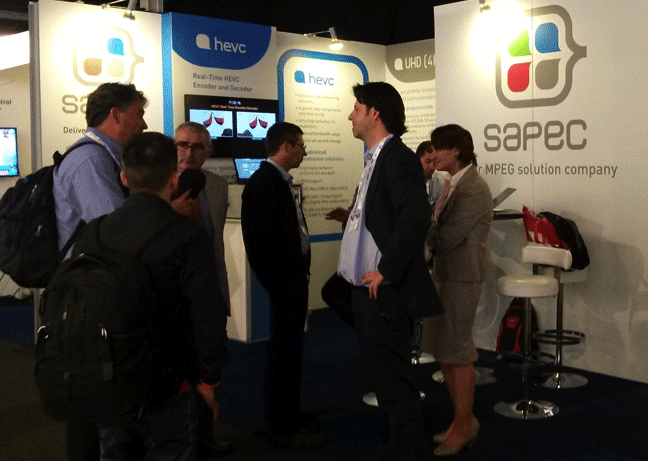
Un año después de su aprobación, el nuevo estándar de codificación de vídeo HEVC (H.265), sigue despertando el máximo interés dentro de la industria audiovisual, tal y como se ha podido constatar en la Exposición y Conferencia Técnica Anual que la SMPTE ha celebrado del 21 al 24 de octubre pasados en Hollywood, California (EE.UU.).
Por segundo año consecutivo, SAPEC líder en el sector profesional de audio y vídeo, en colaboración con el Instituto de Telecomunicaciones y Aplicaciones Multimedia de la Universitat Politècnica de València (iTEAM-UPV), han participado como máximos exponentes de la tecnología audiovisual española, presentando una solución tecnológica para la utilización eficiente del estándar HEVC en los servicios de contribución e intercambio de contenidos entre productores, radiodifusores y operadores.
 Arquitectura novedosa
Ante un numeroso grupo de expertos del sector, SAPEC y el iTEAM-UPV mostraron los beneficios que puede aportar HEVC en la codificación de formatos entrelazados, en especial para el formato de alta definición 1080i. Su relevancia estriba en que este formato entrelazado sigue teniendo a día de hoy una fuerte implantación tanto en el área de la producción de TV, donde más del 80% de los contenidos se siguen produciendo en 1080i, como el campo de la radiodifusión, donde es el formato claramente dominante en todas las plataformas de HD, y sin olvidar el inmenso y valioso archivo de contenidos en HD existente, donde dicho formato es de igual modo el preferido frente al formato progresivo (720p ó 1080p).
Debido a la ausencia de herramientas especificas para la codificación de modo entrelazado que presenta HEVC, existe una gran confusión en la industria relativa a la capacidad de HEVC para codificar contenidos entrelazados. Muestra de los beneficios que puede aportar HEVC en este ámbito, el DVB ha aprobado recientemente una nueva versión de su recomendación TR 101 154 con el objetivo de dar soporte con el estándar HEVC a los formatos entrelazados de 1080i en sus distintos frame-rates.
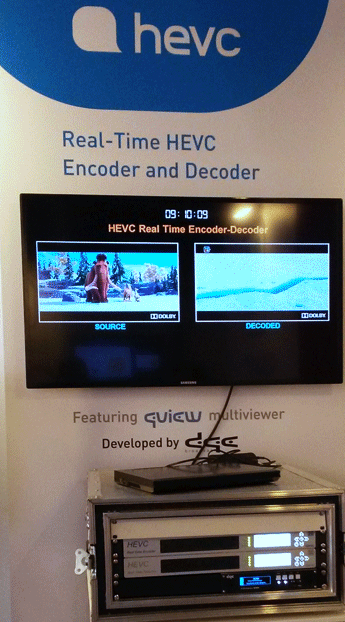
Sapec y el iTEAM-UPV presentaron una arquitectura novedosa que facilita la implementación del modelo de “Sequence-Adaptive Field-Frame’” o SAFF, que permite la codificación eficiente de formatos entrelazados con bajo retardo.
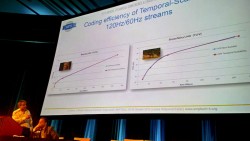
Con el objetivo de analizar la eficiencia del modelo propuesto en un codificador HEVC, se mostraron los resultados obtenidos sobre un amplio conjunto de secuencias con distintas complejidades espacio-temporales, utilizando el nuevo perfil “Main 422 10b” de HEVC.
Estos resultados confirman que HEVC puede reducir el ancho de banda utilizado en la actualidad por H.264 en su perfil “High 422” hasta valores superiores al 60%, para secuencias de alta complejidad (como son las secuencias deportivas) mientras que para secuencias de menor exigencia, como pueden ser contenidos de animación, HEVC sigue obteniendo una eficiencia superior al 30% con respecto a H.264 para formatos entrelazados.
Experiencias pioneras
Como conclusión final, SAPEC y el iTEAM-UPV remarcaron que el nuevo perfil “Main 422 10 bits” de HEVC para aplicaciones profesionales, puede ofrecer unas reducciones de los anchos de banda sustanciales que pueden ser aprovechadas por los radiodifusores de TV y operadores, tanto para servicios de contribución como de difusión de TV con el actual formato entrelazado de alta definición.
Sapec, es actualmente uno de las primeras empresas a nivel mundial en disponer de codificadores profesionales HEVC en tiempo real, en los cuales integra esta tecnología para el soporte de los formatos entrelazados.
La ponencia
Con el título ‘Evaluación de la eficiencia del HEVC para los servicios de contribución con contenido entrelazado’, los ingenieros Juan José Anaya, director técnico de Sapec, y Damián Ruiz, de laUniversitat Politècnica de València, presentaron un vanguardista ‘paper’ técnico a la exigente audiencia que acude cada año a la Exposición y Conferencia Técnica de la SMPTE.
El pasado enero de 2014 se aprobó una nueva familia de perfiles HEVC llamado “Rango de extensiones”, con el que se pretenden cubrir las necesidades dentro de los entornos de producción de alta calidad, como son los de distribución primaria, los servicios de contribución y los de edición / postproducción. El nuevo perfil “Main 422@10” se convertirá en el sucesor del exitoso perfil “Hi422P” del H.264/AVC, al lograr una alta eficiencia para formatos emergentes más allá de la HD, como son los formatos 4K y 8K. Sin embargo, el contenido HD entrelazado en la actualidad es el principal dentro de la producción de difusión, pero los perfiles HEVC no incluyen herramientas específicas para el contenido entrelazado como así ocurría con el H.264/AVC.
La ponencia trató sobre los temas involucrados en los servicios de contribución de HD entrelazados bajo el perfil “Main 422@10” HEVC, con el objetivo de identificar la verdadera eficacia del HEVC en comparación con el perfil Hi422P del H.264/AVC. Los ingenieros españoles ofrecieron los resultados de esta simulación, donde se reporta un ahorro de ancho de banda y mejora en la calidad para los radiodifusores y operadores de red cuando usan codificación HD entrelazada utilizando los nuevos perfiles HEVC.
Did you like this article?
Subscribe to our NEWSLETTER and you won't miss anything.
Related articles
 SMPTE 2110 is consolidated in Sapec solutions during IBC 2025
 Sapec demonstrates its readiness for the SMPTE 2110 universe at NAB 2024
 Sapec to debut Laguna support for SMPTE 2110 and RIST at NAB 2024
 The industry can now present its “technical papers” for IBC 2023
 Zero Density launches its Certified Technical Support Partner (CTSP) program
 Solidcom M1 from Hollyland, key to communications at 2nd annual eSports China ceremony
 IBC opens the call for the presentation of 'Technical Papers'
 The Polytechnic of Valencia, Panasonic and Teracom win the ‘Best Conference Paper Award’ at IBC
 Sapec and the UPV demonstrate at the SMPTE annual conference the efficiency of HEVC for UHD compression in HFR
 VSN's Business Intelligence solution, protagonist of the FIAT/IFTA World Conference
 A work on stereoscopy without glasses wins the IBC Best Conference Paper Award
 AES Latin American Conference en Uruguay
 EVS will show all its solutions at SMPTE Exhibition in Sydney
 Fujinon presents three new series of lenses at the HD World Conference.