





Viewer loyalty and service provider success are directly linked to OTT video streaming experiences.
An Akamai study measuring user physical and emotional reactions to poor-quality or buffering videos shows disenchanted users on both subscription and free services.

Akamai Technologies has published a new study that demonstrates how the resolution and playback quality of a video affects user engagement in terms of loyalty to an OTT video streaming service. Using advanced biometric measurement tools, including facial coding and network conductivity, the findings highlight the importance of consistently delivering high-quality video in any OTT business model.
According to the study conducted by Sensum, users tune out emotional arguments and react negatively to low-quality streaming incidents such as buffering, regardless of which platform broadcasts or how interested they are in the content. The study shows that negative emotions increase by 16 percent, and audience engagement decreases by 20 percent as a result of a poor viewing experience. According to the data included, 76 percent of participants would stop using a service if problems such as buffering were recurring.
 Ian Munford, Director of Marketing for Media Products and Solutions at Akamai, highlights that "this unique study demonstrates that there is no room for poor quality video in any streaming business model. The market for premium quality online video is extremely competitive; the battle for revenue is intense and subscriber acquisition costs are increasing, giving factors such as quality of experience an importance never seen before. Service providers cannot risk offering streaming experiences with low resolution or constant buffering. They must provide high-quality, consistent experiences that help retain their subscribers and help reduce acquisition costs.”
The study also reflects that subscription video on demand (SVOD) brands are the ones that lose the most subscribers due to buffering; transactional video on demand (TVOD) models, which do the most in terms of brand loyalty if they incur low quality experiences.
On the other hand, high-resolution video content with emotional storylines increases users by more than 10 percent.
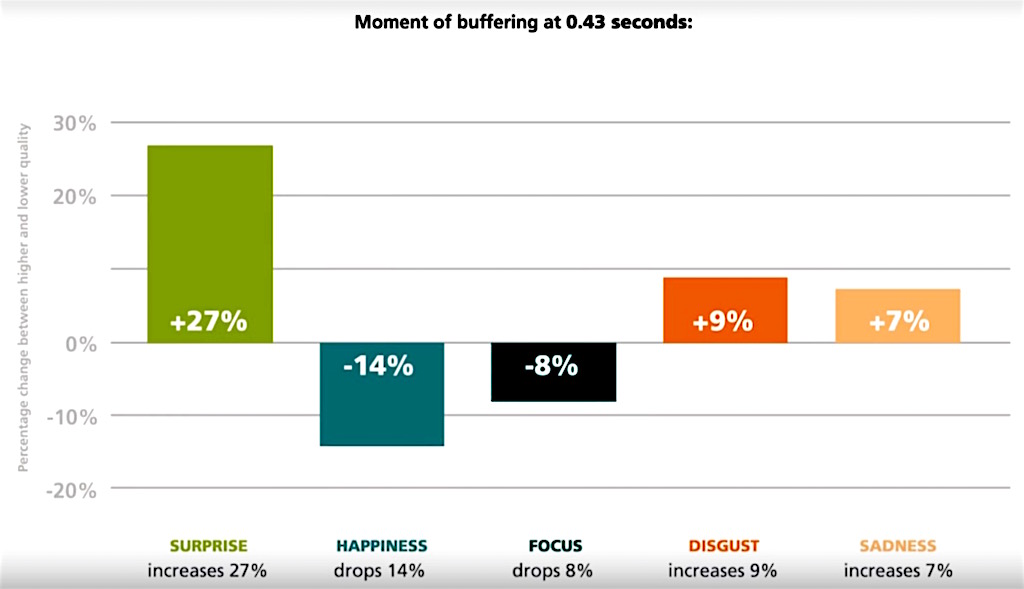
Once buffering begins to occur, satisfaction drops by 14 percent, negative emotions (disgust or dissatisfaction) increase an average of 8 percent, users' feeling of surprise increases by 27 percent, and attention declines by 3 percent and drops to 8 percent.
The study, one of the largest of its kind ever conducted, uses a series of testing procedures, including implicit and explicit sensory responses from more than 1,200 participants. All tests carried out followed the standards of the Video Quality Experts Group (VQEG) to guarantee the accuracy of their results. Akamai also created fictitious brands to eliminate any emotional association with any business model and used the same content for all platforms to nullify the impact of the type of content on participants.
Studio Access Scientific explanation of the physical reaction to the quality of the video.
https://www.youtube.com/watch?v=OC_CYG8Dev0
Did you like this article?
Subscribe to our NEWSLETTER and you won't miss anything.
Related articles
 Mediaset España's next great comedy, 'Serrines, actor's wood', will premiere directly on Prime Video
 Ateme makes the most of 5G to create new streaming experiences at events
 LiveU acquires cloud video production provider easylive.io
 Agile Content strengthens its position as a neutral video infrastructure provider in Europe
 Quality developed intense activity as a provider of “news services” at Tokyo 2020
 German service provider PVSC selects Harmonic cloud platform
 Lawo reinforces its position as a provider of production and IP infrastructure products and services at IBC
 Flumotion, Telefónica's online video platform provider
 CBM, provider of the technical services of ‘Among all’ for TVE
 NPEngine: First hardware engine that directly distributes streams of video content from SSDs to IP networks
 Multiscreen Service Provider Guide and Content Protection
 Cisco MOVE Optimizes Mobile Video Experiences Over Wireless Networks
 EBU selects StreamTheWorld as streaming provider
 Akamai and Brightcove Team Up to Raise the Bar for Online Video Experiences